By Izentis LLC
Izentis LLC designs custom tools for detecting endpoint of etches on reactive and deep reactive-ion etch tools. We currently offer a camera system to visually determine when etches finishes for features ∼100 μm. When a deep etch in silicon hits a buried SiO 2 the color changes from a silver-like color to a bright green or red depending on the thickness. This can be observed by eye on many etch tools via top windows. We have developed a camera and lens imaging system that allows for clear observations of the etches and users can end the etches when they fully clear. The camera can be outputted to a standard computer monitor or a large flat panel display. See the media page for a video of an endpoint tool and contact us for more information and quotes.
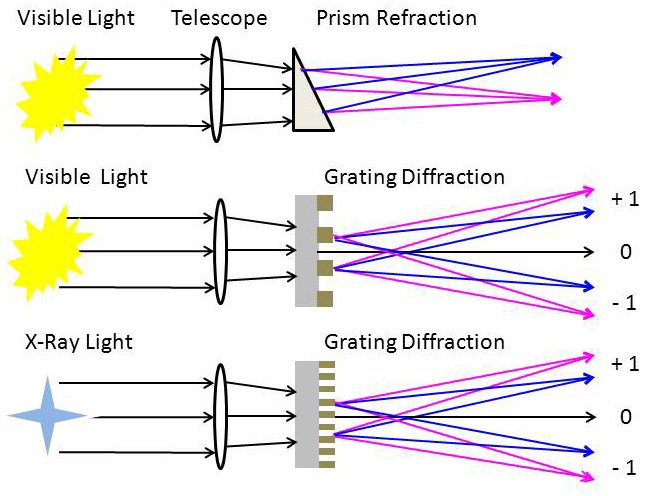
Izentis offers both amplitude and phase transmission gratings.A grating where lightpasses through an opaque surface with multiple slits is known as an amplitude transmissiongrating, since the light varies as a periodic step function in amplitude. A more efficient transmission grating has aperiodic structure that alters the phase of the light without blocking the light. (The efficiency is defined by the ratio of lightintensity in a given non-zero diffraction order to monochromatic incoming light.)Thesegratings are known as phase gratings. An example is periodically-etched glass, suchthat the optical path difference between the etched and non-etched regions is halfa wavelength. Such a design suppresses the zeroth order which vastly improves efficiency. Photograph and scanning electron micrograph of a freestanding transmission grating fabricated by Dr. Bruccoleri. This is an example of an amplitude grating for soft x-rays. Scanning electron micrograph taken of the bottom surface of a freestanding transmission grating fabricated by Dr. Bruccoleri. The cross supports can be made narrower for applications that require higher x-ray throughput.
CATEGORY
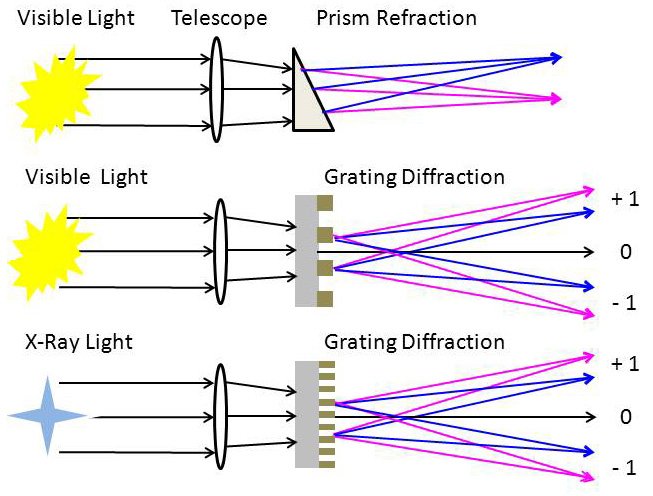
At present we offer both transmission and reflection gratings with periods ranging from 200 nanometers to 5 microns.
CATEGORY
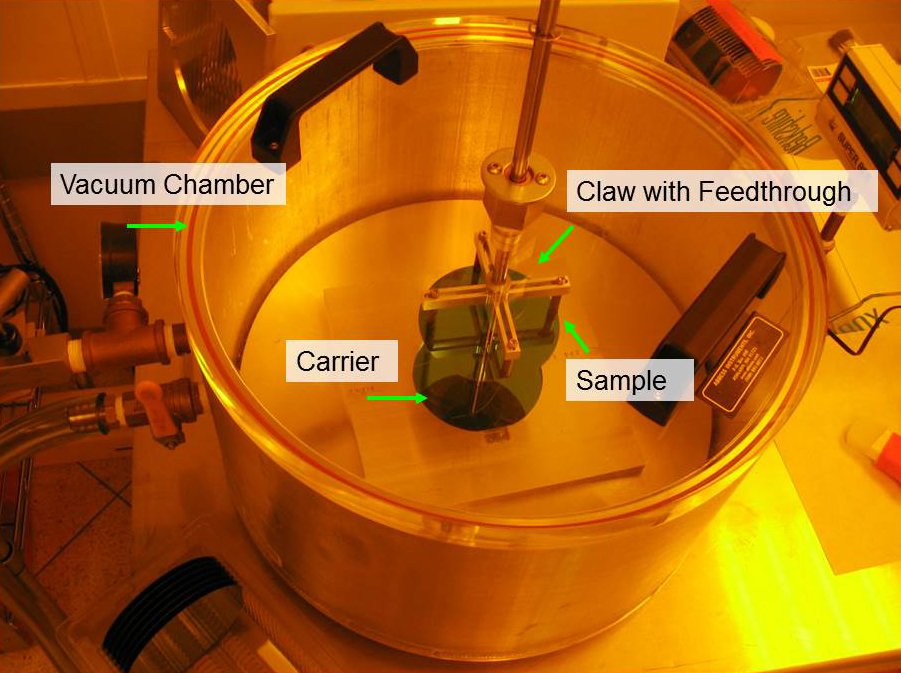
Izentis designs and sells custom tools for bonding silicon and other MEMS substrates to carrier wafers. The main purpose of these tools is to temporarily bond wafers that have been diced into chipsonto whole wafers for subsequent processing. Many tools, and in particular etching tools, require complete wafers to process. In a research environment wafers often need to be cleaved for inspection or other purposes, which makes further processing steps difficult. We have developed a bonding tool to create high quality bonds in a vacuum. We use crystalbond 555, a wax with a melting point around 54 degrees C, to bond chips to carriers. We have found that bonding the wafers on a hot plate at ambient pressure leaves voids, which can be detrimental when using a reactive-ion etcher. A vacuum bond significantly reduces the voids since all the voids are compressed when the bond is placed at ambient pressure. The resulting bonds lead to significantly higher quality etches. The vacuum bonder is a vacuum chamber with a precision hot plate inside, and a claw to hold the sample. The carrier wafer is placed on the hot plate, and crytalbond is applied and melted. The chip is then held above the carrier by the claw while the chamber is pumped down to around 700 mTorr. Once at the desired pressure, the sample can then be pressed onto the carrier and bonded. After the bond the carrier and sample can be removed from the chamber, and the crytalbond will solidify completing the bonding process. We can design a variety of different vacuum chambers, with hot plates and claws for different size wafers. The vacuum bonder shown here is 18 inches in diameter, and the claw is designed for chips up to 4 inches. Please contact us for more information and quotes on vacuum bonders.
CATEGORY
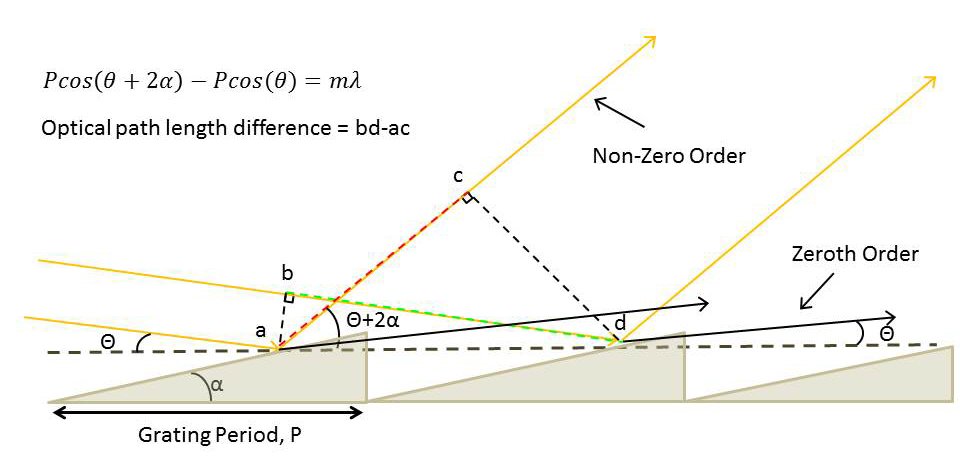
Izentis offers gratings that utilize reflection from periodic surfaces, known as a reflection gratings. If the surfaces are flat, reflection gratings are similar to phase transmission gratings. Specifically much of the light is in the zeroth order. The key break-through for reflection gratings is to reflect the light on angled mirrors (often called grating facets) such that the diffraction orders coincide with the specular reflection angle. This effect is knows as blazing and it can significantly increase efficiency since the majority of the light is directed into a small number of non-zero diffraction orders. The angle α has to be designed such that the optical path length difference for two rays, that specularly reflect one period apart, is an integer multiple of the wavelength. Izentis LLC offers custom reflection gratings with facet angles ranging from 0.5 to 30 degrees, with pitches as low as 200 nm. The grating dimensions can be as large as 60 mm on a side. Please contact us for more information and quotes on reflection gratings.
CATEGORY
