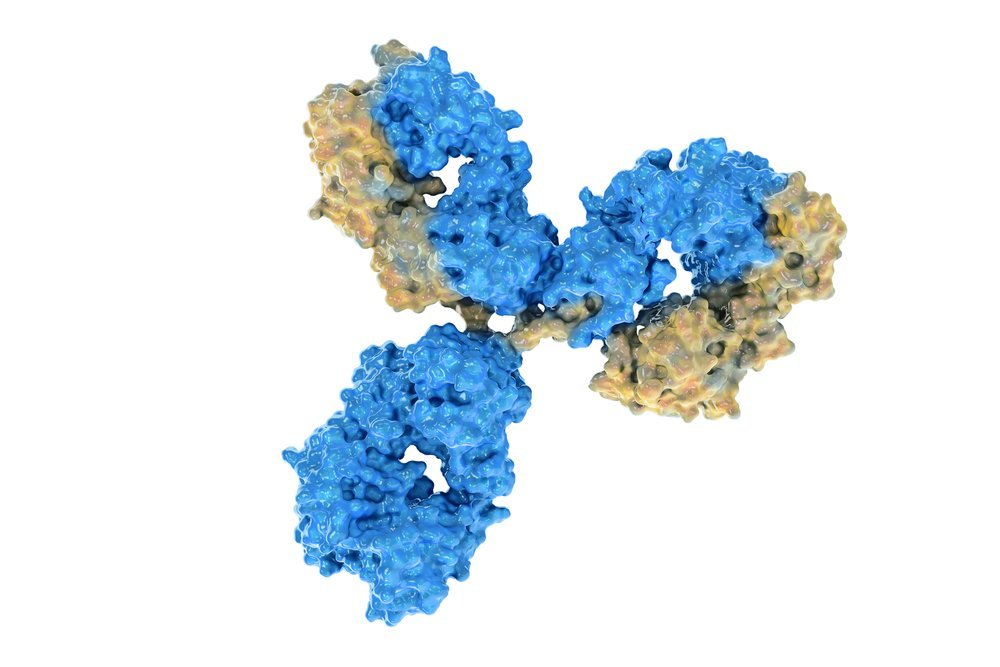
Mpox antibody for use in lateral flow immunoassay applications. Monoclonal Antibody, Clone 12B2 can be used as capture reagent with matched monoclonal antibody clone 3A3 (sold separately). This product has been validated for use in enzyme immunoassay, chemiluminescent immunoassay, and lateral flow rapid test technologies.
Catalog MT00102 - Matched Pair MT00101 - Synonym Mouse anti-Alpha-Fetoprotein monoclonal antibody - Product type Antibody - Source The monoclonal antibody is pruified from mouse - Purity 95% as determined by SDS-PAGE - Molecular Characterization The monoclonal antibody has a calculated MW of 160 kDa. - Recommended Applications Lateral flow immunoassay, ELISA - Recommended Pairing The application for douoble-antibody sandwich for capture, pair with MT00101 for detection. - Buffer System 0.01M PBS,pH7.4 - Resconstitution Please see Certificate of Analysis (COA) for which is sent along with the products. - Shipping The antibody in liquid form are transported in frozen form with blue ice. - Storage For long term storage, the product is stable for up to two years by stored at -20℃ or lower. Please use the product (liquid form) within 2 weeks if it is stored at 2-8℃. Please avoid repeated freeze-thaw cycles. Please contact us for any concerns. Background Fetoprotein (AFP) is a glycoprotein that belongs to the albumin family and is synthesized by fetal liver cells and yolk sacs. Alpha-fetoprotein is present in high concentrations in fetal blood circulation, decreases after birth, and is extremely low in adult serum. Alpha-fetoprotein has many important physiological functions, including transport function, bidirectional regulation function as growth regulator, immunosuppression, T lymphocyte apoptosis induction, etc. Alpha-fetoprotein is closely related to the occurrence and development of liver cancer and a variety of tumors, and can be used as a positive indicator for a variety of tumors. At present, it is mainly used as a serum marker for primary liver cancer in clinical diagnosis and curative effect monitoring.
CATEGORY
Catalog MT00101 Matched Pair MT00102 Synonym Mouse anti-Alpha-Fetoprotein monoclonal antibody Product type Antibody Source The monoclonal antibody is pruified from mouse Purity 95% as determined by SDS-PAGE Molecular Characterization The monoclonal antibody has a calculated MW of 160 kDa. Recommended Applications Lateral flow immunoassay, ELISA Recommended Pairing The application for douoble-antibody sandwich for detection, pair with MT00102 for capture. Buffer System 0.01M PBS,pH7.4 Resconstitution Please see Certificate of Analysis (COA) for which is sent along with the products. Shipping The antibody in liquid form are transported in frozen form with blue ice. Storage For long term storage, the product is stable for up to two years by stored at -20℃ or lower. Please use the product (liquid form) within 2 weeks if it is stored at 2-8℃. Please avoid repeated freeze-thaw cycles. Please contact us for any concerns. Background Fetoprotein (AFP) is a glycoprotein that belongs to the albumin family and is synthesized by fetal liver cells and yolk sacs. Alpha-fetoprotein is present in high concentrations in fetal blood circulation, decreases after birth, and is extremely low in adult serum. Alpha-fetoprotein has many important physiological functions, including transport function, bidirectional regulation function as growth regulator, immunosuppression, T lymphocyte apoptosis induction, etc. Alpha-fetoprotein is closely related to the occurrence and development of liver cancer and a variety of tumors, and can be used as a positive indicator for a variety of tumors. At present, it is mainly used as a serum marker for primary liver cancer in clinical diagnosis and curative effect monitoring.
CATEGORY
Product Information - Catalog: MT00204 - Matched Pair: MT00203 - Synonym: Mouse anti-Carcinoembryonic Antigen monoclonal antibody - Product type: Antibody - Source: The monoclonal antibody is pruified from mouse - Purity: 95% as determined by SDS-PAGE - Molecular Characterization: The monoclonal antibody has a calculated MW of 160 kDa. - Recommended Applications: Lateral flow immunoassay, ELISA - Recommended Pairing: The application for douoble-antibody sandwich for detection, pair with MT00204 for capture. - Buffer System: 0.01M PBS,pH7.4 - Resconstitution: Please see Certificate of Analysis (COA) for which is sent along with the products. - Shipping: The antibody in liquid form are transported in frozen form with blue ice. - Storage: For long term storage, the product is stable for up to two years by stored at -20℃ or lower. Please use the product (liquid form) within 2 weeks if it is stored at 2-8℃. Please avoid repeated freeze-thaw cycles. Please contact us for any concerns. Background CEA was originally found in colon cancer and fetal intestinal tissue. CEA determination in blood is mainly used for clinical monitoring of colorectal cancer, gastric cancer, pancreatic cancer, hepatocellular carcinoma, lung cancer, breast cancer and medullary thyroid cancer, as well as choriocarcinoma, bone cancer, prostate cancer and ovarian cancer, but has no early diagnosis value. Continuous monitoring of CEA level can be used to observe the curative effect and predict the prognosis of tumor treatment. In general, the level of serum cea decreases when the disease improves and increases when the disease progresses.
CATEGORY
Product Information - Catalog: MT01402 - Matched Pair: MT01401 - Synonym: Mouse anti-Progastrin-releasing peptide monoclonal antibody - Product type: Antibody - Source: The monoclonal antibody is pruified from mouse - Purity: 95% as determined by SDS-PAGE - Molecular Characterization: The monoclonal antibody has a calculated MW of 160 kDa. - Recommended Applications: Lateral flow immunoassay, ELISA - Recommended Pairing: The application for douoble-antibody sandwich for capture, pair with MT01401 for detection. - Buffer System: 0.01M PBS,pH7.4 - Resconstitution: Please see Certificate of Analysis (COA) for which is sent along with the products. - Shipping: The antibody in liquid form are transported in frozen form with blue ice. - Storage: For long term storage, the product is stable for up to two years by stored at -20℃ or lower. Please use the product (liquid form) within 2 weeks if it is stored at 2-8℃. Please avoid repeated freeze-thaw cycles. Please contact us for any concerns. Background Gastrin-releasing peptide precursor (ProGRP) is the precursor structure of gastrin-releasing peptide. It is relatively stable in blood and mainly exists in the gastrointestinal tract, respiratory tract and central nervous system. It is the preferred sensitive tumor marker for lung cancer at present. Gastrin releasing peptide (GASTRin releasing peptide), as a tumor marker of small cell lung cancer, is highly specific, and is often used in the early diagnosis, disease monitoring, therapeutic efficacy evaluation and prognosis judgment of small cell lung cancer.
CATEGORY
