All measurement services purchase orders received by July 31, 2025, will receive a three-pack of SPRm Cell Chamber Kits for free. These kits are used to grow your cell samples for the binding measurement.
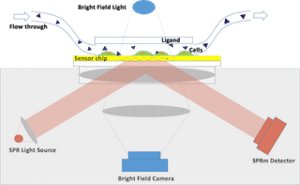
The SPRm 200 from Biosensing Instrument Inc. is a system that seamlessly combines both optical bright-field and SPR microscopies thus enabling the unique in vitro binding kinetic measurement of individual cells in their native environment. The architecture of the system consists of using the SPR phenomenon to measure binding kinetics while also simultaneously permitting use of bright-field microscopy to study topographical and phenotypical changes in the sample (Fig. 1). Typically, the cells are cultured and fixed on a poly-L-lysine coated SPR sensor chip. The integrated optical microscope allows for visualization of the sample with x10 magnification and 1 um resolution. The SPRm 200 exceeds the performance of homemade systems by demonstrating a much larger field of view, simultaneous bright-field and SPR microscopies, and greater stability. SPRm 200 has the resolution to observe sub-cellular binding activities (Fig. 3). In conclusion, SRPm 200 is a novel instrument that seamlessly integrates bright-field and SPR microscopies into one system. This instrument enables the kinetic binding study of multiple individual cells as well as the localized responses on a single cell.
CATEGORY
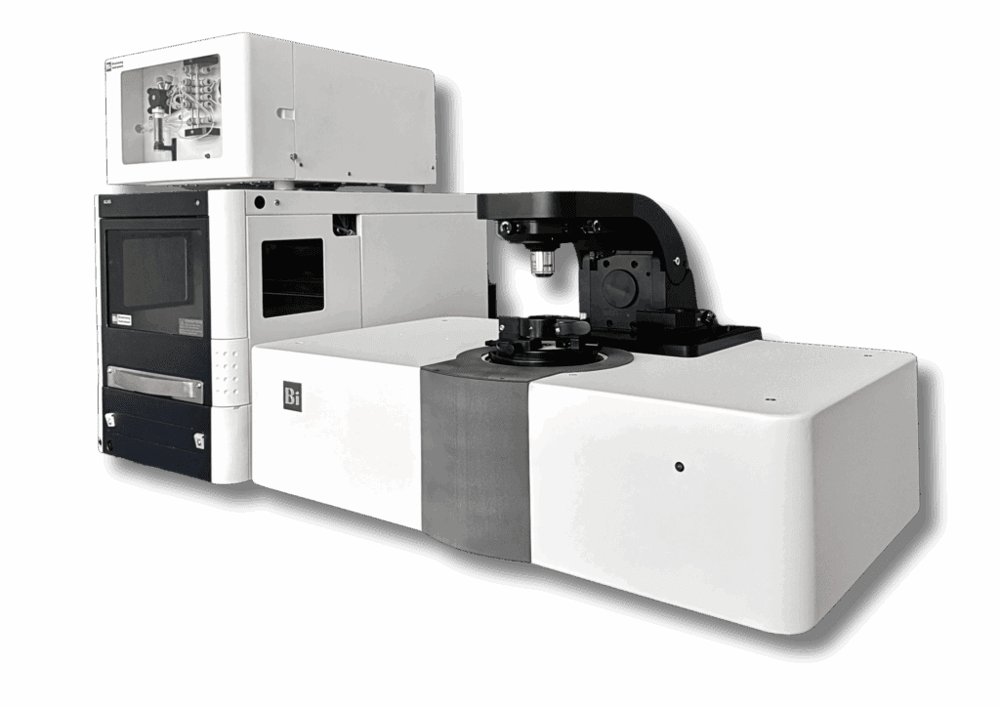
The Surface Plasmon Resonance (SPR) Microscopy system, which combines optical microscopy with SPR, is a powerful and label-free technology for measuring the binding affinity and kinetics of membrane proteins directly on whole cells in vitro. This integrated approach enables the simultaneous analysis of phenotypic changes via brightfield imaging and molecular interactions through SPR, offering a comprehensive view of cell-surface binding events. SPR Microscopy has been replacing radioligand binding assays and has become a go-to platform in both pharmaceutical and academic research for studying the interactions of small molecules, peptides, antibodies, and proteins with membrane targets such as GPCRs, ion channels, and other difficult-to-purify membrane proteins. It supports measurements on both fixed and live cells, whether adherent or in suspension. Thanks to its high spatial resolution (~1 μm), the technology also enables real-time monitoring of nanoparticles, virus and bacterial binding activity, expanding its applications in infectious disease and microbiology research.
CATEGORY
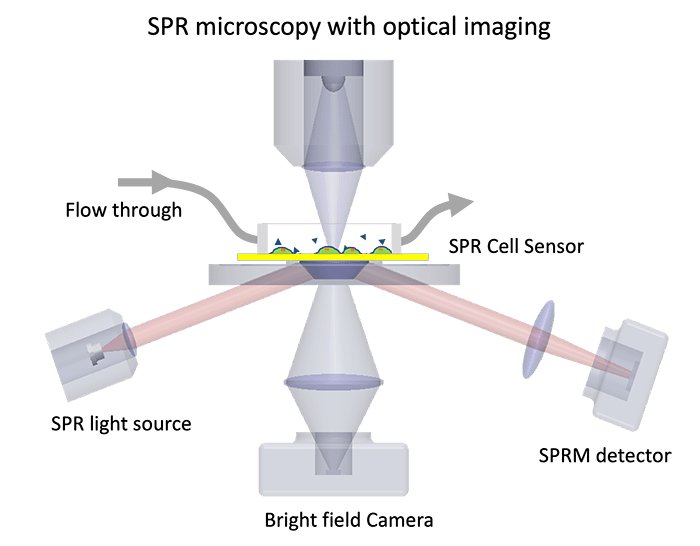
SPR microscopy integrates optical imaging and SPR technology into one system. It provides high-quality data on binding kinetics and affinity of cell membrane proteins and spatial visualization of cellular structures. Real-time interactions of the drug and membrane protein can be measured in its native state without needing to extract proteins from the cell. Because of its unique measurement of cell membrane proteins on the cell, SPR microscopy has become a powerful tool that provides binding information about various drug compounds and drug efficacy. Antibody-interaction studies are also used to investigate disease pathways and targets for potential drug therapies, and much more. In addition, the system measures nanometer scale binding activities needed for the study of bacteria and virus interactions and the development of new methods for nanoparticle drug delivery.
CATEGORY
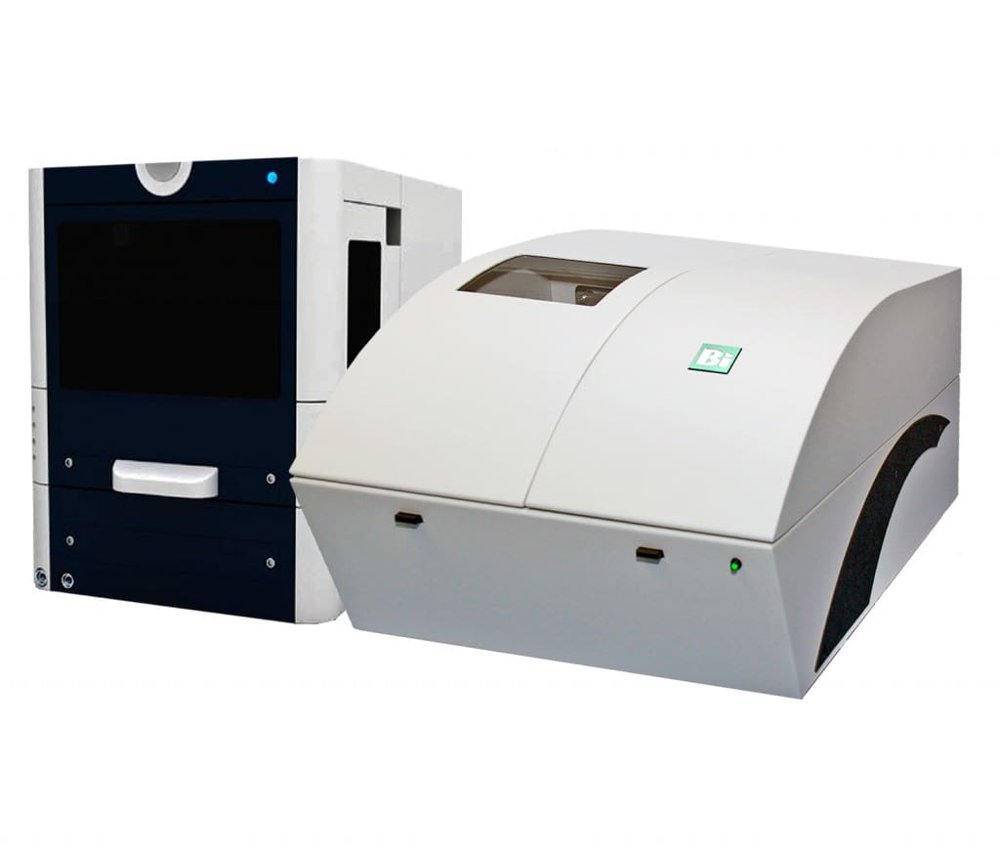
The 5-channel SPR instrument, when paired with the BI Autosampler, offers an ideal solution for high-throughput assay development, combining efficiency with low operating and maintenance costs. Featuring advanced BI-DirectFlow™ technology—integrated into the BI-4500 system—it ensures precise sample delivery for exceptional binding kinetic measurements. This innovative flow system, together with temperature-controlled SPR detection, provides highly sensitive and reproducible binding responses, even for low immobilization levels and small molecule targets (<100 Daltons). The system also supports compatibility with electrochemistry and chemical vapor analysis modules, enabling integrated EC-SPR and gas-SPR measurements. These capabilities make it especially well-suited for a wide range of biosensing applications.
CATEGORY
