By Nanoacademic
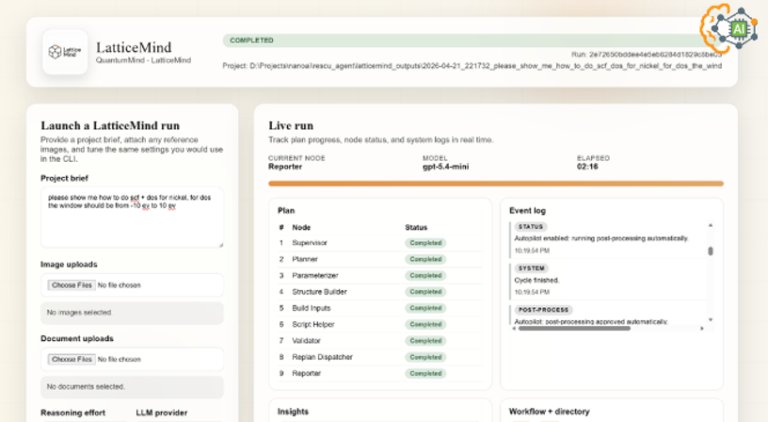
World's first DFT agentic simulation assistant. LatticeMind is an agentic modeling assistant that helps materials scientists build, organize, and execute complex first-principles simulation workflows using natural-language instructions. By automating repetitive setup, best simulation parameter choices, debugging, and documentation tasks, it accelerates the path from material models to reliable, traceable results—leaving researchers more time to interpret the physics.
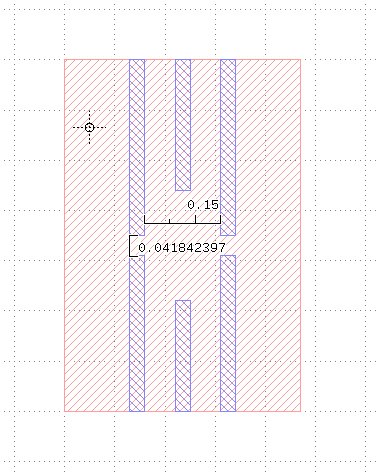
QTCAD® is a unique finite-element method (FEM) simulator used to model and predict the performance of solid-state quantum hardware such as quantum-dot and spin-qubit devices.
CATEGORY
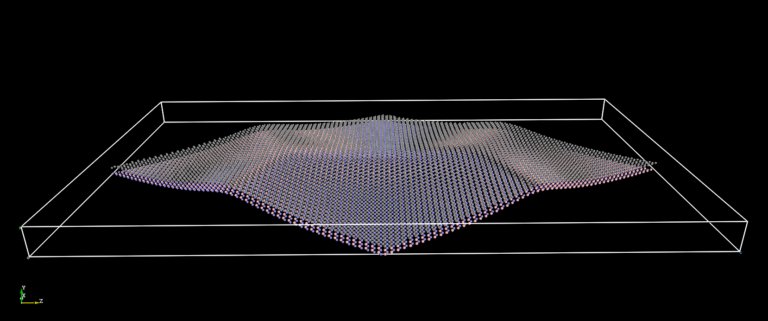
A powerful DFT/DFPT solver which can simulate physical properties of advanced materials consisting of thousands of atoms.
CATEGORY
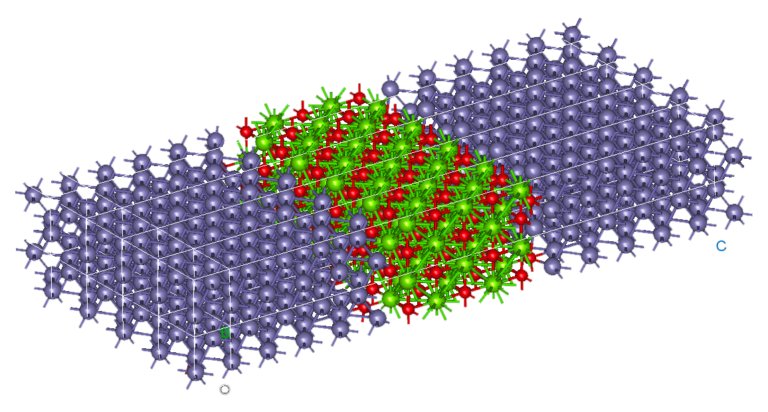
Predicts quantum electronic structure and transport properties in nanoscale devices from first principles. NanoDCAL is available for single users, research groups and a cluster system license (HPC) is available too Device engineers Predict next generation devices - such as molecular junctions, spintronics and tunnel FETs - performance with NanoDCAL. Materials engineers Predict advanced and quantum material functions in silico reducing development costs and time. Academic researchers Researchers use NanoDCAL to predict transport measurements and validate experimental hypotheses - about atomic structure, defects, and more - and support their theoretical models. Academic teachers NanoDCAL is a convenient and powerful implementation of NEGF-DFT that computes ground state and non-equilibrium properties of nanodevices from first principles. Teachers use it to illustrate and teach condensed matter concepts. Benefits Predict the electronic structure of virtually any material. NanoDCAL computes the properties of a given atomic arrangement (molecules, crystals, surfaces, etc.) from first principles using density functional theory (DFT). Accurately predict non-equilibrium properties of heterojunctions and devices. NanoDCAL derives a device’s Hamiltonian from first principles and accounts for non-equilibrium quantum statistics using Keldysh’s Green function formalism (NEGF) to achieve a description beyond the predictive power of semiclassical transport methods. Get the answer faster using NanoDCAL’s powerful implementation. NanoDCAL’s high-performance solvers yield the answer faster and allow simulating larger and more realistic systems. Using NanoDCAL is convenient and easy. You may use NanoDCAL from Device Studio, the command line or the MATLAB environment. Easily parse through the documentation, select files from our database of pseudopotentials and atomic orbitals. NanoDCAL is integrated in the MATLAB environment, which allows customization and automation of tasks. Quickly parse through doc and pseudopotentials via the command line. Compute spin properties of devices like this graphene nanoribbon contacted by a nickel lead. Predict non-equilibrium current in complex heterojunctions such as ZnO-MgO-Si. Features Description NanoDCAL offers reliable and powerful quantum transport simulation features to model nanostructures or nanodevices. It is an atomic orbital implementation of NEGF-DFT. It computes the Hamiltonian of materials and devices from first principles (i.e. without external parameters) using density functional theory (DFT) and simulates quantum transport phenomena within the Keldysh non-equilibrium Green function formalism (NEGF). NanoDCAL includes a large suite of methods for calculating important transport properties of your materials. NanoDCAL was used in hundreds of peer-reviewed papers in domains as varied as molecular electronics, nanotubes, topological insulators, batteries, magnetic tunnel junctions, metal grain boundaries (crystallites) and more. It has demonstrated efficiency, so why not test it? Unleash the full power and functionality of NanoDCAL by obtaining a parallel license. Ground state properties Predict ground state properties like total energy, atomic forces, stress tensor. Atomic structure Find equilibrium atomic positions and crystal shapes using NanoDCAL’s powerful structural optimizers. Transmission & conductance Get transmission channels and coefficients, conductance for bulk materials, surfaces and devices. IV characteristic Compute the current versus voltage characteristic to predict nanoscale device performance. Multiple probes capability NanoDCAL simulates devices involving more than two probes. Atomic orbitals and pseudopotentials Benefit from our accurate, efficient and complete database of atomic orbitals and pseudopotentials. Fast & parallel solver NanoDCAL is carefully optimized to get you the right answer faster. Key functions are written in C while most of the code is parallelized using both OpenMP and MPI. MATLAB integration NanoDCAL is integrated in the MATLAB computing platform, allowing one to quickly and easily build workflows and visualize data. Spin & SOC Include the physics of electronic spin and spin-orbit coupling via a state-of-the-art spin-DFT implementation (collinear and non-collinear formalisms). Spectral analysis Understand the electronic structure of materials and devices with the band structure, complex band structure, (projected or total) density of states and more. Real space analysis Calculate and visualize relevant data in real space, such as local density of states, wavefunctions, scattering states and potentials. Photocurrent Compute the photocurrent of various materials and devices. Thermal transport Predict how thermal gradients drive electronic transport and vice versa. What's new? A newly designed and enhanced version of NanoDCALhas just been released: NanoDCAL+. Written in Python and Fortran, it provides new Python calculators and features, more performance and scalability for workstations and supercomputers alike. It is a complementary version of NanoDCAL. Please see the NanoDCAL+ product page for more information! Current NanoDCAL version is 2022B (v3.1.0). NanoDCAL user documentation To access to NanoDCAL user documentation, click the link below: installation and user manuals, tutorials, theory and technical information pages are all there for your support and to get you up to speed as quickly as possible.
CATEGORY
