By Advanced Hall Sensors (AHS) Ltd
Carbon fibre composite is not conductive like metals and makes the selection of NDT testing equipment restricted to X-ray. However, Eddy current and magnetic flux leakage systems are catching up. To this effect, the AHS high sensitivity QWHE sensors are proving invaluable in picking up the tiny magnetic fields in the low conductivity composite material.

P15A rated at 850V/AT The P15A Hall Sensor is outstanding for its ultra-high sensitivity and its low temperature coefficients. The P15A Hall Sensor is fabricated from an AlGaAs/InGaAs/GaAs 2 - DEG (two dimensional electron gas) heterostructure. Applications - Position sensing elements for industrial encoders - Motor speed control - Current metering - Magnetic spatial imaging for medical / scientific instrumentation - Bank note validation - Mass Flow control
CATEGORY
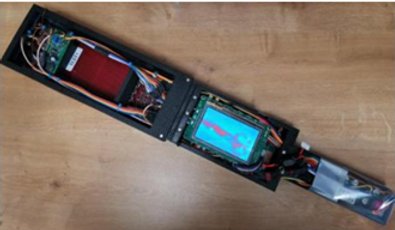
AHS has developed a miniaturised Intelligent magnetic Imaging device with the potential to revolutionise the speed and accuracy of high-resolution non-contact magnetic imaging of metallic threats. Our technology offers the advantages of metallic component X-ray imaging without the need for X-ray energy generation. The innovation is based on a radically new sensor developed in house which offers high resolution and high throughput magnetic camera imaging in real world environments with low power consumption, which makes portable solutions viable. The initial application will be in threat detection applications as a portable handheld camera imager for screening and identification of metallic objects in personal body search. The new magnetic camera will enable users to identify the concealed metallic object and take decisions accordingly. The AHS key breakthrough innovation is based on our bespoke Gallium Arsenide based Quantum Well Hall Effect (QWHE) technology that is 100x more sensitive than existing Silicon Hall sensor technology and has unprecedented large dynamic range making it ideal for imaging modalities. It is key to unlocking multiple benefits for Threat Detection: nanoTesla sensitivities in an uncooled format, AC operation enabling 3D inspection, and minimal power consumption for portable implementation. The superior sensitivity enables visualisation of the geometrical characteristics of hidden metallic objects, determination of the type of metallic object (ferrous and non-ferrous), discrimination of metallic combinations, & 3D profiling of metallic objects.
CATEGORY

Our sensors have been developed over the past twenty years into rugged, reliable components. They operate the same as other Hall sensors, using the conventional Hall Effect to provide a point magnetic field (magnetic flux density) measurement from an analogue signal voltage. To distinguish them from other Hall sensors, they are referred to as Quantum Well Hall Effect (QWHE) or Quantum Hall sensors due to their quantum well design to improve sensitivity and noise floor. Key features • High sensitivity and low noise floor • Wide (linear) dynamic range • Linearity to magnetic field strength and frequency • Wide frequency operation • Compact size • Rugged to high temperature and radiation levels (-100 to +200 °C) This is made possible from the use of modern semiconductor materials (Gallium arsenide); as well as state of the art design and advanced manufacturing processes (molecular beam epitaxy). Therefore, our sensors are suitable for a wide range of applications
CATEGORY
