The TCC2 is an electronics module for Time-Correlated Single Photon Counting (TCSPC) and Multichannel Scaling (MCS) in the FLS1000. - TSCPC time range: 2.5 ns – 50 µ s full scale, MCS time range: 5 µ s – 200 s full scale - From 500 to 8,000 channels - Time resolution from 305 fs/channel with ultra-low time jitter of 20 ps
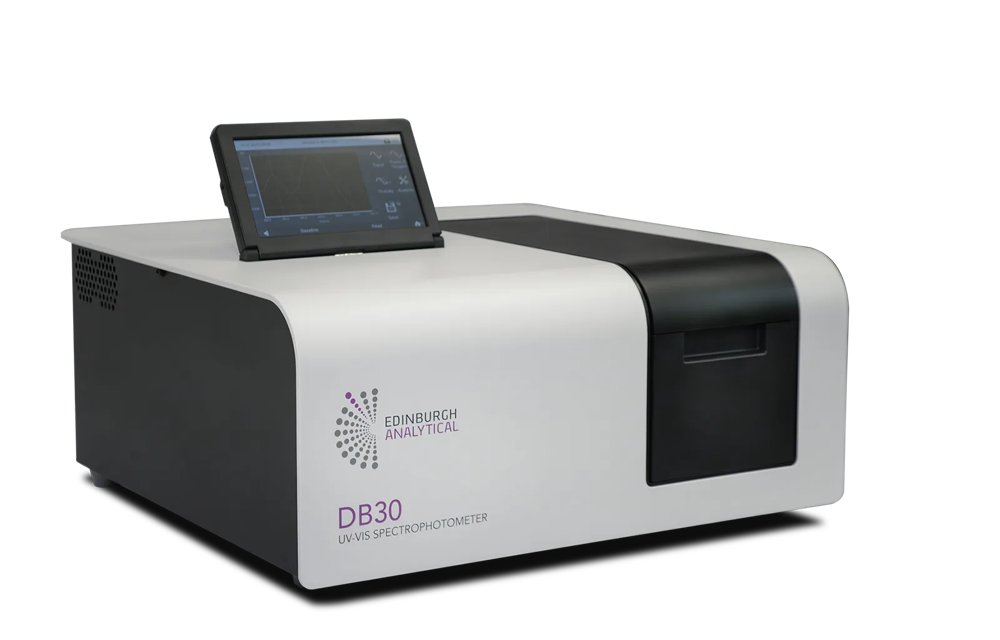
Versatile double beam UV-Vis spectrophotometer with a benchtop footprint. Suitable for analytical, research, and pharmaceutical industry applications. Variable bandpass options: 0.5, 1.0, 1.5, 2.0 or 4.0 nm over the range 190 nm – 1100 nm Fast scanning: up to 6,000 nm/min to aid sample analysis throughput Automatic accessory recognition: when connected to the DB30 Optional Visacle® software: for easy PC control Touchscreen interface: intuitive menus and functions for ease of use for standalone control Multiple Data Storage Options: USB, SD card and internal data storage for convenient retrieval of methods and results The DB30 UV-Vis Spectrophotometer is a powerful double beam instrument designed for precise and accurate measurement of absorption and transmission across various wavelengths, making it essential for analytical applications where precision is paramount. Engineered for versatility, this user-friendly spectrophotometer excels in a wide range of measurements, from standard absorbance in cuvettes to solid samples and flow cell experiments. Its high-throughput optical design delivers exceptional performance, ensuring superior stray light control, baseline stability, and unmatched wavelength and photometric accuracy. The DB30 UV-Vis Double Beam Spectrophotometer offers flexible operation, allowing users to work either independently through its integrated touchscreen or via PC control using the powerful Spectracle® software. Spectracle® features an intuitive workflow-based interface, enabling efficient data acquisition, advanced data processing, and comprehensive reporting. For laboratories operating in regulated environments, the optional Visacle® CFR software package provides 21 CFR Part 11 compliance, ensuring enhanced data security, integrity, and traceability. As standard, the DB30 comes with a touchscreen for standalone operation controlling all modes of operation: photometry, time scan, wavelength scan, and data analysis, including calibration curves. Spectracle® PC-controlled software is designed to be easy-to-use, providing powerful features and functions. Using the software’s workflow design, users can easily create, join, and process different scans for analysis and reporting purposes. Spectracle® enhances the DB30 experience by offering comprehensive control, validation, data analysis, and reporting—all in one streamlined package. Acquired data can be processed and easily exported in.txt,.csv, or PDF formats Core Features: UV Absorption Spectra - The DB30 covers the UV range down to 190 nm with an absorbance range 3. This makes measuring samples high UV absorption possible, such as the edible oil spectra plotted below. Particle Size: DB30 NanoSize package - The DB30 NanoSize package includes DB30 main unit, SpectroLink™, NanoCuvette™ S. Particle size measurement is now affordable with NanoSize package and calculations are to be done in SpectroWork™ using machine learning software. Refractive Index: DB30 NanoIndex package - The DB30 NanoIndex package includes DB30 main unit, SpectroLink™, NanoCuvette™ One. Refractive index of sugar solution can be measured easily with NanoIndex package and calculations are to be done in SpectroWork™ using machine learning software. Chromium (VI): Quantitation made easy - The DB30 features a built-in quantitation mode that simplifies concentration analysis. Standard solutions are measured, and the instrument automatically generates a calibration (standard) curve. For unknown samples, the DB30 calculates the sample concentration directly from the measured absorbance value using the established calibration curve. This enables fast, accurate, and reliable quantitation with minimal user effort. TECHNICAL SPECIFICATIONS Optics: Czerny-Turner, Dual Beam Monochromator Wavelength Range: 190 nm - 1100 nm Spectral Bandwidth: 0.5 nm, 1 nm, 1.5 nm, 2 nm and 4 nm Stray Light: ≤1% T (198 nm KCl, 340 nm) ≤0.05%T (220 nm, NaI, 340 nm, NaNO2) Wavelength Accuracy: ±0.1 nm D2 peak 656.1 nm, ± 0.25 nm entire range Wavelength Repeatability: ±0.1 nm (Max deviation), ≤0.05 nm (Standard deviation) Photometric Range: Absorbance: -3.4 to +3.4, %T: 0 to 300, Concentration: 0,000 to 9,999 Photometric Accuracy: ±0.002 Abs (0 - 0.5 Abs), ±0.004 Abs (0.5 - 1.0 Abs), ±0.008 Abs (1.0 - 2.0 Abs) ±0.3% T Photometric Reproducibility: ±0.0005 Abs (0.5 Abs), ±0.001 Abs (1.0 Abs), ±0.004 Abs (2.0 Abs) Wavelength Scan Speed: 10, 100, 200, 400, 800, 1200, 2400, 3600, 6000 nm/min RMS Noise: 0.0001 Abs (Peak-to-peak) 0.00005 Abs (RMS) Baseline Stability: <0.0003 Abs/hr (500 nm, 2 hour lamp warm-up period) Baseline Flatness: ±0.0009 Abs (200 nm - 950 nm) Light Source: Tungsten-Halogen and Deuterium Lamps Light Source Switching: Automatic switching selectable for 325 nm - 370 nm range Detector: Silicon Photodiode Display: 7” Touchscreen Software: Touchscreen operation, PC-controlled software or CFR compliant PC-controlled software Dimensions: 500 mm (W) × 475 mm (D) × 250 mm (H) Net Weight: 20 kg (approx) Power Supply: 100 - 240V, 50/60 Hz, 150VA Ambient Temperature: 10°C - 35°C Output Device: USB flash drive, SD card Interface: USB PC interface
CATEGORY
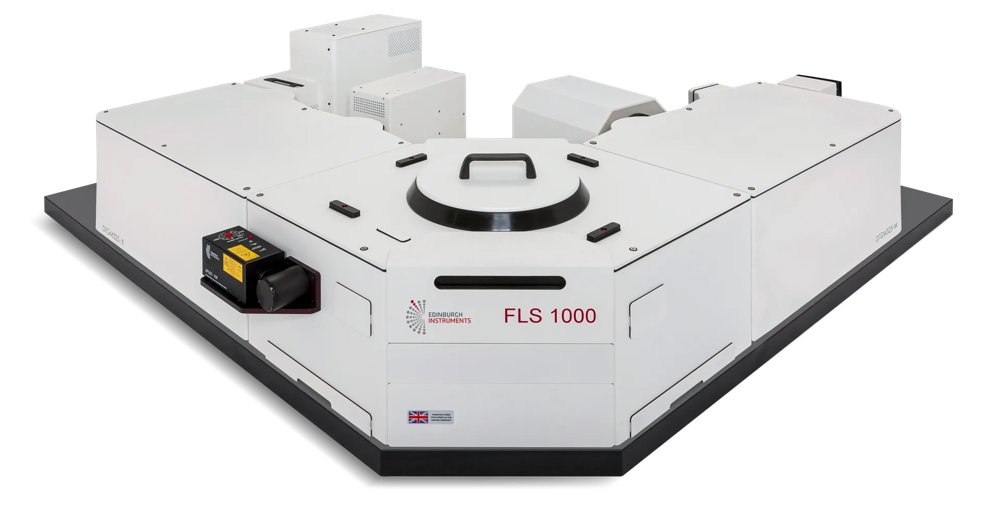
Highly modular photoluminescence spectrometer designed for ultimate sensitivity and versatility in steady-state and time-resolved photoluminescence research. The FLS1000 Photoluminescence Spectrometer redefines excellence in steady-state and time-resolved photoluminescence spectroscopy, making it the go-to choice for both advanced research and routine lab work. This modular system delivers precise measurements across a broad spectral range—from ultraviolet to mid-infrared (up to 5,500 nm)—and captures lifetimes from picoseconds to seconds. It also offers highly accurate absolute photoluminescence quantum yield measurements, with flexible upgrade options available at purchase or added later as your research grows. No matter your application, the FLS1000 enables you to measure luminescence spectra and kinetics with unmatched accuracy using cutting-edge sources, detectors, and acquisition techniques. Its spacious sample chamber accommodates nearly any sample accessory with ease. With industry-leading sensitivity of over 35,000:1 for the standard water Raman (SQRT method), this instrument excels at detecting weakly fluorescent samples. All functions are seamlessly managed by Fluoracle®, an all-in-one software package for comprehensive data acquisition and analysis. - Ultimate Sensitivity: Highest sensitivity on the market, with a signal-to-noise ratio of 35,000:1, ensures that the weakest photoluminescence signals can be detected - Modular Design: Customise the configuration to suit your specific research requirements; select from different light sources, detectors, and sample holders to create the optimal configuration - Upgradability: Upgrade your system with additional modules as new research needs arise, protecting the investment and keeping the equipment at the cutting edge of your research - NIR & MIR: Characterise NIR and MIR emitters with a wide range of infrared detector options with sensitivity out to 5500 nm - Automation: Equipped with advanced Fluoracle® software for comprehensive control of experiments, data acquisition, analysis, and time-saving automation features - Micro-Spectroscopy: Transform the FLS1000 into a powerful photoluminescence microscope with the MicroPL Upgrade; enabling high-resolution mapping of microscopic samples Live Video Demonstration: Send us your samples, and we can measure them live in an online demonstration Bespoke Development: Fully customisable systems for your requirements Faster Measurements: Increased scan speeds and leading performance Industry Leading Sensitivity: 35,000:1 Sensitivity Specification MicroPL Upgrade: For spectral and time-resolved photoluminescence microscopy Dedicated Team: Our dedicated team of applications scientists are available assist you with your samples
CATEGORY
Whilst the RMS1000 can be configured with a wide range of lasers, techniques, detectors and gratings as standard, sometimes that simply isn’t enough! Recently, we engineered a system that fully leverages its capabilities to their fullest extent. Equipped with two spectrographs to enhance resolution and functionality, the RMS1000 facilitates numerous techniques thanks to its extensive array of lasers and detectors. Internally, this system integrates 4 CW diode lasers for Raman and photoluminescence (PL) measurements. In response to the customer’s existing EI pulsed lasers (EPL, HPL, and VPL series), the microscope was modified to seamlessly integrate filter cubes. This adjustment relieves pressure on the six-position filter turret, enabling unrestricted use of EPL/HPL/VPL lasers, and allowing additional external lasers to be coupled. The system includes two IR lasers for upconversion measurements, alongside a Ti:Sapphire laser coupled into the external port, offering shared compatibility with their FLS1000, shown in the image below. To accommodate these diverse laser sources, the instrument houses 4 detectors: EMCCD, InGaAs, PMT, and NIR-PMT. Despite its complexity, Ramacle software efficiently manages and operates all internal components, ensuring user-friendly control while expanding capabilities to support a wide range of techniques—a true Multimodal RMS1000! Techniques: Raman, PL, FLIM, Upconversion
CATEGORY
