By KMLabs
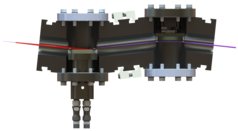
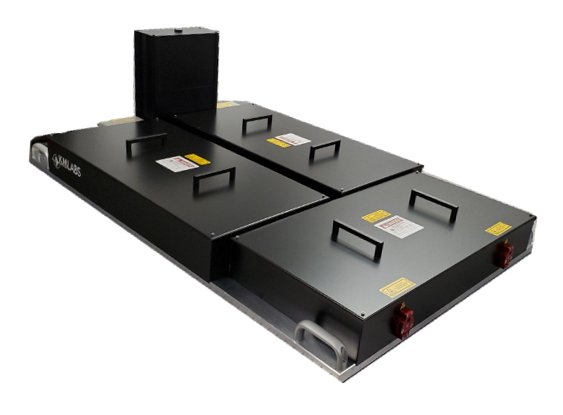
The Arterium beamline modules are designed with flexibility in mind. Various modules are available for for different functions such as removing the high power IR that is used for driving harmonics, steering, focusing, and filtering. Please contact us to discuss your specific beamline requirements. Salient Features: Rejector Module Removes 99.8% of IR Filter Wheel Module Up to 4 filters in series with a 28-filter capacity SwitchYard Module Three-way splitter for flexibility Focusing Module Spot sizes down to ~ 1 m m Monochromator Single harmonic selector EUV Diagnostics Spectral content and flux
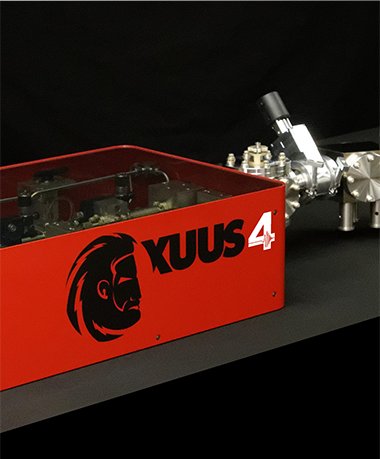
XUUS 5 upconverts ultrafast laser pulses into the Extreme UV(EUV or XUV) or soft X-ray regions of the spectrum. Employing HHG processes, the output beam inherits the coherent properties of a driving laser such as the KMLabsRAEAwith wavelengths that can be tuned from ~10 to 50 nm. Moreover, customized systems can generate coherent beams with wavelengths as short as 6 nm. The XUUS 5 employs KMLabs' patented hollow waveguide for the high harmonic up-conversion process. Salient Features: Photon Energy Range 20 - 1,600 eV Flux Up to 10 12 ph/s/h at source Pulse Duration Femto- to attoseconds
CATEGORY
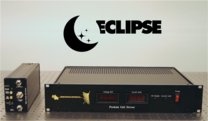
The KMLabs Eclipse TM is a high repetition rate, half wave Pockels cell and driver unit, designed for laser pulse picking at up to 20kHz. The Eclipse has a minimum window of 10ns, and 90% throughput between 750-850nm. KMLabs' compact design allows the driver to be packaged in with the optical unit, thus minimizing the high voltage line-length, and thereby maximizing the switching speed. The high voltage source for the Eclipse is an external, 19"w x 13"d x 3.5"h unit. Salient Features: Minimum Switching Window 10 ns Switching Efficiency 90 % for 750 - 850 nm Driver/Cell Aperture Diameter 9 mm Monochromator Single harmonic selector
CATEGORY
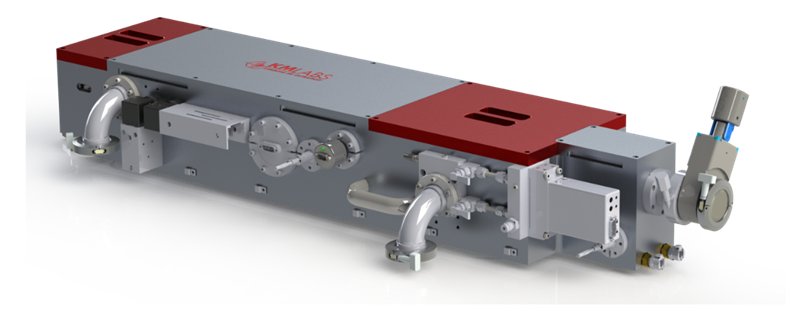
Table-top ultrafast EUV laser sources enabled by pairing the KMLabs XUUS with a variety of IR driving lasers.
CATEGORY
Wavelength tunable ASOPS system enabling fast aquisition spectroscopy Developed from our proven line of Ti:Sapphire oscillators, KMLabs' Orthos is the first stand-alone wavelength tunable Asynchronous Optical Sampling (ASOPS) system in the market. ASOPS is a technique commonly used in ultrafast pump-probe spectroscopy and terahertz time-domain spectroscopy (THz-TDS). It allows for high-speed and high-resolution time-resolved measurements without the need for mechanical delay lines. ASOSP systems use two mode-locked lasers, each operating at slightly different repetition rates: f master and f slave = f master – f offset where f offset causes the relative delay between the pump and probe pulses to automatically scan over time very quickly and precisely, as shown in the schematic below. Orthos Specifications Center Wavelength~ 800 nm Tunable Wavelength Range~ 750-850 nm Repetition Rate~ 93 MHz Maximum Mode-locked Power 500 mW at 800 nm Pulse Duration (based on Fourier transform limit)< 15 fs Pulse Energy 5 nJ Timing Jitter< 150 fs RMS Repetition Rate Offset 1-20 kHz Orthos integrates the Griffin as the free-running MHz-range oscillator and the Halcyon as the repetition-rate-stabilized oscillator, with a controlled frequency offset from the Griffin Prime. Both oscillators are mounted on a shared, water-cooled baseplate alongside a comprehensive set of diagnostics, including an optical coincidence detection system. With the master laser repetition rate of 93 MHz and maximum offset frequency of 20 kHz, Orthos allows for scanning a 10 ns time delay window in an unprecedented acquisition speed, as short as 50 microseconds. The ability to independently tune the center wavelength of each oscillator enables: - On-demand spectral filtering of the pump and probe beams - Probing specific absorption bands within materials - Resonant excitation of certain molecular vibrations/electronic transitions While each oscillator’s output spectrum can be tuned in the 750-850 nm range, the possibility of coupling Orthos to an Optical Parametric Oscillator (OPO) provides an even wider wavelength tunability range on either of the pump or probe arms. Alternatively, white light continuum can be generated by pumping a nonlinear photonic crystal fiber with only a fraction of 5 nJ per pulse energy, provided by either oscillator.
CATEGORY
