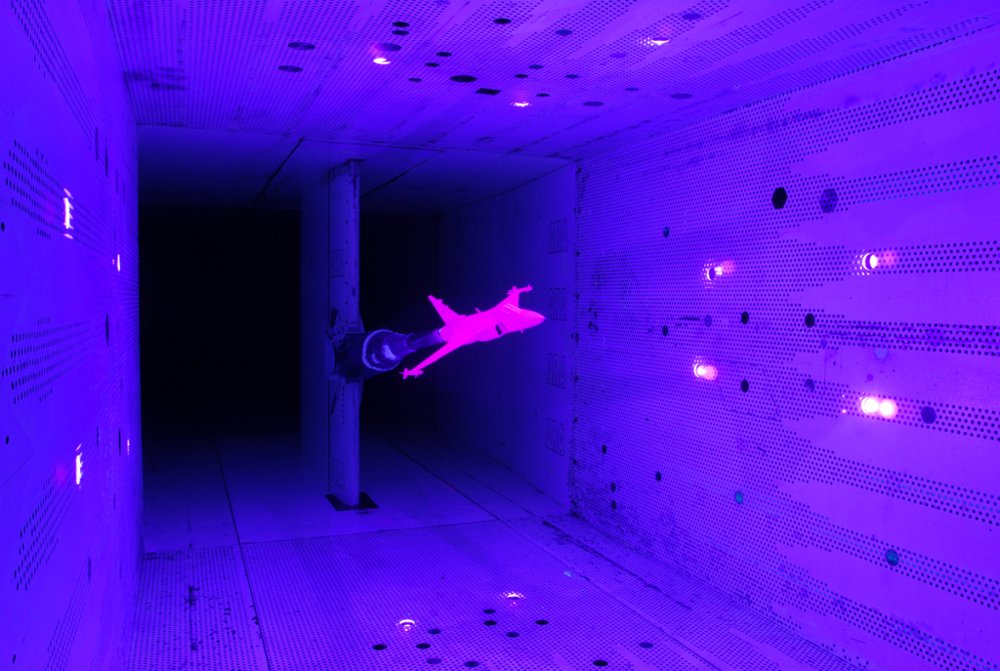
By Innovative Scientific Solutions Inc.
Temperature Sensitive Paint is an optical sensor for temperature measurements. A paint-like coating is applied to a surface and the fluorescence of the paint is monitored with a camera. The paint fluorescence is a function of the local temperature, and therefore, each pixel on the camera acts as a thermocouple.
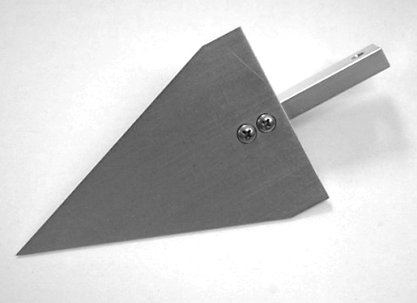
The educational PSP/TSP system provides everything needed for new users to get started using PSP and TSP. This system provides high spatial resolution, excellent dynamic range, but lower data capture rates than our higher-end systems. For applications where time in the wind tunnel is not a critical issue, it represents an excellent cost/performance trade-off. This system provides full capability for undergraduate demonstrations, training, and laboratory exercises. It will support all but the most demanding graduate and faculty research programs requiring distributed pressure and temperature measurements in wind tunnel environments. The system employs proven ISSI LED technology for excitation of the luminous probes in the paints. The camera is based on a color CCD sensor, eliminating the need for a filter wheel when using bi-luminophore paints. The OMS-Lite software package is easy to use and fully supports the educational and research capabilities of the PSP/TSP system. Standard System Components: - Color CCD Camera: 12 bit, 1.9 Megapixel color CCD camera with Gigabit Ethernet connectivity - LM2X-DM-400 LED Array: High-power UV LED module with TTL control - PSG-3: Pulse/delay generator for instrument control and synchronization - Parbolic Reflector and Diffuser: Focuses output of LM2 series LEDs from 120- to 40-degrees giving 2-3 times increased focused output. - PSP/TSP Starter Kit: PSP starter kit including beginner paints in spray cans, Binary FIB and FIB Basecoat with HVLP paint gun and airbrush with compressor and fittings. - Optical Kit: This kit contains all lenses and filters needed to get started using PSP and TSP. Available with c-mount or Canon® EF mount lenses. - ProAcquire and OMS-Lite: Data acquisition and data reduction software. Test models used in the lab experiments are provided with the the educational PSP/TSP system. An aluminum delta wing and NACA 0012 airfoil model are included with the system along with the mounting hardware to install them for either 1/4″-20 or M6. Other models are available to purchase upon request as well as pressure tapped models. The PSP system package has several options for purchase. Depending on the size of the facility the system will be used in, some different optical kits may be appropriate. Additional LEDs and cameras can also be added to systems and seamlessly integrated. Building a system with the appropriate hardware for your facility is paramount to the success of the results.
CATEGORY
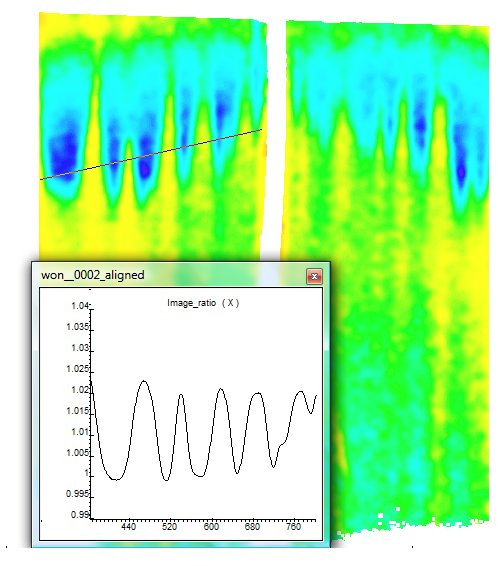
Binary paint is composed of two probes, a pressure sensor and a reference probe. The reference probe is used to compensate for errors caused by model displacement/deformation. It can also be used to compensate for temperature.
CATEGORY
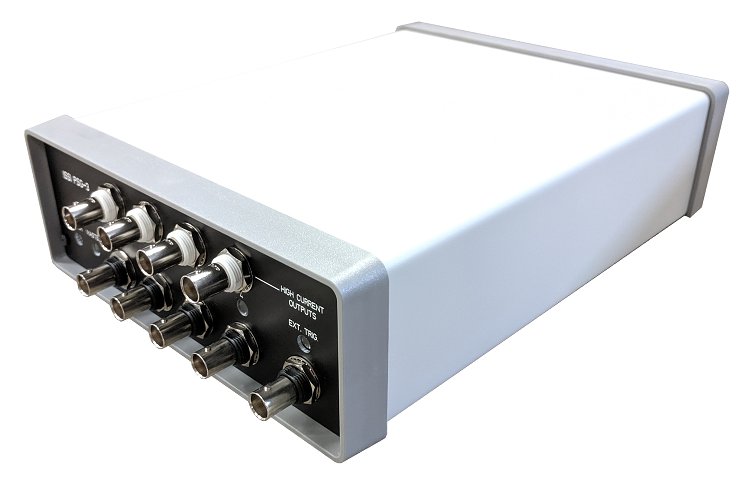
The PSG-3 is a four channel digital pulse/delay generator used for controlling the timing of experiment parameters and can be used as an experiment master clock or externally triggered (or gated) by an external event. The PSG-3 replaces the PSG-2 in the ISSI product line. Pulse width, delay, repetition rate, and other timing parameters are controlled by a simple user interface (or also by any web browser interface) and communication is via Ethernet or USB. Features - Two dual-channel independently programmable pulse generators (each PSG-3 has 4 total channels). The PSG-3 can produce two separate frequency outputs either synchronously or asynchronously. - Four high-current TTL level outputs extend the utility of this generator by allowing it to drive low impedance loads (50 Ohms) such as solenoids and drive logic over long cable runs - Browser accessible HTTP-interface (internal web-server) - Remotely programmable through Ethernet or USB via simple software interface (or HTTP-based API) - Multiple timing bases (ns, us, ms) - Multiple PSG-3s can be cascaded to increase the number of channels - BNC inhibit input (TTL high level) to allow the PSG-3 to be gated by an external source - User application controlled or external signal triggering - Firmware upgradeability through USB - 50 MHz maximum trigger rate (20ns delay resolution) - Divide-by-N from 1-255 - Input Trigger Threshold 0.05-5.0V - Simple LabVIEW® integration Ideal for laser timing systems, automated testing, and precision pulse applications.
CATEGORY
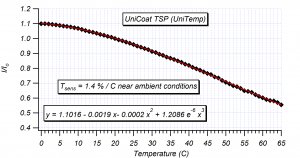
Traditional measurement techniques for acquiring surface temperature distributions on models have utilized embedded arrays of thermocouples and RTD’s. This requires significant construction and setup time while producing data with limited spatial resolution. An alternative approach is to use temperature sensitive paint (TSP) to measure surface temperature. The advantages of temperature sensitive paint include non-intrusive measurements and high spatial resolution when compared to conventional measurement techniques. Much like pressure sensitive paint, image based temperature measurements using TSP are accomplished by coating the model surface with the paint and illuminating the surface with an LED of the appropriate wavelength. The luminescence from the surface is recorded using a CCD camera through a long-pass filter to separate the luminescent signal from the excitation light. The luminescence from the TSP is a function of the local temperature, and therefore, each pixel on the camera acts as a thermocouple. TSP is made up of a luminescent molecule within a polymer binder. Generally, a binder that is impermeable to oxygen is preferred. The basis of the temperature sensitive paint method is the sensitivity of the luminescent molecules to their thermal environment. The luminescent molecule is placed in an excited state by absorption of a photon. The excited molecule deactivates through the emission of a photon. A rise in temperature of the luminescent molecule will increase the probability that the molecule will return to the ground state by a radiationless process, this is known as thermal quenching. The temperature of the painted surface can be measured by detecting the fluorescence intensity of the luminescent paint. To determine this intensity versus temperature relationship, a sample of the TSP is placed in a calibration chamber. The sample is exposed to a series of temperatures and the luminescent intensity of the sample is recorded. For reasons that will be discussed later, each intensity is normalized by the intensity at a reference condition and plotted versus temperature. A plot of the calibration of a typical TSP is shown here. Luminescent intensity distribution is not only a function of the temperature. In fact the luminescence from the painted surface varies with illumination intensity, paint layer thickness, and probe distribution. If we assume that these parameters don’t vary in time however, they can be eliminated by taking the ratio of the image at the test condition or wind-on image to an image taken at a known reference condition or wind-off image. This wind-off to wind-on ratio is often referred to as radiometric TSP.
CATEGORY
