N-Hydroxysuccinimidyl (NHS)esters of the carboxylic acids (RCOOH) look like RCOONS (where NS is N-succinimidyl residue). They readily react with primary amines (R’NH2) forming hydrolytically stable amides RCONHR’ and N-hydroxysuccinimide. N-Hydroxysuccinimidyl carbonates of the alcohols (RCH2OH) look like RCH2OCONS, where NS is N-succiimidyl residue(as above). They readily react with amines R’NH2 forming hydrolytically stable urethanes RCH2OCONHR’ and N-hydroxysuccinimide. N-hydroxysuccinimidyl carbonates are expected to react with amines a bit slower, but their stability is typically higher that that of N-hydroxysuccinimidyl esters. The stability of the NHS esters differs between the individual dyes. For non-dissolved dyes which are kept at dry conditions at 4 °C the shelf life is typically 6 – 12 month. The shelf life increases significantly if they are stored at -20°C or better -80 °C. For dissolved NHS esters the shelf life depends strongly on the solvent used for dissolving or diluting the dye. Best use water free solvents. In water containing solvents NHS esters are very labile. Therefore we recommend dissolving NHS esters in water free dimethylformamide. Alternatively water free and very pure dimethylsulfoxide may be used.
The abberior RAINBOW Detection pairs high transmission and quantum efficiency with optimal wavelength discrimination. There are no more compromises: you benefit from both maximum signal and full spectral flexibility! The superior detection efficiency of APDs compared to any other photon detector, including PMTs and hybrid detectors, guarantees that you collect as many precious fluorescence photons from your sample as possible. full contrast, full flexibility Continuously variable spectral detection. Spectral selection with ultra-high transmission A pair of gradient-coated filters are translated within the RAINBOW Detection in order to freely define the edges of the detection window between 400 and 800 nm. Up to four RAINBOW devices can be installed or upgraded at any time and the fluorescence can be freely distributed between every detector. Super-sensitive detection Our standard detectors are avalanche photo detectors (APDs), because they have superior quantum efficiencies, up to a factor of two above hybrid detectors. This means that even when the signal levels are low, our APDs still collect plenty of photons for a meaningful image. Typical applications are superresolution STED imaging and experiments with low labeling densities designed to maintain physiological conditions. At the same time, high-signal samples are perfectly taken care of by DYNAMIC PLUS, our dead-time compensation that yields crisp images of brightly labeled samples. This way, confocal imaging is highly improved, too. Of course, you can opt between quantitative analysis of raw data or mathematical post-processing, e.g. deconvolution. Because we always give you genuine photon counts, you remain in full control of your data interpretation. Always. Other detectors are available on request. - Gap-free spectral detection - Choose any wavelength band between 400 and 800 nm - APDs for the highest sensitivity (up to 65% quantum efficiency) - Free selection of excitation and STED wavelength combinations Because every photon counts
CATEGORY
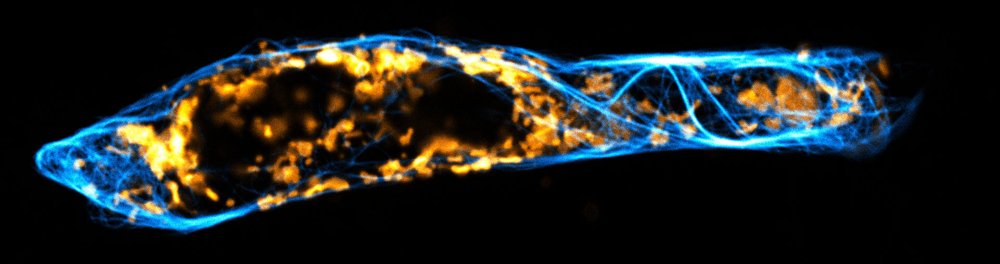
Two color live-cell confocal and STED image of a mammalian cell expressing a SNAP-tag® OMP25 fusion protein decoration the outer membrane of mitochondria. OMP25 is visualized by our new abberior LIVE 610 SNAP ligand (orange). Tubulin filaments are highlighted with abberior LIVE 550 tubulin (cyan). The SNAP-OMP25 plasmid was a gift from Francesca Bottanelli, FU Berlin.
CATEGORY
The RESOLFT device offered by abberior is a superresolution point scanning system for switchable GFPs. It features the lowest principal light dosages of all superresolution methods and is greatly suited for live-cell imaging. - Fully compatible and integrated - Other options on request
CATEGORY