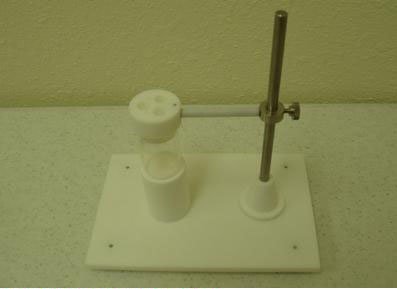
The Model 600F series is designed for general purpose electrochemical measurements. The figure below shows the block diagram of the instrument. The system contains a fast digital function generator, a direct digital synthesizer for high frequency AC waveforms, high speed dual-channel data acquisition circuitry, a potentiostat, and a galvanostat (available only in select models). The potential control range is ±10 V and the current range is ±250 mA. The instrument is capable of measuring current down to picoamperes. With the CHI200B Picoamp Booster and Faraday Cage (fully automatic and compatible with the CHI600F series), currents at sub-picoamperes can be measured. The instrument is very fast. The function generator can update at a 5 MHz rate. Two high speed and high resolution data acquisition channels allow both current and potential (or an external voltage signal) to be sampled simultaneously at a rate of 2.5 MHz, with 16-bit resolution. The instrument provides a very wide dynamic range of experimental time scales. For instance, the scan rate in cyclic voltammetry can be up to 500 V/s with a 0.1 mV potential increment or 5000 V/s with a 1 mV potential increment. The potentiostat / galvanostat uses a 4-electrode configuration, allowing it to be used for liquid/liquid interface measurements, and eliminating the effect of the contact resistance of connectors and relays for high current measurements. The data acquisition systems also allow an external input signal (such as spectroscopic) to be recorded simultaneously during an electrochemical measurement. The 600F series is the latest upgrade to our very popular 600/A/B/C/D/E series. The changes will be faster data acquisition, 16-bit resolution, two channel simultaneously AD conversion will be 2.5M Hz. It was 1M Hz two channel simultaneous ADC. It allows CV at 2500V/s scan rate with 1 mV sample interval. It was at 1000V/s scan rate for 1mV sample interval. CA sample interval is changed from 1 usec to 0.4 usec, two channel simultaneously. The new model has faster data transfer with USB 3 port. The real time data transfer for CV is changed from 3V/s to 12V/s. For time based techniques (such as CA and i-t), the sample interval for real time data transfer is changed from 0.0003333 sec to 0.0001 sec. AC impedance has a frequency up to 3M Hz. We added current interrupt iR compensation. We added galvanostatic intermittent titration technique (GITT) and potentiostatic intermittent titration technique (PITT). The 600F series also includes a true integrator for chronocoulometry. Two 16-bit highly stable bias circuits are used for current and potential bias, allowing a wider dynamic range in AC measurements. These can also be used to re-zero the DC current output. The model 600F series can be upgraded to the corresponding model 700F series bipotentiostat with an add-on board that includes circuitry for the second channel’s potential control, current measurement (including sensitivity switching), two low-pass filters, three gain stages, and channel selection. It is therefore identical to the 600F series when used for single channel measurements. When it is used as a bipotentiostat, the second channel can be controlled at an independent constant potential, to scan or step at the same potential as the first channel, or to scan with a constant potential difference with the first channel. The second channel is available for many voltammetric and amperometric techniques. The instrument is capable of a wide variety of electrochemical techniques, and is available with integrated simulation and fitting software functions for both impedance and cyclic voltammetry. These features provide powerful tools for both electrochemical mechanistic studies and trace analysis, as well as electrochemical sensor studies. We provide several different models in the 600F series. The following table compares the different models. Other than what is listed, the specifications and features of these models are identical. Specifications Potentiostat: • Zero resistance ammeter • 2- or 3- or 4-electrode configuration • Floating (isolated from earth) or earth ground • Maximum potential: ±10 V • Maximum current: ±250 mA continuous, ±300 mA peak • Compliance Voltage: ±13 V • Potentiostat rise time: < 1 μs, 0.8 μs typical • Potentiostat bandwidth (-3 dB): 1 MHz • Applied potential ranges: ±10 mV, ±50 mV, ±100 mV, ±650 mV, ±3.276 V, ±6.553 V, ±10 V • Applied potential resolution: 0.0015% of potential range • Applied potential accuracy: ±1 mV, ±0.01% of scale • Applied potential noise: < 10 μV rms • Measured current range: ±10 pA to ±0.25 A in 12 ranges • Measured current resolution: 0.0015% of current range, minimum 0.3 fA • Current measurement accuracy: 0.2% if current range >=1e-6 A/V, 1% otherwise • Input bias current: < 10 pA Galvanostat: • Galvanostat applied current range: 3 nA – 250 mA • Applied current accuracy: 20 pA ±0.2% if > 3e-7A, ±1% otherwise • Applied current resolution: 0.03% of applied current range • Measured potential range: ±0.025 V, ±0.1 V, ±0.25 V, ±1 V, ±2.5 V, ±10 V • Measured potential resolution: 0.0015% of measured range Electrometer: • Reference electrode input impedance: 1e12 ohm • Reference electrode input bandwidth: 10 MHz • Reference electrode input bias current: <= 10 pA @ 25°C Waveform Generation and Data Acquisition: • Fast waveform update: 10 MHz @ 16-bit • Fast data acquisition: dual channel 16-bit ADC, 2,500,000 samples/sec simultaneously • External signal recording channel at maximum 2.5 MHz sampling rate Experimental Parameters: • CV and LSV scan rate: 0.000001 to 10,000 V/s • Potential increment during scan: 0.1 mV @ 500 V/s • CA and CC pulse width: 0.0001 to 1000 sec • CA minimum sample interval: 0.4 μs • True integrator for CC • DPV and NPV pulse width: 0.001 to 10 sec • SWV frequency: 1 to 100 kHz • i-t sample interval: minimum 0.4 μs • ACV frequency: 0.1 to 10 kHz • SHACV frequency: 0.1 to 5 kHz • FTACV frequency: 0.1 to 50 Hz, simultaneously acquire 1 st, 2 nd,3rd, 4 th, 5 th, and 6 th harmonics ACV data • IMP frequency: 0.00001 to 3 MHz • IMP amplitude: 0.00001 V to 0.7 V rms Other Features: • Automatic and manual positive feedback iR compensation • Current interrupt iR compensation • Current measurement bias: full range with 16-bit resolution • Potential measurement bias: ±10V with 16-bit resolution • External potential input • Potential and current analog output • Programmable potential filter cutoff: 1.5 MHz, 150 KHz, 15 KHz, 1.5 KHz, 150 Hz, 15 Hz, 1.5 Hz, 0.15 Hz • Programmable signal filter cutoff: 1.5 MHz, 150 KHz, 15 KHz, 1.5 KHz, 150 Hz, 15 Hz, 1.5 Hz, 0.15 Hz • RDE control output (Model 630E and up): 0-10V (corresponding to 0-10000 rpm), 16-bit, 0.003% accuracy • Digital input/output lines programmable through macro command • Flash memory for quick software update • USB port for data communication • Cell control: purge, stir, knock • CV simulation and fitting program, user-defined mechanisms • Impedance simulation and fitting program • Maximum data length: 256K-16384K selectable • Dimensions: 14.25”(W) × 9.25”(D) × 4.75”(H) • Weight: 12 lb. Differences of 600F Series Models Functions 600F 602F 604F 610F 620F 630F 650F 660F Cyclic Voltammetry (CV) Linear Sweep Voltammetry (LSV) & Staircase Voltammetry (SCV) #,& Tafel Plot (TAFEL) Chronoamperometry (CA) Chronocoulometry (CC) Differential Pulse Voltammetry (DPV) #,& Normal Pulse Voltammetry (NPV) #,& Differential Normal Pulse Voltammetry (DNPV) #,& Square Wave Voltammetry (SWV) & AC Voltammetry (ACV) #,&,$ 2nd Harmonic AC Voltammetry (SHACV) #,&,$ Fourier Transform AC Voltammetry (FTACV) Amperometric i-t Curve (i-t) Differential Pulse Amperometry (DPA) Double Differential Pulse Amperometry (DDPA) Triple Pulse Amperometry (TPA) Integrated Pulse Amperometric Detection (IPAD) Bulk Electrolysis with Coulometry (BE) Hydrodynamic Modulation Voltammetry (HMV) Sweep-Step Functions (SSF) Multi-Potential Steps (STEP) Potentiostatic Intermittent Titration Tech (PITT) AC Impedance (IMP) Impedance - Time (IMPT) Impedance - Potential (IMPE) Chronopotentiometry (CP) Chronopotentiometry with Current Ramp (CPCR) Multi-Current Steps (ISTEP) Galvanostatic Intermittent Titration Tech (GITT) Potentiometric Stripping Analysis (PSA) Electrochemical Noise Measurement (ECN) Open Circuit Potential - Time (OCPT) Galvanostat RDE control (0-10V output) Full version of CV simulation and fitting program Limited version of CV simulation and fitting program Impedance simulation and fitting program iR Compensation External Potential Input Auxiliary Signal Measurement Channel #: Corresponding polarographic mode can be performed. &: Corresponding stripping mode can be performed. $: Phase selective data are available.
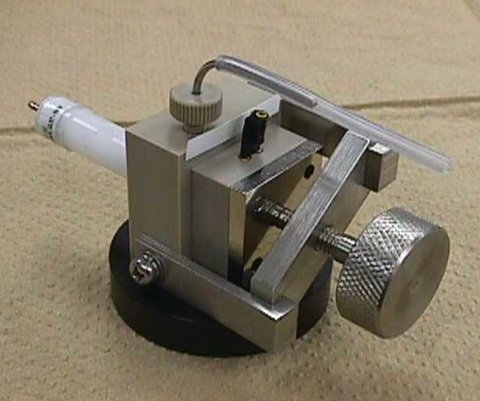
Non-Aqueous Ag/Ag+ Reference Electrode w/ porous Teflon Tip. For the CHI112, Ag+ solution (typically 10 mM) should be prepared with the supporting electrolyte and AgNO3 (not included). This solution is then filled into the reference electrode compartment using a syringe (not included). The instructions will come with the components.
CATEGORY
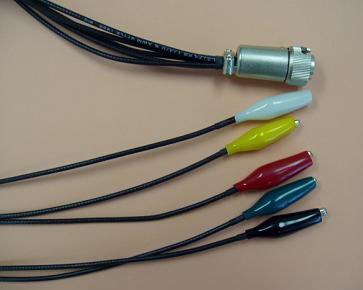
Electrode leads for model number xxx (where xxx = 600, 710B, etc.)
CATEGORY
Electrode Polishing Kit. The CHI120 electrode polishing kit contains 1 bottle of 1.0 micron Alpha alumina powder, 1 bottle of 0.3 micron Alpha alumina powder, 3 bottles of 0.05 micron Gamma alumina powder, 2 glass plates for polishing pads, 5 pieces of 73 mm diameter 1200 grit Carbimet disks (grey in color), 5 pieces of 73 mm diameter Mastertex polishing pads (white in color), and 10 pieces of 73 mm diameter Microcloth polishing pads (brown in color).
CATEGORY