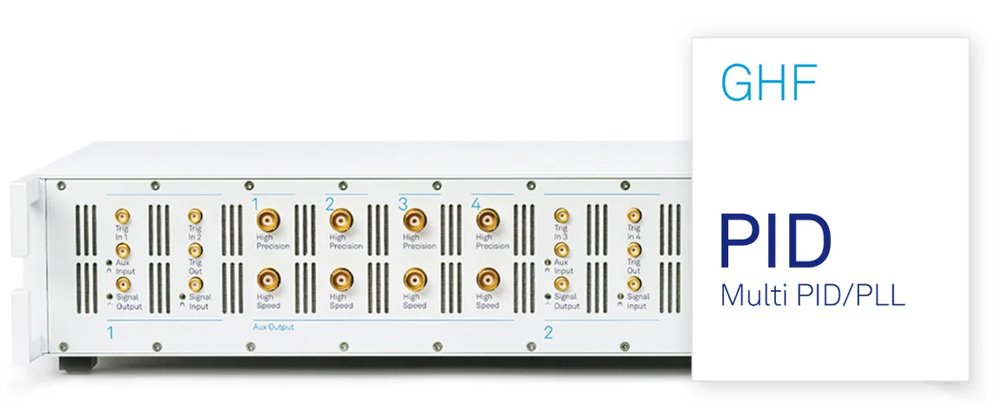
Zurich Instruments offers PID controllers exclusively as upgrade options for lock-in amplifiers, impedance analyzers and boxcar averagers. Consequently, a number of different inputs can be chosen for the PIDs: the set of choices includes amplitude, phase, quadrature and in-phase components of demodulated signals, boxcar outputs, as well as auxiliary inputs and outputs. Integrated digital signal processing guarantees maximum signal-to-noise ratio, minimal feedback loop latency and closed-loop operation with high stability. Even tiny signals can be located in a noisy and spurious-rich background and used as reliable inputs. The feedback signal is then available as an analog output and can also be directly applied to an internal frequency generator output to control its amplitude, frequency, offset and phase. 50 kHz max. loop filter bandwidth PID Advisor and Auto Tune PID PLL capability Phase unwrap for demodulator phase data The PID options for the MFLI Lock-in Amplifier and the UHFLI Lock-in Amplifier are also equipped with a D-gain low-pass filter and the phase unwrap functionality. In many cases, introducing a D-gain offers the potential to speed up the loop's response. However, this often leads to instability because it introduces increasing gains towards high frequencies. Introducing an adjustable low-pass filter in the D-branch helps take advantage of the D-gain without running into instabilities. Phase detection facilitated by a lock-in amplifier is usually limited by the arct2(y/x) function to the value range ±π. In turn, this limits the 'capture range' of the PID as well as the stability of operation in the presence of external noise. In the digital domain, this limitation can be overcome thanks to a 'phase unwrap' functionality that detects instances where phase detection exceeds its limits and keeps track of this behaviour accordingly. Zurich Instruments' PIDs support a 'capture range' that extends up to ±1024π.
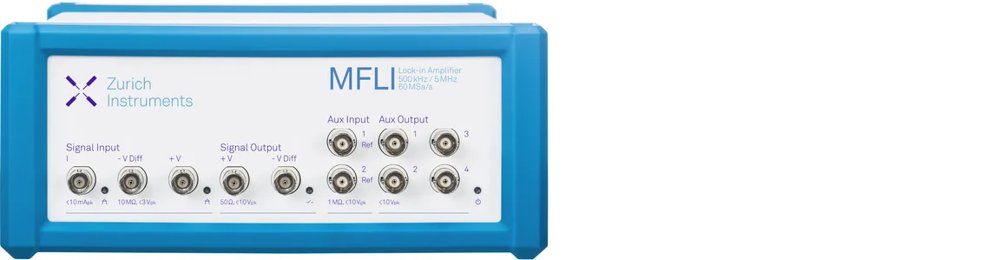
Zurich instruments’ lock-in amplifiers are ideal instruments for measuring the amplitude and phase of periodic signals from a large variety of optical experiments, covering the range from elementary to cutting-edge experimental designs. Thanks to their low input noise and large dynamic reserve, they can detect minute signals and achieve large signal-to-noise ratios (SNRs) quickly and reliably. Each instrument is equipped with a set of advanced measurement tools, such as an oscilloscope, a parametric sweeper, a spectrum analyzer, and more,allowing you to characterize your optical signals more comprehensively. Additionally, if an analog interface to other instruments is needed — for example, a control voltage for laser cavities or delay lines — internal measurement results or other customizable signals can easily be routed out from the instruments via the auxiliary output connectors. This toolset, together with several field upgradeable options, expand the functionality of the instruments well beyond lock-in amplification,making them a perfect fit for the demanding requirements of many applications. Each of these functionalities can be controlled through LabOne®,a proprietary software of Zurich Instruments.This platform-independent instrument control tool provides users with a powerful and intuitive user interface, together with support for the most popular programming languages. These features make Zurich Instruments' lock-in amplifiers extremely versatile, allowing them to be tailored to any experimental setup, reducing experiment complexity and decreasing the time to publication. Explore higher frequency domains of your optical experiment with high noise rejection and faster measurements: with signal inputs up to 8.5 GHz, Zurich Instruments’ lock-in amplifiers cover a wide range of modulation techniques and applications. Carry out multiple tasks in parallel with one instrument: for example, you can simultaneously perform lock-in detection and boxcar averaging on the signal from the photodetector while running a PID/PLL control loop to stabilize your laser cavity. The parallelization of several experimental aspects allows you to achieve results more efficiently and quickly. Ease of integration: thanks to our APIs (LabVIEW, MATLAB, Python,.NET, C), swiftly connect your lock-in amplifier with all the elements, e.g., delay lines and/or modulators, in your experimental setup.
CATEGORY
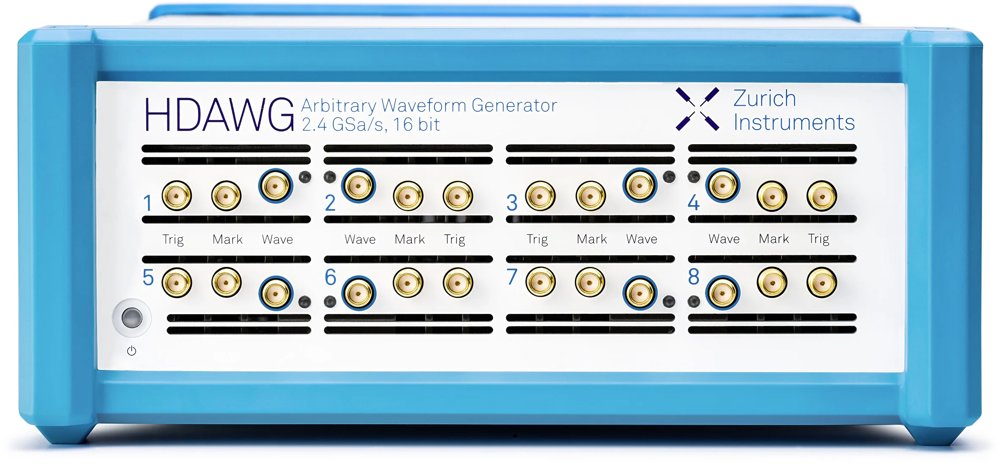
The HDAWG multi-channel Arbitrary Waveform Generator generates the fast pulses for the metallic gates which are used to control the QD energy levels and couplings and to drive the two-qubit gates. To counteract the effect of cross-coupling, additional pulses are applied to multiple gates. The HDAWG is able to modulate the microwave source in order to produce single-qubit gates. Different qubits can be addressed with frequency multiplexing. A single-sideband modulation scheme, in conjunction with the internal oscillators, suppresses unwanted images and facilitates a clean spectrum. Experience accurate spin control and enhanced fidelity, also for fast qubits, thanks to the fast and low-noise HDAWG outputs.
CATEGORY
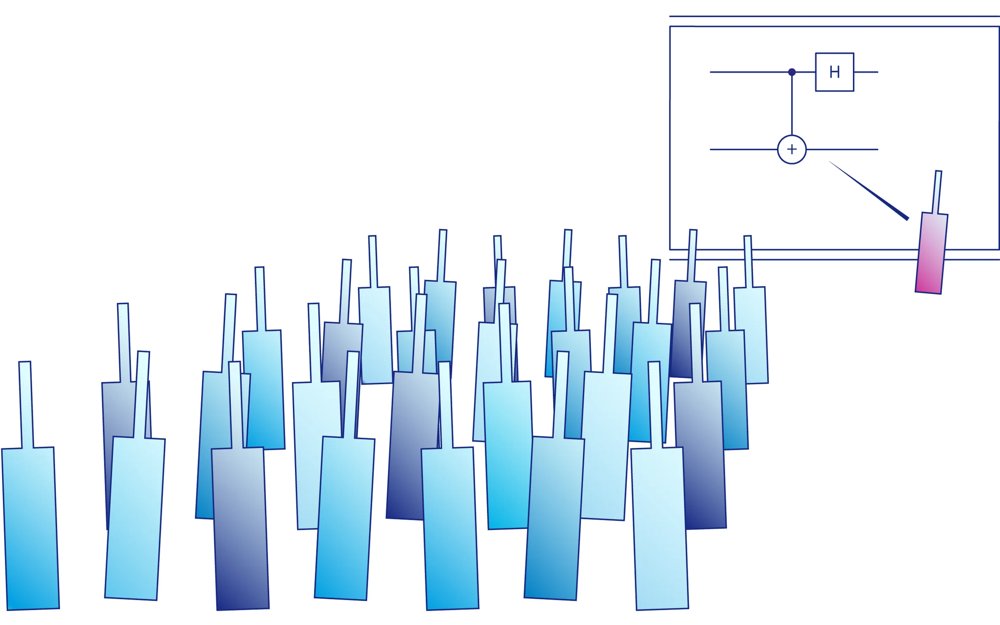
Operation from DC to 8.5 GHz 1 GHz bandwidth free from mixer calibration High output power for short qubit gates
CATEGORY