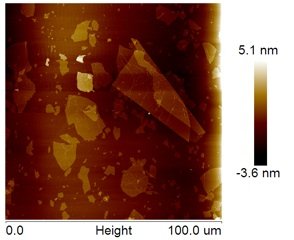
Our Few Layer Graphene Oxide 2-4L is produced by a modified hummer’s method and features 40-60% functional group content providing high solubility in Di Water features high solubility in Di Water, NMP, DMF, DCB, and other solvents that behave like water. We supply Few Layer Graphene Oxide 2-4L by the milligram, gram, or KG in powder form, dispersed, or as a coating on substrates. The structure and properties of few layer graphene 2-4l oxide depend on particular synthesis method and degree of oxidation. It typically preserves the layer structure of the parent graphite, but the layers are buckled and the interlayer spacing is about two times larger (~0.7 nm) than that of graphene. Strictly speaking “oxide” is an incorrect but historically established name. Besides oxygen, epoxide groups (bridging oxygen atoms), other functional groups experimentally found are: carbonyl (C=O), hydroxyl (-OH), phenol, for graphite oxides prepared using sulphuric acid (e.g. Hummers method) also some impurity of sulphur is often found, for example in a form of organosulfate groups. Graphene oxide layers are about 1.1 ± 0.2 nm thick, Few Layer Graphene Oxide Layers are multiples of this thickness. Scanning Tunneling Microscopy shows the presence of local regions where oxygen atoms are arranged in a rectangular pattern with lattice constant 0.27 nm × 0.41 nm. The edges of each layer are terminated with carboxyl and carbonyl groups.Graphene oxide is hydrophilic and easily hydrated when exposed to water vapor or immersed in liquid water, resulting in a distinct increase of the inter-planar distance (up to 1.2 nm in saturated state). Additional water is also incorporated into interlayer space due to high pressure induced effects. Maximal hydration state of graphite oxide in liquid water corresponds to insertion of 2-3 water monolayers, cooling the graphite oxide/H2O samples results in “pseudo-negative thermal expansion” and below freezing point of water media results in de-insertion of one water monolayer and lattice contraction. Complete removal of water from the structure seems difficult since heating at 60–80°C results in partial decomposition and degradation of the material. Similar to water, graphene oxide also easily incorporates other polar solvents, e.g. alcohols. We can provide single layer graphene oxide and few layer graphene oxide dispersions In Di Water, NMP, THF, or DMF. Hazmat shipping fees may apply. The standard concentration for dispersions is 2mgs/ml, up to 10mgs/ml is available. Few Layer Graphene Oxide 2-4L Specifications Size: 300-800nm lateral dimensions Thickness: 1.4-4.8 nm by AFM Solubility: DI Water, NMP, DCB, THF, DMF, and other solvents that behave like water Purity: 99wt% Elemental Analysis: C: 35-42%, O: 45-55%, H: 3-5%
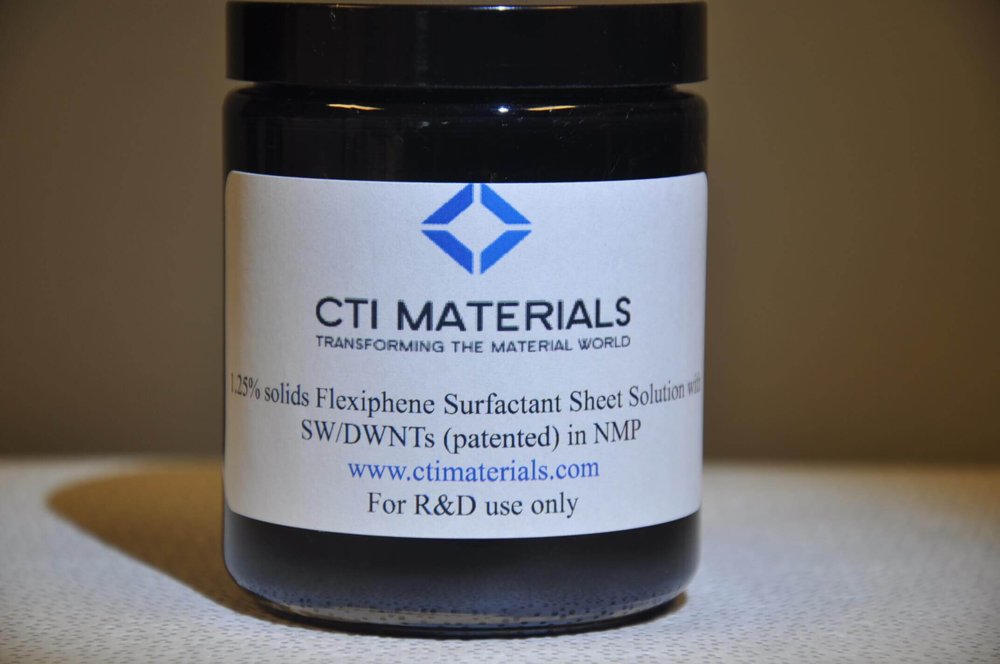
Try patented Flexiphene solvent based nanomaterial emulsions today and put the power of graphene to work in your formulations. Flexiphene is amphiphilic, tune-able by pH, sheet size, and degree of reduction. Flexiphene is transforming the material world! Contact us Today to arrange for your Flexiphene Emulsions!To Buy Flexiphene emulsions, please contact us with the solvent, materials, amount, and loading ratio you need. CTI Material’s patented Flexiphene solvent based nanomaterial emulsions are just what you need to disperse nanomaterials into solvents. Flexiphene works with SWNTs, MWNTs, and many other nanomaterials. Flexiphene are amphiphilic, tunable surfactant sheets, highly soluble in many solvents and can make colloidal dispersions of nanomaterials, stable for weeks to months. We typically work with NMP, DMF, THF, Acetone, & Ethanol solvents however many more are possible. Please contact us today and let us know what materials you require, the loading ratios, and solvents and we can quote it for you. Note- Hazmat shipping fees may apply. Prices depend on materials used and loading ratios. Flexiphene solvent based nanomaterial emulsions are transforming the material world!
CATEGORY
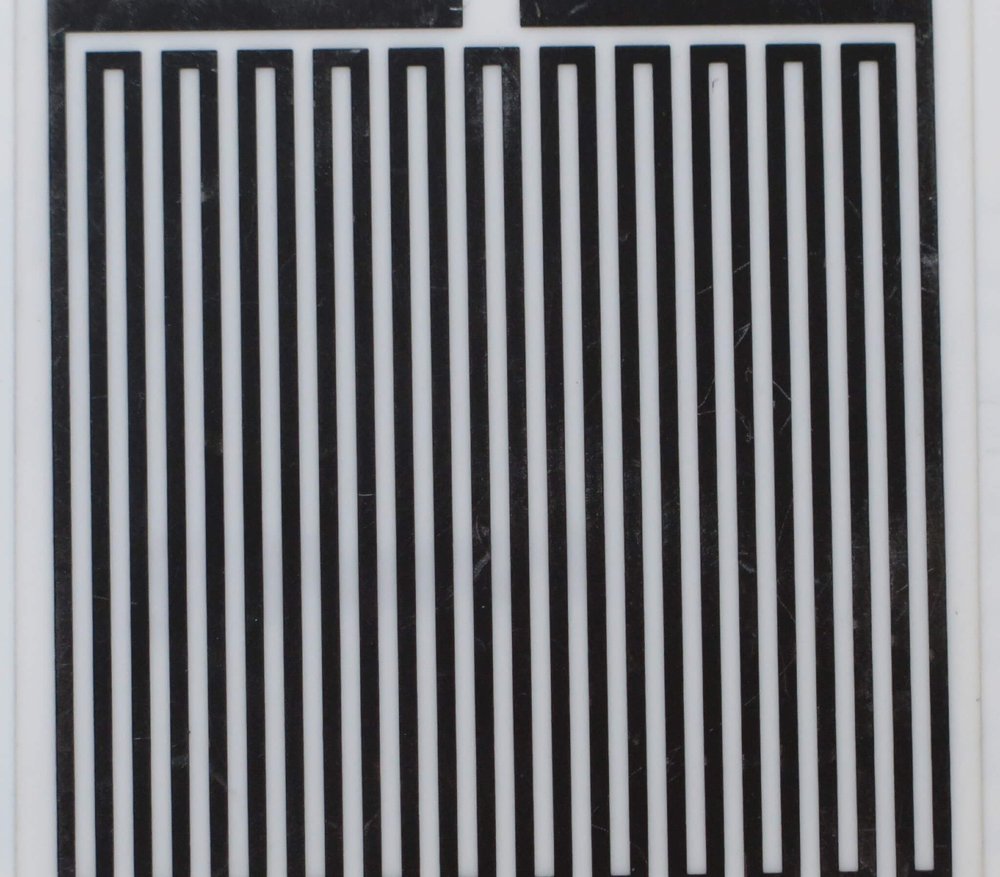
Silver nanowire (AgNW) ink is the leading solution for transparent conductive electrodes (TCEs) that require both high conductivity and optical transparency. At loadings that achieve sheet resistance below 10 Ohm/sq, AgNW films maintain optical transmittance above 85% — performance that rivals ITO at a fraction of the cost and with far superior flexibility. Unlike ITO, silver nanowire electrodes do not crack under bending, making them essential for rollable displays and conformable biosensors. Cheap Tubes synthesizes 30 nm outer diameter silver nanowires in-house at our Vermont facility, giving us direct quality control over aspect ratio, concentration, and lot-to-lot consistency — shipped at 25 mg/mL in isopropanol (IPA). Cheap Tubes supplies silver nanowire ink for transparent electrode applications in touch screens, OPV, and flexible electronics. Both ink types are formulated for compatibility with screen printing, gravure, flexographic, and inkjet deposition methods. Silver nanowire ink is the choice when optical transparency is required alongside low sheet resistance.
CATEGORY
Try patented Flexiphene Surfactant Solutions today and put the power of graphene to work in your formulations. Flexiphene is amphiphilic and compatible with water, solvents, and many other host matrices. To Buy Flexiphene, please contact us with the amount and loading ratio you need. Standard concentration is 2mgs/ml. Flexiphene is transforming the material world! CTI Material’s patented Flexiphene aqueous nanomaterial emulsions are just what you need to disperse nanomaterials into aqueous solutions. Flexiphene works with SWNTs, MWNTs, GNPs, and many other nanomaterials. Flexiphene are amphiphilic, tunable surfactant sheets, highly soluble in many solvents and can make colloidal dispersions of nanomaterials, stable for weeks to months. We typically work with Di Water and can modify the solution if required. Please contact us today and let us know what materials you require, the loading ratios, and solvents and we can quote it for you. Prices depend on materials used and loading ratios. Flexiphene aqueous nanomaterial emulsions are transforming the material world!
CATEGORY
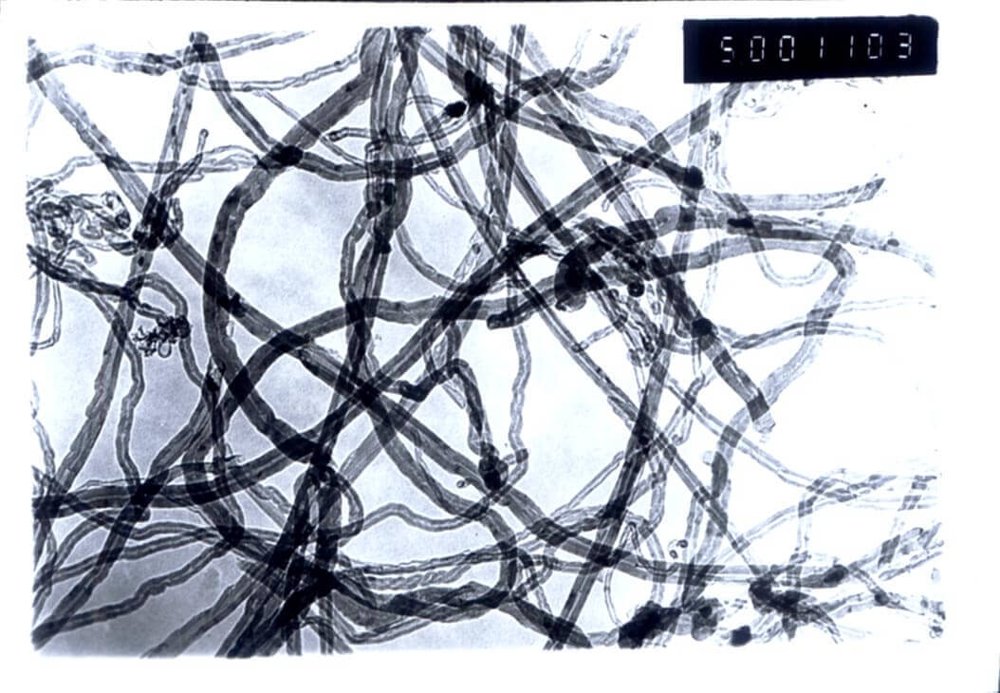
Amine | -NH₂ | Basic, highly water-dispersible; reacts with COOH, epoxides, aldehydes | Drug delivery, biosensors, crosslinked epoxy composites Amine (-NH2) groups are introduced via diamine coupling to -COOH and provide direct bonding to epoxy resins and conjugation chemistry to biomolecules via standard NHS/EDC coupling. -COOH and -NH2 functionalized MWCNTs are the standard substrates for biomolecule conjugation... use glutaraldehyde or NHS-PEG-NHS linkers between -NH2 surfaces and amine-bearing biomolecules. For dispersion in aqueous biological or analytical applications, -COOH and -NH₂ groups provide colloidal stability through electrostatic repulsion (high negative or positive zeta potential) without requiring surfactants that would need to be removed in downstream processing. This makes functionalized CNTs the preferred choice for drug delivery systems, biosensors, and diagnostic conjugation chemistry.
CATEGORY
