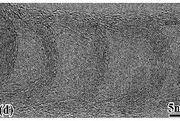
By NanoLab Inc.
COOH Functionalized, Surfactant Free Carbon Nanotube Suspensions. Our carboxylation process yields nanotubes with a strong negative charge that keeps them suspended in water at up to 2 gram/liter concentrations without the presence of a surfactant. Lower concentrations can be achieved in a number of other solvents that can be used as a nanotube paint, ink, etc. Bamboo MWCNT BPD15L5-20-COOH 1G/L, Solvent: DMF, Ethanol, THF, Acetone, Volume: 100 ml. Backordered.
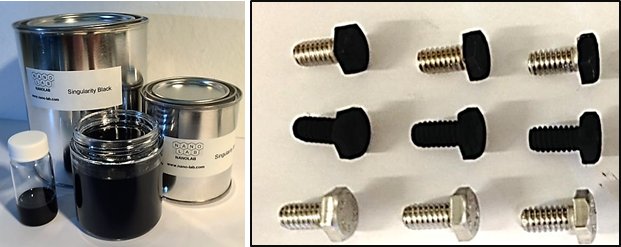
Singularity Black LT AERO is a nanotube filled, solvent based paint that has exceptionally strong absorption in the visible, and is similar in performance to the vertically aligned arrays of nanotubes that are the blackest items known to mankind. Singularity has world class performance in the visible, NIR and IR (<1% reflectance in the visible (400-800nm) and < 1.5% in NIR (800nm to 1400nm) exceeding the optical properties of other commercially available products like Acktar's Metal Velvet and Aeroglaze Z306. Singularity's grazing angle performance is unmatched. Formulations are available for use as beam dump coatings, black body sources, etc. Both the standard and aerospace grades offer the same optical performance. The Aerospace grade has been tested for outgassing, vibration, and other tests related to spaceflight. For the trained artist community, the Singularity lineup offers an intense matte black, a void-like experience. Singularity TM Black LT, How is it applied? The paint is solvent based, and requires application in a spray booth or fume hood, or with protective solvent vapor/particulate masks suited to the task. HVLP sprayguns or airbrush spraying is the recommended application technique. Substrates and spray guns should be resistant to chemical attack from solvents such as THF. An Iwata HP-TH2 airbrush is well suited for small scale coating jobs. Coverage at ~1ml/cm 2 results in a thick coating that performs well in the IR and visible. Thinner coats may perform well in the visible. After spray application, a heat cure is required to activate the coating. Once activated, it is a fragile surface with limited scratch resistance. We offer primers for difficult to coat materials, like copper and composites/plastics. The heat cure requires that the coating see 140C +/-10C for 10 minutes. In lab, we have cured the coating with an oven, hair dryer or heat gun. While fragile, Singularity coatings can be field repaired with a air brush and a heat gun. In addition to these offerings, we have created applique' versions that let you 'wallpaper' the coating onto parts with low melting points that could not withstand our part coating process. We also offer a 'repair kit' for scratched optical components to restore black coatings to <1% reflectance in the visible. Singularity TM Black LT-AERO, What are its properties? We have collected UV-VIS-NIR diffuse & spectral reflectance values BRDF data for this coating. We have a full compliment of scratch & adhesion test data, along with vibration tests and outgassing rates for the Aerospace version. Singularity TM Black LT- AERO has been tested for various flight qualifications: ✔ Cleanliness level of <200 per Institute of Environmental Sciences and Technology (IEST) STD-CC1246E. ✔ ASTM E595-07 and ECSS-Q-70-02 [Outgassing] tests shows a TML of 0.4, RML 0.18, and CVCM of 0.06 ✔ Pass thermal cycling tests between -60 o C and 85 o C at a ramp rate of 10 - 20 o C/minute, per Ball Aerospace ✔ Vibration - tested to General Environmental Verification Specification (GEVS) and BPL profile We sell Singularity Black L TAero in pints, quarts, and gallons. Singularity Black Paints have a shelf life of 6 months from date of sale when unopened. All Singularity Black paints are flammable, and shipped via FEDEX GROUND domestically and EXPRESS internationally, wherever hazmat shipments are allowed.
CATEGORY
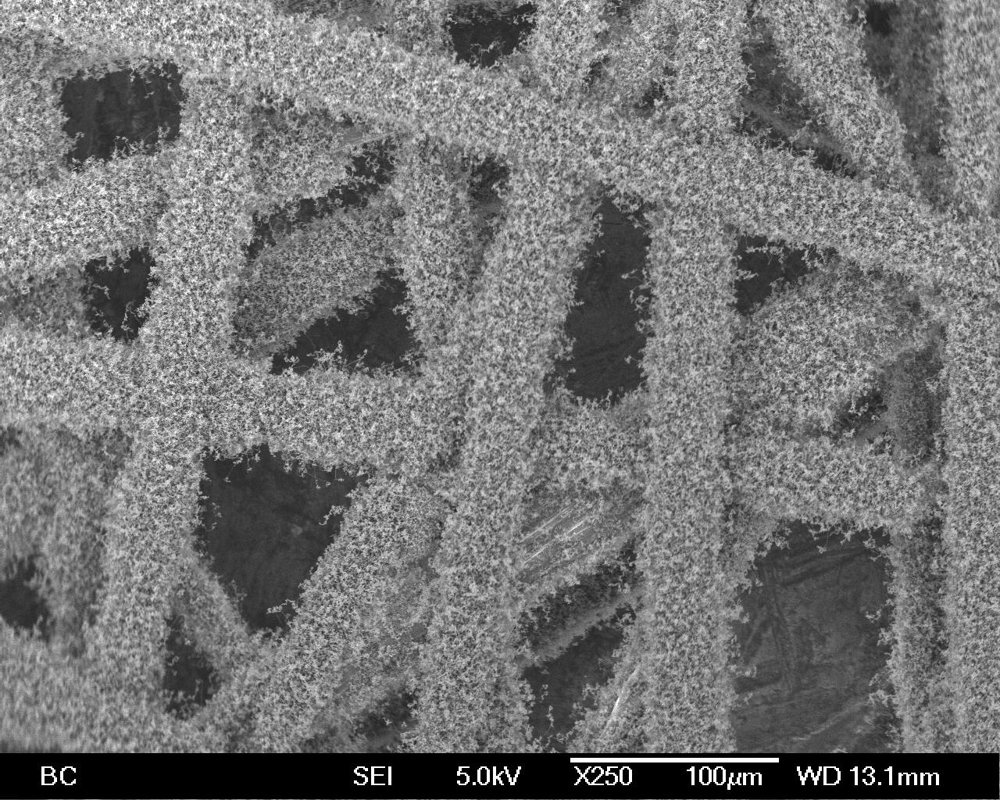
NanoLab developed Carbon Nanotube- Carbon Fiber Veil Composite material to create a highly scalable, low cost sheet form of our carbon nanotubes. We start with a carbon fiber veil, made up of 7-10 micron diameter fibers, and coat this sheet with our catalyst composition, using a low cost roll to roll process. We then use the In-Situ Growth process to grow carbon nanotubes on every carbon fiber in the nonwoven sheet. The resulting composite has a number of uses, and can be customized for particular applications. A number of stock basis weights are available, and we can also process woven carbon cloth, fibrous carbon preforms like TGPH and AVcarb papers, and metal fiber mesh with the same process. Image at right: Carbon nanotubes grown on carbon fiber mesh, using the In-Situ-Growth (ISG) process. The apparent fiber diameter is now increased from 7 microns to ~50 microns due to the nanotube coating. Properties Width: up to 10” wide Length: up to 200m rolls Thickness: 50 microns Basis Weight: CF 6.8g/m2 Basis Weight: CNT 20g/m2 Specific Surface area: 100-150 m2/g Resistivity: <20 ohm/sq Porosity (Gurley): 10-1000 s/100cm3 Wettability: Hydrophobic or hydrophillic Standard offering: Contact us for ISG veil materials Catalog CV 2 / CV 8x10 / CV 10x144 / CV 10xR Shape: Square / Rectangle / Rectangle / Rectangle Size: 2"x2" / 8"x10" / 10"x12ft / 10"xRoll thickness: ~0.05mm ± 0.05mm CNT Density: 2mg/cm2 Price: $100 / $800 / Contact us / Contact us Carbon fiber veil, before (left) and after CVD carbon nanotube growth at 10,000X, the diameter of the carbon nanotubes can now be seen. Here, the nanotubes are ~10nm in diameter, and well over 20 microns in length. Applications 1. Energy Storage The ISG carbon nanotube nonwoven veil has a high electrical conductivity and a high surface area (~100m2/g), and can be tailored for use as electrodes materials in supercapacitors, ultracapacitors, gas diffusion electrodes, fuel cell electrodes, and battery electrodes. For data regarding this material as an electrode in supercapacitors, please review the pdf file (will come soon) This material can be customized for your product development needs. 2. Composites The ISG carbon nanotube veil can make an excellent conductive top layer in composite fabrication. The nanotubes impart conductivity to the sheet, sufficient for electrostatic dissipation aka ESD, resistive heating or resistive curing of composites, or electromagnetic interference, aka EMI shielding. The veil can be infiltrated with epoxies using standard VARTM processing or simple vacuum bagging. Mechanically, the ISG carbon nanotube veil can boost fracture toughness and interlaminar shear strength of composites. For data regarding the mechanical performance of these carbon fiber veils in composites, please review the pdf file (will come soon).
CATEGORY
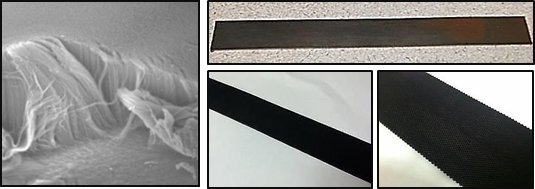
adVANTA is a vertically aligned nanotube array coating, having world class absorption across the UV, visible and infrared. It is used to coat optical components that must be non-reflective, absorbing and completely black across the visible and IR spectrum. This optical coating was developed under NASA support, (Phase II Small Business Innovative Research (SBIR) “Nanostructured Super-Black Optical Materials” (S2.02-8177)), along with a number of other materials and processes for the production of very high absorbance optical and infrared blacks. NanoLab offers two products to meet the needs of optical engineers: - adVANTA (vertically aligned nanotube arrays) and - Singularity, which is a paint-like analog of the aligned forest. How is it processed? adVANTA is synthesized in a two step process, catalyzation and growth. 1. Catalyst Deposition can be accomplished by sputtering or by a newly formulated sprayable catalyst formulation. During catalyzation, nanoparticles of iron are deposited on the surface, so that each one will nucleate a carbon nanotube. 2. CVD Processing After the part has been masked and catalyzed, it is moved to a thermal chemical vapor deposition system, where the vertically aligned nanotubes are grown. Processing temperatures are around 600C, which limits the substrates that can be used with this process. adVANTA is readily grown on metal surfaces, quartz, silicon, and others for use as beam dump coatings, black body sources, etc. For parts that cannot tolerate this temperature, we developed a transfer process where we can apply the CNT array to another part using an adhesive, like an applique' or wallpaper. This is used primarily for thermoplastic components that need this coating. What are its Properties? adVANTA has world class performance in the visible, NIR and IR (<1% reflectance from 250nm to 25 microns) exceeding the optical properties of other commercially available products like Acktar's metal velvet and Martin Black. It has passed multiple outgassing, vibration, thermal cycling and other tests to validate it for aerospace use. We have collected UV-VIS-NIR diffuse & spectral reflectance values BRDF data for these aligned arrays (aka forests or carpets). We have a full compliment of scratch & adhesion test data, along with vibration tests and outgassing rates.
CATEGORY