Product name of the predetermined data controller board for GLV/PLV products.
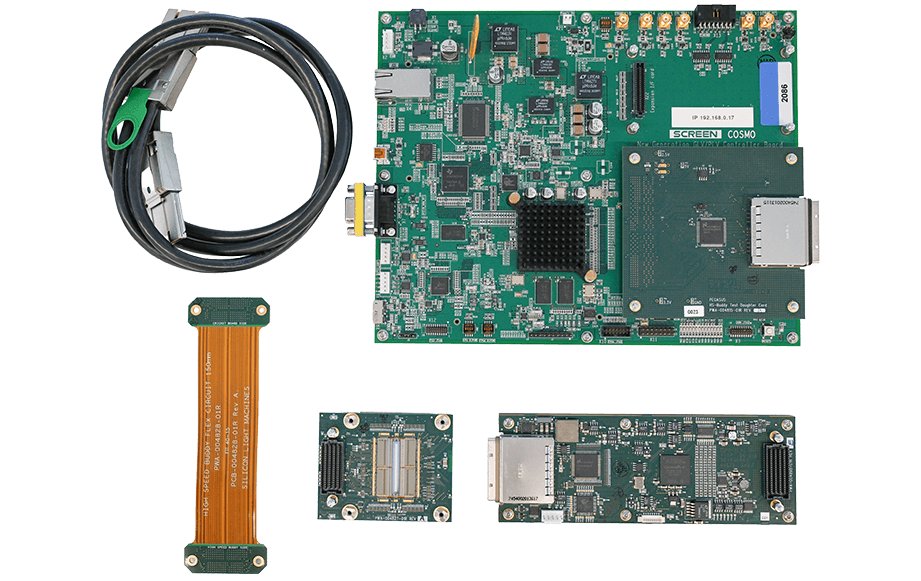
A development kit consists of the GLV® module, controller board, firmware, interface cables and operating manual. Have confidence with SLM’s development kits. Silicon Light Machines offers GLV®, PLV™, and DPM™ module development kits. Technical support is provided by email or phone. Although the development kit currently does not include optics, optomechanics or power supplies, Silicon Light Machines has application notes illustrating options for illumination and imaging. For additional information on evaluation, please contact Silicon Light Machines.
CATEGORY
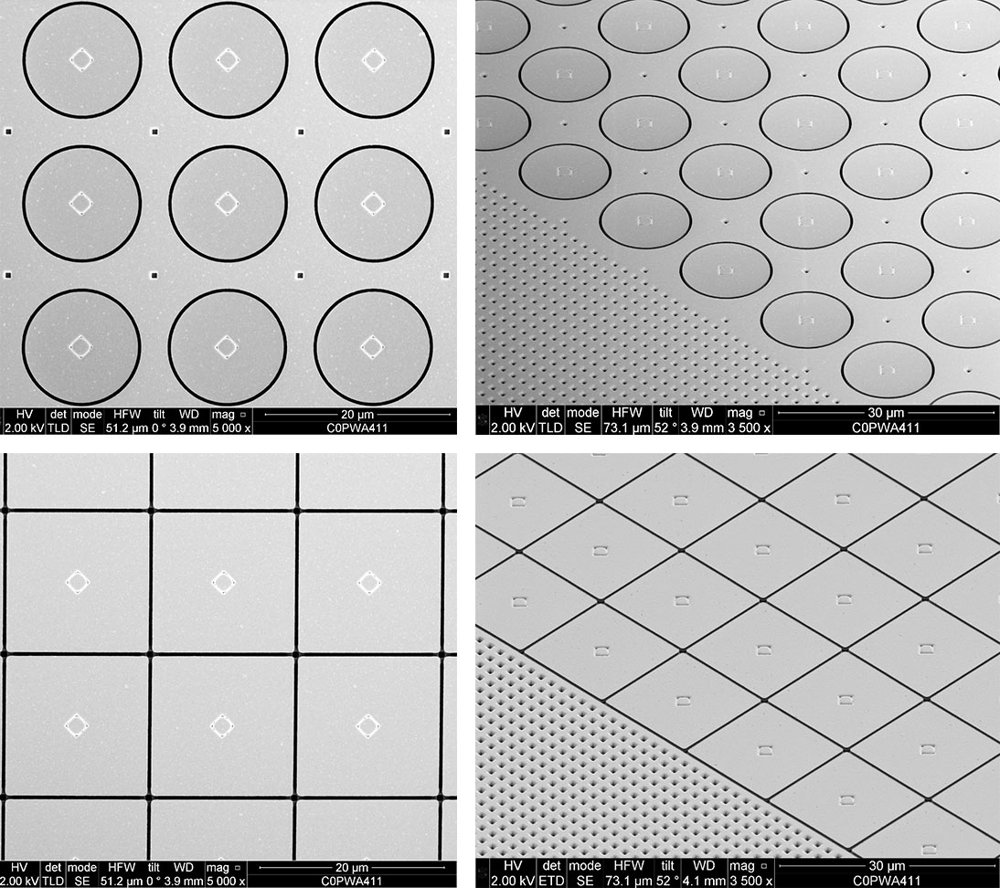
PLV ™ is a 2D version of the GLV ® spatial light modulator with a larger illuminated area and more power per pixel. Expand into New Dimensions with PLV ™ The Planar Light Valve (PLV ™ ) is a two-dimensional analog of the one-dimensional GLV ®. It inherits the desirable properties of the GLV ® (high speed, high-power handling, analog grayscale) and offers new advantages such as higher pixel counts, increased power handling, and larger étendue. Most notably, the PLV ™ removes the restriction of line illumination associated with the GLV ®. This allows the PLV ™ to be flood-illuminated, similar to conventional spatial light modulators. Principle Large aperture diffractive modulation The PLV ™ is a dual-layer MEMS composed of an exposed upper faceplate and underlying hidden flexure layer. The faceplate is patterned into a two-dimensional array of diffractive elements composed of active circular disk surrounded by an equal-area static reference surface. In the quiescent state, the active disk is coplanar with the surrounding static reference and light is reflected like a mirror. When the pixel is activated, the disk is displaced with respect to the surrounding faceplate and light scattering light into fixed diffraction angles. The PLV ™ creates images by exploiting the wave-nature of light. Light reflected active disk interferes coherently with light reflected from the surrounding static faceplate. If the active disk and surrounding faceplate are co-planar, the phase difference between reflected waves is zero (φ=0), and light is reflected like an ordinary mirror. However, if the active disks are electronically displaced by quarter-wave relative to the surrounding faceplate, the reflected waves are anti-phase (φ=π), and the specular beam is extinguished as light is scattered into fixed diffraction angles. A key advantage of the PLV ™ is its inherent analog grayscale. For intermediate phase relationships between the active disks and static faceplate (i.e. 0<φ<π), the light distribution between reflected and diffracted beams varies continuously. Thus by carefully controlling the active disk displacement, true analog grayscale is achieved. Other spatial light modulators rely on pulse-width-modulation for grayscale. However, this comes at great cost to modulation rate. The “built-in” grayscale of the PLV ™ allows deep intensity resolution with zero speed penalty. The two layer design ensures the active region does not warp with activation An SEM image showing the PLV ™ pixels Advantages More Pixels x More Power = More Throughput High Speed Due to the low mass, high tension and short stroke, PLV ™ pistons can switch in less than 500ns. This is 10x faster than MEMS tilt mirrors and 1000x faster than liquid crystal spatial light modulators. Our PLV ™ modules support refresh rates up to 250 kHz. Analog Grayscale Many spatial light modulators are binary devices: they’re either fully on or fully off. The PLV ™ is different. It is an inherently analog device, allowing intensity to be continuously varied from dark to bright according to applied voltage. Amplitude resolution is limited only by the bit-depth of the electronic driver. High Power Handling The increased optical area of the PLV ™ and its ability to accommodate flood illumination endow it with even higher power handling than the Grating Light Valve (GLV ® ). Current PLV ™ products support CW powers of up to 1 kW and pulsed laser energies of 1mJ. Increased Pixel Count Due to physical die-size constraints, 1D Grating Light Valve (GLV ® )s are generally limited to <10 4 pixels. By contrast, PLV ™ ’s can support pixel counts 10 5 by exploiting the increased packing efficiency of 2D arrays. Non-contact, High Reliability Unlike other MEMS spatial light modulators, the PLV ™ is a non-contact device and requires no lubricants inside the package. This attribute is particularly valuable in high-fluence UV applications. Borderless Pixels PLV ™ images are formed by spatially filtering the angular content of light reflected from the grating. As a result, PLV ™ images contain no dark lines between pixels. The absence of the familiar “screen door” effect results in stunning images that have been likened to “painting with light.” Resources Further information and application notes PLV ™ Technology An introduction to the Planar Light Valve (PLV ™ ), a 2D spatial light modulator that extends the capabilities of the original 1D GLV ® for new applications. Controlling the Grating Light Valve™ in Real-Time Applications Technical discussion on the methods and systems for controlling GLV ®, PLV ™, and DPM ™ devices in applications that require real-time adjustments and feedback. High Power MEMS Planar Light Valve The PLV ™ supports modulation of over 500W of laser power for materials processing. It provides a line beam with 1088 individually addressable pixels and 200kHz switching speed. A custom optical head complements the PLV ™. High Throughput Materials Processing An overview of how the Planar Light Valve (PLV ™ ) spatial light modulator enables high-throughput, multi-beam materials processing for applications like laser marking and micromachining.
CATEGORY
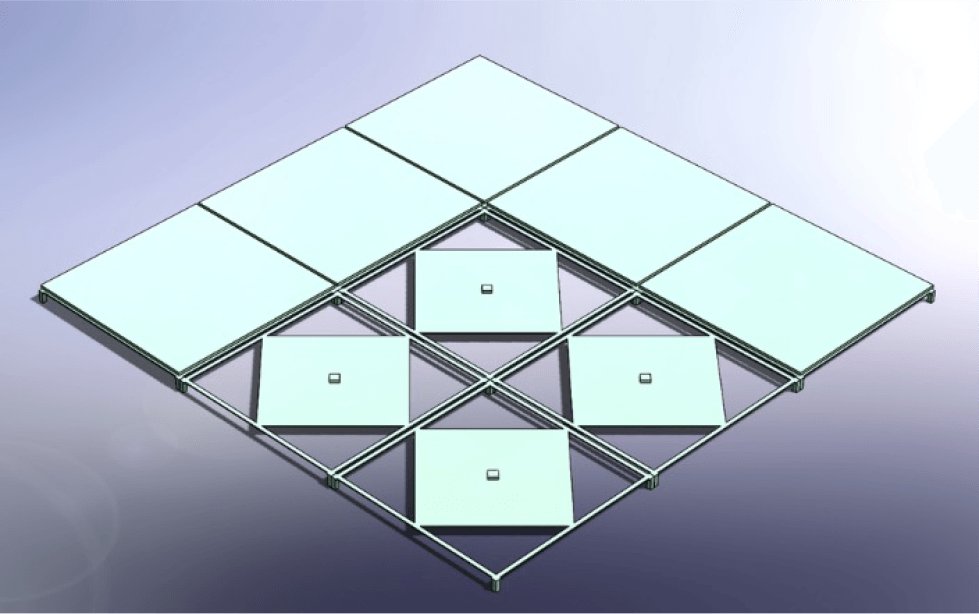
Displacement Phase Modulator (DPM ™ ) Endless Applications with Phase Modulation Increases in computing processing and new techniques for holographic control as well as other technological advancements such as increased laser power have made phase modulators more usable and more desirable for applications ranging from material processing to sensing to medical. The thin-film MEMS technology that enables the high-speed phase elements of Silicon Light Machine’s Light Valve technology is uniquely suited for creating ultra-fast phase modulators with exceptional power handling. Ribbon-based modulators 1D and piston-based 2D devices currently support UV-VIS modulation, while NIR versions up to 1550 nm are in development. Phase Modulation for Beam Forming or Holographic Control Displacement Phase Modulator (DPM™) Principle An extremely simple method of phase modulation. Silicon Light Machines’ MEMS phase modulators operate on an extremely simple method of phase modulation: piston. The 1D phase modulators are composed of electrostatically actuated ribbons while the 2D phase modulators faceplates on electrostatically actuated flexures. In either case, a reflective surface is deflected by a voltage, causing incident light on that pixel to travel further, creating a phase delay in reference to the quiescent state. Up to one half wavelength is required to create a 2 modulation at normal incident, at which point “phase-wrap” allows for full holographic control suitable for most applications. Note that additional deflection is needed at a non-normal angle of incidence because the axial phase modulation is reduced by the cosine of the angle of incidence. A = Active Ribbon 1D Phase Modulation with electrostatically actuated ribbons 2D Phase-only faceplates on electrostatically actuated flexures Advantages Speed, power, and precision for demanding applications. High Speed Due to their low mass, high tension and short stroke, the 1D phase micro-ribbons can switch in less than 300 ns. This is more than ten times faster than the DMD tilt mirrors and one thousand times faster than liquid crystal spatial light modulators. The GLV ® ’s high-switching speed facilitates high-line refresh rates typically between 250–500 kHz. The piston-based 2D phase pixel is bulkier than its ribbon cousin, but switching speeds greater than 200 kHz are still possible. High Power Handling The 1D phase modulator is made using the same robust silicon-nitride comprising the GLV ® that endows it with unparalleled power handling capability. GLV ® s have been used for years in harsh industrial applications with incident powers of 80W per device at power densities as high as 10kW/cm 2. The 2D phase modulator also has robust piston faceplates based on the same technology used in our very high-power laser processing optical heads. Analog Phase Modulation The basic piston modulation of the MEMS devices leads to natural analog phase modulation. Phase resolution is limited only by the bit-depth of the electronic driver. Drivers may be configured to offer a linearized phase-DAC response. Non-contact, High Reliability Unlike other MEMS spatial light modulators, both the ribbon and Displacement Phase Modulator (DPM ™ ) are non-contact devices and require no lubricants inside the package. This attribute has proven to be a significant form of reliability, especially in high-fluence UV applications. Broad Wavelength Possibilities While a single wavelength should be used at a time, the simple piston method of phase modulation means that wavelength range of a device is only limited by maximum deflection of the MEMS reflector. Current devices support UV through green, while red through NIR – 1550nm devices are in development. Imaging & Optics Flexible modulation techniques for precision beam shaping and wavefront control. The phase modulator may be used in many different configurations depending on the application e.g., as a programmable filter in a 4F system or as a holographic projector in a Fraunhoffer or Fourier set-up. The illumination of the 2D phase modulator is therefore dependent on the use-case and may be as simple as collimating a fiber output to match the modulator aperture to using a custom lens for purely uniform illumination. The 1D phase modulator does have a uniquely high aspect ratio, requiring line illumination. In both the 1D or 2D case, a minimal angle of incident of less than 15 degrees is recommended. Line illumination for the 1D phase modulator can be generated from laser sources by a variety of methods including a Powell lens, a DOE (Diffractive Optical Element), or a cylindrical lens. For illustration purposes, a Powell lens is shown in the figure. The circular beam from the laser is dispersed uniformly in angle in one axis. A “slow axis” collimator is then used to collimate the rays into a “top-hat” profile of uniform intensity along the phase modulating long axis. Next, an orthogonal “fast axis” cylindrical lens is used to focus the beam onto the device. Typical numerical apertures for the fast axis focus are between 0.01 and 0.1. The full width of the line illumination should be less than one third of the ribbon length (50–75 µm). A smaller waist (~25 µm) is often used to minimize lateral positioning precision at the expense of axial positioning. Example voltage-deflection curves may be provided with a modulator. These curves may be manipulated for desired phase modulation of differing wavelengths and angle of incidences by referring to the equation θ = 4π d sin(φ)/ λ; the phase delay θ is equal to 4 times pi times the deflection d times the cosine of the incident angle φ divided by the wavelength λ. Otherwise in situ calibration can be achieved by directly measuring the wavefront response using a device such as a Shack–Hartmann wavefront sensor or deflection using a confocal microscope or by measuring the intensity response of a rolling diffraction grating pattern after 4F filtering, as shown. Pixels Resources Further information and application notes Beamforming for Optical Communications A presentation on the use of high-speed MEMS phased arrays for beamforming in Free Space Optical (FSO) and Light Fidelity (LiFi) communication systems. Controlling the Grating Light Valve™ in Real-Time Applications Technical discussion on the methods and systems for controlling GLV ®, PLV ™, and DPM ™ devices in applications that require real-time adjustments and feedback. MEMS Displacement Phase Modulator for Quantum Computing Silicon Light Machines’ high-speed MEMS Displacement Phase Modulator (DPM™) is a breakthrough technology enabling scalable, precise, and ultra-fast optical control for neutral atom quantum computing applications.
CATEGORY
Features - Supports evaluation and testing of all modules - Generates multiple test patterns to the module - Custom test patterns - Configures GLV® Module parameters - Operates as master or slave for synchronization of GLV® images to user equipment Description Cosmo is a custom designed single board computer utilizing an embedded ARM processor and a FPGA. The Cosmo Board can support all GLV®, PLV™ and DPM™ Modules by selecting an appropriate daughter card. The Cosmo features a LVDS interface to send pixel data to the module at the full maximum column rate. An I2C interface allows the test board to initialize and configure the module for operation. An RS-232 serial interface allows the user to control the module with a PC HyperTerminal using parametrized ASCII commands. In addition, a USB-3 interface is provided that allows the user to download large custom test patterns to the Cosmo’s pixel memory. A GUI based “Pixel Download Tool” is available for ease of use. User Interfaces - RS-232: Provides user control using parametrized ASCII commands (115,200 baud) - USB3: For downloading user defined pixel data to Cosmo’s pixel memory - Ethernet: Allows in-the-field firmware upgrades of the Cosmo ARM processor & FPGA - Trigger In: Column and frame trigger inputs - Trigger Out: Column and frame trigger outputs - Power Input: Cosmo test board: 24 VDC Specifications - Column Rate: 350 kHz (max, module dependent) - Pixel Memory: 65k–130k columns or frames (module dependent) Application Software Allows a user to define many columns of custom GLV® pixel data in a spreadsheet (.csv format). The Pixel Download Program will read the pixel data from the spreadsheet and download the pixel data to memory on the Cosmo Test Board. ASCII commands can be used to control the sequencer on the Cosmo that reads the memory and sends the data to the GLV® Module at up to the maximum column rate.
CATEGORY
