By Insplorion
The Insplorion XNano modular instrument system provides the opportunity to study processes occuring within or on nanomaterials and at interfaces. The XNano measurement cell is very flexible and compatible with both liquid and gas phase measurements at temperatures of up to 80ºC. The integrated fluidic system simplifies sample handling and delivery, minimises sample consumption and makes the XNano especially well suited for applications within life science, polymer science, and nanochemistry. The very large dynamic range enables high sensitivity studies of processes in both thin films and at the hidden internal interface of thick surface coatings under variable conditions. The XNano product offer includes all hardware, software, support and initial training needed to get started quickly. Many different processes and systems can be studied with the XNano system. The chart lists some of the proven applications. More information, application notes and scientific references can be found on the Insplorion webpage: www.insplorion.com - True nano-scale measurements - Monitor processes in/on nanoparticles, nanostructures, and thin films in the few tens of nm size-range and at the hidden internal interface of thick films. - Suitable for any sample material - The nanomaterial to be studied can be soft, hard, metallic, ceramic, polymeric, biomolecular, porous, conducting or insulating. - Real-time analysis - Measure with sub-second temporal resolution. - Complete system - The XNano system includes Optics Unit, Temperature Control Unit, Liquid Handling System, Measurement Cell and Desktop Computer with Insplorer Control Software. - In-situ measurements - Measure in liquid or in air at select temperature. - User friendly - The XNano system design is compact, robust and easy to use. Insplorion XNano Specifications Measurement cell Volume above sensor ~ 4 μL Minimum sample consumption ~ 100 μL Typical flow rates 20-100 μL/min Materials* Titanium and Kalrez ® Temperature range Room temperature to 80ºC *Custom choices are available. Temperatures up to 250ºC can be obtained with optional configuration. Sensors Size 9.5 x 9.5 mm, 1 mm thick Substrate Fused silica Surface Nanostructured gold Standard coatings Au, Si 3N4, SiO 2, Al 2O3, TiO 2 Measurement characteristics Light source Tungsten-Halogen lamp Measured spot diameter 2 mm Time resolution Up to 10 sample points per second Typical noise <0.01 nm in wavelength Wavelength range 450-1000 nm Dimensions (Width x Depth x Height) XNano module 31 x 25 x 25 cm Insplorion optics unit 25 x 27 x 9 cm Temperature Control Unit 225 x 27 x 9 cm

Versatility is at hand. Simple, elegant and robust. The perfect instrument for biomolecular research. Insplorion S2 features a dual-channel flowcell for label-free and real-time studies of molecular interactions and surface adsorption events. The system enables true nano-scale measurements within a few tens of nm of the surface/sample interface, with perfect control over the flow of your samples and buffers. Integrated and automated fluidic handling Automated flow operation with software command queue, 6-way injection valve and syringe pump with uninterrupted flow. Integrated buffer change and flush operation. Accurate temperature control Fast and stable temperature control with a range between 15 and 45°C and fluctuations under 0.05 °C. Easy operation Samples are delivered by means of the integrated fluidic handling system, with complete user accessibility for ease of handling and accurate control. Operation is automated using the Insplorion InControl software. The one-grip removable flowcell with a separate sensor carrier tray makes day-to-day use and maintenance easy. Dual sample system Measure simultaneously on up to two samples. Equipped with a dual sample system in series, include the controls in your experiments or test two conditions at a time. Compatibility The Insplorion S2 is suitable for any biomaterial and can easily handle any different types of biosamples: – Lipids – Proteins – Nucleic acids – Viruses – Biofilms – Biominerals – Hydrogels Versatility The Insplorion S2 allows for a multitude of process analysis: – Molecular adsorption to different surfaces – Lipid bilayer formation – Temperature dependent interactions – Conformational changes – Biomolecular recognition – Biomineralization seeding – Biofilm formation – Loading and unloading dynamics
CATEGORY
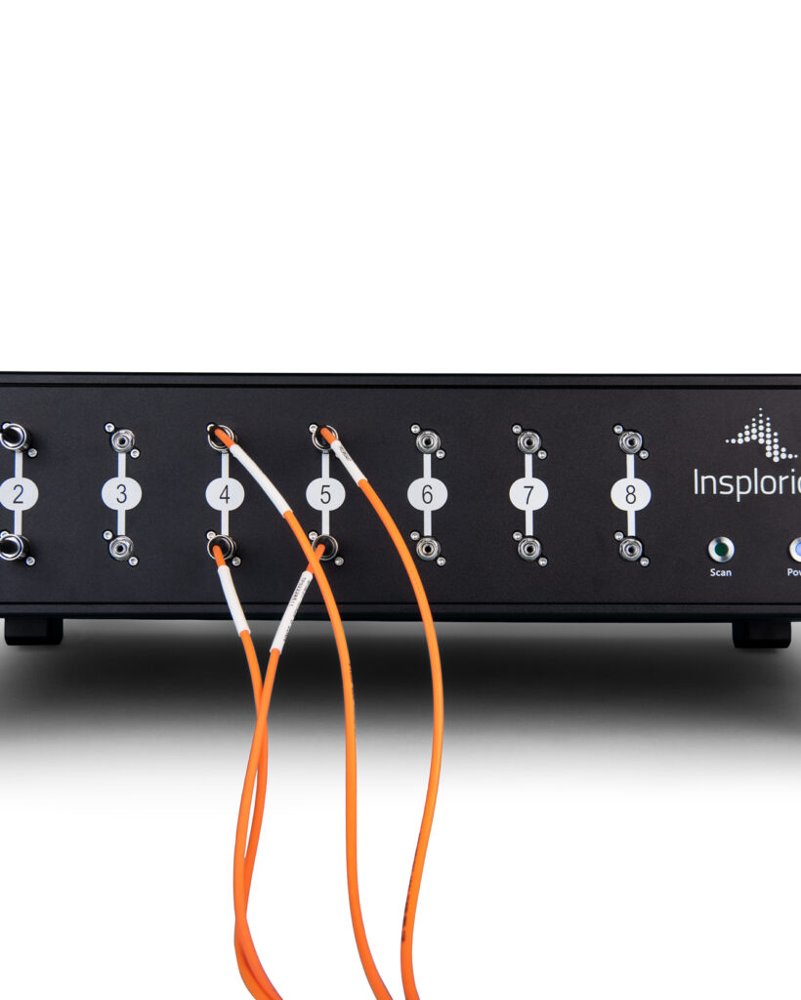
Insplorion M8: 8-Channel Analyser displays an eight-channel readout for in situ studies of materials and processes occurring inside batteries. The system allows operando measurements at nanoscale resolution. Key features The M8 system will provide an additional, optical, signal (along with the standard output I and V) that can increase the understanding of physicochemical processes that occur inside battery cells. The system can be used in hard-to-access environments, such as inside a climate chamber or in test rigs where accessing the battery cell is hard for other characterization techniques. The fiber sensors can be used in several battery chemistries and cell designs. Operando sensing capabilities Optical operando sensing of physicochemical as well as temperature changes inside battery cells, using Insplorion's NPS fiber optic sensors. Measure on up to 8 battery cells Connect up to 8 cells simultaneously for data acquisition, or equip a few cells with multiple sensors for spatially resolved measurements. Versatile compatibility Insplorion's sensors are compatible with various cell types, as well as various battery chemistries. Nanoscale optical monitoring Obtain information on battery processes and learn more about electrode surfaces and electrolytes with nanoscale resolution. Complete standalone package The Insplorion M8: 8-Channel Analyser system comprises software and rack-mountable hardware in one complete package, ready for implementation. Download the product sheet to learn more about the specifics.
CATEGORY
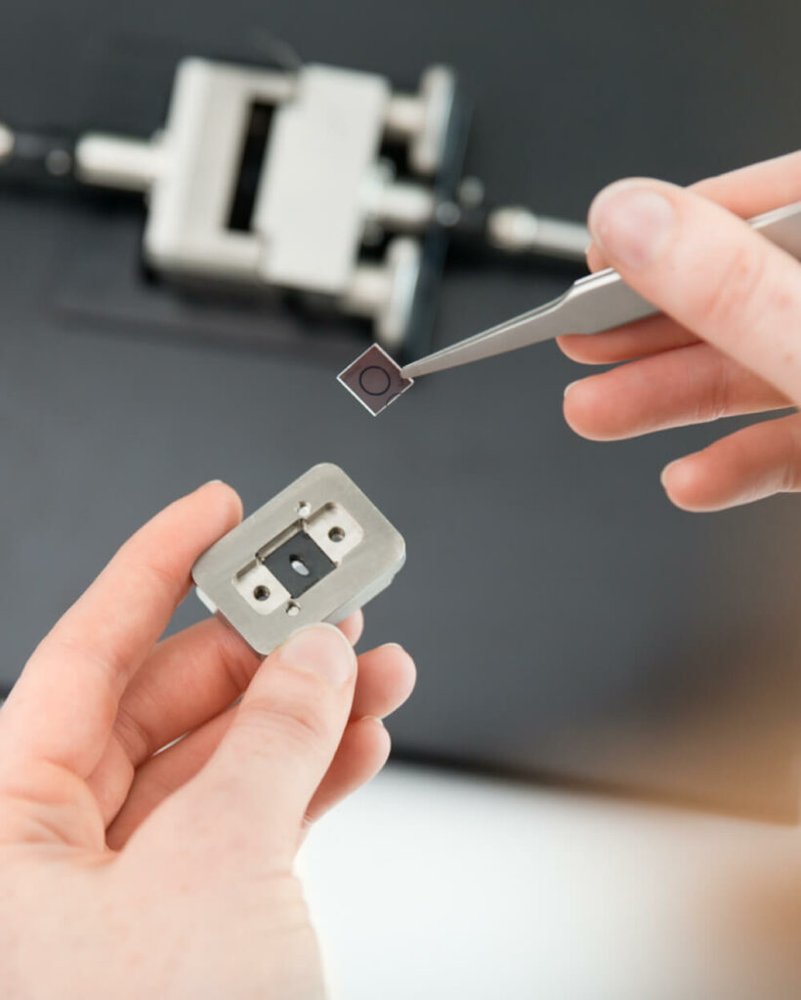
Insplorion provides nanoplasmonic sensors, which enable ultrasensitive measurements of refractive index changes close to (< 30 nm from) the sensor surface. The sensors can be coated with a range of materials, which allows studies of how surface chemistry influences processes such as molecular adsorption and thin film phase transitions. Insplorion offers also plasmonic nanostructures of various types and sizes, allowing the user to perform systematic studies of how surface processes are influenced by the surface topography/structure. Surface processes Get a better understanding on surface chemistry, structure, molecular adsorption as well as the structure and composition of adsorbed layers. Different sensor surfaces are available A variety of sensor coatings is available, providing the possibility to tailor the surface chemistry. Tailored to your needs On Insplorion's standard sensors, the nanostructures are normally made of gold but other metals are available upon request. Different nanoplasmonic structures are also available. Robust and reproducible Insplorion's nanostructured sensors are produced in a state of the art clean room facility, which guarantees stability, reproducibility and well controlled surface chemistry. Download the product sheet to learn more about the specifics.
CATEGORY

O2 independent operates without oxygen, eg. in inert environments Highly specific to H2 detects H2, even in presence of other gases Optical readout sensor can be separated from electronics Fast response enables quick action Key features: - Fibre optic based NPS detection - Ultrafast detection, demonstrated t 90<1s - 8 channels - Carrier gas: Air or oxygen depleted environments (e.g. N 2, Ar), combustible gases - Sample rate: 1 Hz - Control software: Insplorion M8 Control and Acquisition software Application examples: - Hydrogen aircrafts - Pipeline monitoring - Industrial installation, distributed detection
CATEGORY
