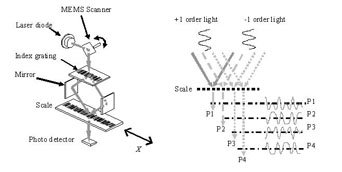
NanoWave's Scanning Probe Position Encoder (SPPE) technology offers many advantages over other encoder technologies. Even laser interferometers and capacitance sensors are unable to match the resolution and performance specifications on an SPPE. Scanning Probe Position Encoders (SPPEs) are, in some ways, similar to other non-contact, reflection-based, optical encoders. Laser light is projected onto a diffraction grating used as a measuring scale. The reflected light is collected in the encoder head and converted via a photo diode cell into one or more electrical signals for further processing. The most important principle of an SPPE is that the laser light is oscillated rapidly (i.e., scanned) with very small amplitude on the grating scale. The direction of the scanning is the same as the direction of the measurement of interest. This creates a high-frequency modulated signal, even when there is no motion. When motion does occur this modulated signal undergoes phase shifts and changes in shape (please watch the video of the actual signal coming out of our SPPE-1000 head). After Analog-to-Digital conversion (at a rate ranging from 50 to 200 MHz), position information is extracted from this complex signal using NanoWave's proprietary signal processing algorithms. These algorithms are implemented in firmware in a high-speed FPGA in our SPPE products to insure low latency and high signal bandwidth. These algorithms employ a phased locked loop and examine the higher harmonics and phase changes in the received signal. Therefore, SPPEs are insensitive to drifts in the light intensity and other noise sources at lower frequencies. The FPGA environment also provides flexible digital filtering mechanisms for effective noise elimination at higher frequencies. Compared with conventional two phase output position encoder, SPPE thus produces a single phase output for the position detection. This enables superior interpolation error (linearity) since fine adjustment of the signal amplitude, DC offset, exact 90-degree phase difference between the two phase output signal is no longer necessary. This in tern allows the usage of the low cost and durable scale selection. There is, of course, a trade-off between resolution (defined as RMS noise) and signal bandwidth governed by the inherent noise spectrum of the opto-electronic system. This is true in any encoder. However, because the laser light is scanned at high-frequency (~ 200 KHz) and even higher speed digital electronics processing the signal, SPPEs can attain both superior signal bandwidth and superior resolution, while also tracking motion at high velocities and accelerations due to its patented multi-frequency synchronous phase tracking position detection. The output of the FPGA is a 40-bit word (parallel or serial) representing the position measurement. In effect, the algorithms in the FPGA serve as both interpolator and counter. It also provides for clock synchronization with the customer's servo controller for fast and accurate motion control. These design principles enable high-performance at low cost, since very few components are involved and since larger pitch gratings can be used to attain very fine resolutions. For instance a grating with a 5 micron pitch can be used to attain resolutions as fine as 10 picometers. This contrasts other technologies that require gratings with ~500 nanometer pitch (10 times smaller) to attain resolutions on the order of 50 to 100 picometers (when examining the noise level).
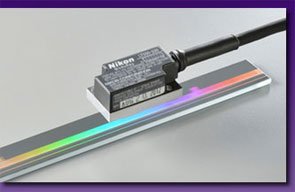
The Nikon ModuRay™ Series of Encoders Nikon's new ModuRay series of encoders represent an exciting new milestone in encoder technology. Both the encoder heads and the scales contribute to their excellent performance. If accurate and stable position information, with easy setup and maintenance, are important to the performance of your product, then you really should investigate the new ModuRay series encoders from Nikon. What Makes the ModuRay Encoders Different? The patented technology of the ModuRay series encoders eliminates the traditional problems of sine/cosine interpolation because the output of each encoder is a single waveform that contains both position and direction information. The output signal is not sensitive to amplitude variation, dc offset or noise at most frequencies. Encoder output signal contains both position and direction information Nikon's proprietary scale technology provides uniform placement of grating lines, with minimal variation, both over short ranges and over the full length of the scale. Because the line spacing and line width are extremely uniform, Nikon achieves high resolution via a patented interpolation scheme, rather than by using a fine pitched grating, with its associated problems. Each encoder head contains two sensing mechanisms, arranged to provide cancelation of "common mode" error sources such as expansion due to temperature. The ModuRay Product Line ModuRay encoders form a product line, with different models achieving different levels of performance. The top of the line model, LT800, achieves the industry's best resolution and repeatability, lowest noise and jump error, and excellent temperature stability. Other models achieve lower levels of performance in one or more of these areas, with commensurate lower price. Scales are available as long as 500mm and as short as 20mm. ModuRay encoders are available with the BiSS interface, which is rapidly becoming an industry standard. Alternatively, we can easily provide a custom interface to your motion controller. Advantages of the ModuRay Encoder Series The overall superior performance of the ModuRay Encoder is determined both by the uniformity of the lines on the scale and the interpolation technique. Exceptional Uniformity Nikon's expertise in lithography creates scales with exceptionally good uniformity, resulting in random error, called Jump Error, far below what has previously been available. Extraordinarily High Resolution The error within the scale pitch, called Interpolation Error, is determined by the interpolation technique, and Nikon uses a patented interpolation technique to achieve extraordinarily high resolution with very low error. The noise immunity of the interpolation technique also produces an output that is exceptionally stable and repeatable. Easy Setup and Maintenance Compared to other scales, the ModuRay scales are insensitive to oil films and can be easily cleaned, when necessary. Setup is also easy, because the allowable yaw is more than twice that of other high performance encoders. Unsurpassed Repeatability The noise immunity of the interpolation technique also produces an output that is exceptionally repeatable.
CATEGORY
model LT800 Performance Data and Typical Values Interpolation Error <1nm measured over the 2 μmoptical pitch Jump Error <1nm measured over any 1mm segment Repeatability, 3 σ 100pm measured 10,000 times, over 1 second Warm Up Drift <40nm 20 min. after power up, from a cold start Specifications Scale Accuracy at 20ºC (after linear comp.) 0.3μm/300mm Resolution 3.8pm Digital resolution Maximum Speed 500mm/s Maximum Acceleration 30m/s 2 Scale Length 120-520mm Tc of Scale 0.47ppm per degree C Index position accuracy 0.1μm 3σ All models are RoHS compliant. IEC Class 1M laser product.
CATEGORY
