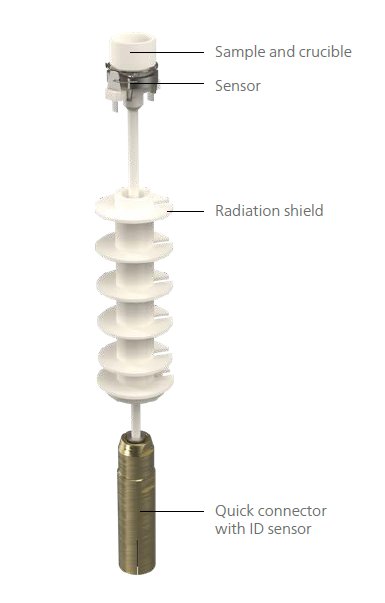
Simultaneous Thermal Analysis generally refers to the simultaneous application of Thermogravimetry (TGA) and Differential Scanning Calorimetry (DSC) to one and the same sample using a single instrument. The advantages are obvious. For a single sample, the TGA and DSC signals can be obtained under perfectly identical experimental conditions, including: - Atmosphere - Gas flow rate - Vapor pressure on the sample - Heating rate - Thermal contact with the sample crucible - Sensor radiation effect, etc. Furthermore, sample throughput is improved as more information can be gathered from each test run. DSC Possibilities - Melting/crystallization behavior - Solid-solid transition - Glass transition - Oxidative stability - Specific heat capacity - Degree of crystallinity - Cross-linking reactions - TM-DSC - Kinetics simulations TGA Possibilities - Mass changes - Decomposition - Oxidation/reduction behavior - Temperature stability - Compositional analysis - Corrosion studies - Kinetics simulations TOP-LOADING DESIGN FOR FREE AND SAFE ACCESS ADVANCED MICROBALANCE FOR ACCURATE TGA RESULTS HIGH-PERFORMANCE DSC SENSOR FOR RELIABLE AND PRECISE RESULTS LARGE AUTO SAMPLER AND COUPLING OPTIONS FOR HIGH EFFICIENCY AND ANALYTICAL DEPTH VACUUM-TIGHT DESIGN FOR DEFINED ATMOSPHERIC CONDITIONS FAST THERMAL CONTROL VIA SOPHISTICATED FURNACE Explore the STA 319 Jupiter: Furnace heater Furnace Furnace water cooling Sample carrier Sample holder lifting device Balance Purge gas sample Thermostatic control balance Protective gas balance chamber Gas outlet Sample and crucible Sensor Radiation shield Quick connector with ID sensor Innovative Design. Uncompromised Precision – the New DSC-TGA Sample Carrier The STA 319 Jupiter DSC-TGA sample carrier features a reference ring design that replaces the conventional reference crucible. This design simplifies handling, provides a stable thermal reference point, and improves measurement consistency, resulting in more reliable experimental outcomes. Innovative Balance Design for Reliable Results Achieve outstanding accuracy and reproducibility with a top-loading microbalance that delivers a 20-ng resolution as well as clean and stable baselines. During sample loading, the balance is automatically decoupled via the hoisting mechanism, reducing mechanical influence on the microbalance and preventing potential damage. Robust and Fast-acting Furnace The low-volume furnace enables rapid heating and ballistic cooling from 1100°C to room temperature, saving time and improving efficiency. Magnetic Shock Absorbers in the Device Base The standard feet on the STA 319 Jupiter series can be optionally replaced with a patented magnetic levitation system (Patent DE 10 2020 007 279 B4; US 11,747,176 B2) that effectively shields the instrument from external disturbances such as vibration. This feature provides reliable results that are unaffected by environmental impact. Technical Specifications Design Top-loading Instrument interface Touch display Temperature range (10°C) RT to 1025°C/1100°C Heating rate 0.001 K/min to 300 K/min Cooling time - In nitrogen: ≈ 12 min from 1100°C to 100°C - In helium: ≈ 5 min from 1100°C to 100°C, ≈10 min to 25°C Max. sample weight/measuring range 2 g Balance resolution 20 ng TGA accuracy 0.0003% DSC accuracy ± 5% Temperature resolution 0.001 K Temperature accuracy ± 0.3 K (after calibration by DSC/c-DTA, indium) Temperature precision 0.15 K Temperature calibration - DSC/c-DTA, also for detection of endo- and exothermal effects - TGA calibration - Curie calibration Vacuum-tightness < 10 -1 mbar AutoVac Automatic evacuation and refilling of purge gas; optionally available when MFC is selected Gas control (optional) - Gas switch - integrated 3-fold MFC - integrated 4-fold MFC Evolved Gas Analysis Optional 192+12-position ASC Optional Piercing device Optional Unlimited Warranty Optional
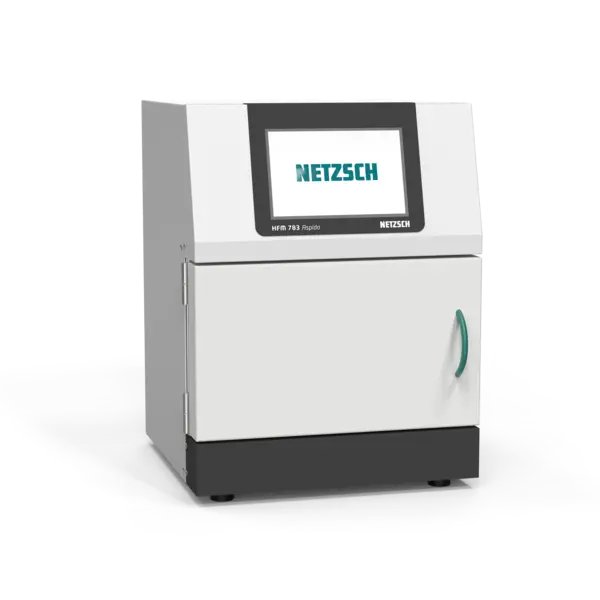
Thermal Conductivity Analysis. Reliable. Cost-effective. Efficient characterization of insulation materials — Heat Flow Meter HFM 783 Aspida Every material has unique insulation and Thermal Conductivity properties. With the NETZSCH HFM 783 Aspida, you can obtain meaningful data on the thermal properties of your insulation materials. Designed for quality assurance and research, the HFM 783 Aspida lays the foundation for developing more efficient insulation materials. This helps minimize energy consumption and create sustainable solutions for industry. - Cost-effective solution to use the HFM measurement technology - Fast results: Measurements take as little as 15 minutes, depending on the application - Precise and reliable data for materials with low Thermal Conductivity - Versatile, standards-compliant applications: Suitable for a wide range of insulation materials in accordance with ASTM C518, ISO 8301, etc. - User-friendly operation: Even under demanding conditions, the system ensures simple touchscreen operation, efficient use of measurement methods, and high data storage capacity. - Wide range of applications: Its compact design and simple sample preparation allow for precise measurements on samples up to 300 mm in side length and a temperature range from -10°C to 70°C.
CATEGORY
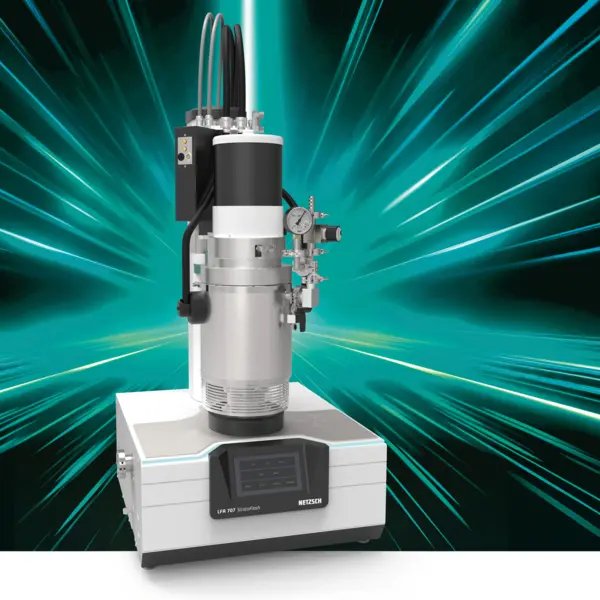
Powerful Laser Flash Analysis LFA 707 StratoFlash® Classic — High-Precision Thermal Diffusivity Measurements up to 1600°C Set a new standard in Thermal Diffusivity analysis with a system designed ideal for the metal, glass, and ceramics industries. Measure up to 1600°C with confidence: Achieve fast, precise Thermal Diffusivity results even under extreme conditions. Increase throughput with automation: Analyze up to five samples automatically under identical conditions for consistent, time-saving workflows. Adapt to any sample type: Flexible holders support solids, liquids, powders, and complex composites for ultimate application versatility. Simplify your data analysis: Advanced calculation models provide perfect curve fitting and intuitive, reliable evaluation. Designed for high-performance thermal analysis, the LFA 707 StratoFlash® Classic combines precision, efficiency, and flexibility — making it the ideal solution for modern research and quality control.
CATEGORY
Objective Results Right After a Measurement AutoEvaluation is the industry’s first fully self-operating evaluation system for TGA and DSC measurements, setting a new benchmark in thermal analysis. It automatically detects and analyzes key events, including mass changes, endothermic and exothermic reactions, DTG curves, and peak temperatures, without requiring user input. Results are displayed in real time after each measurement, and there are flexible options to customize detection settings and visualization. AutoEvaluation empowers both beginners and experienced professionals to achieve faster, more reliable results with ease by combining speed, accuracy, and unbiased analysis.
CATEGORY
