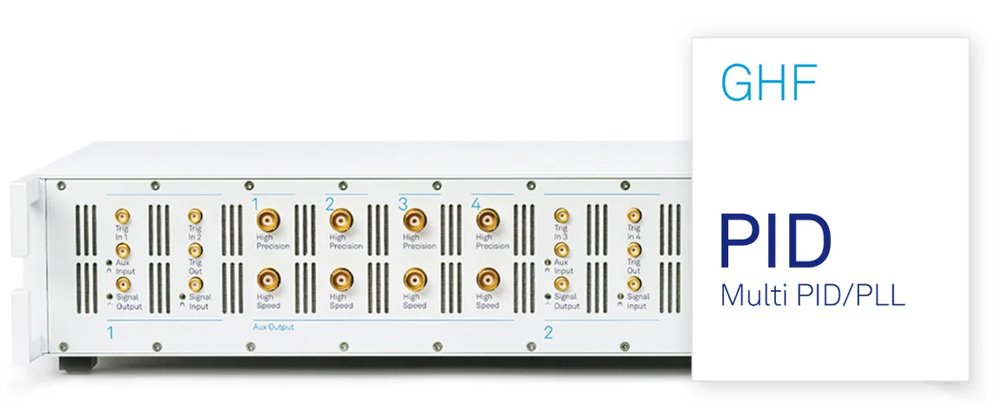
Multi-Channel Measurement Control and Timing Hub The Zurich Instruments VHFLI Lock-in Amplifier is a very high-frequency, multi-channel lock-in amplifier providing industry leading performance and functionality. Key Features Frequency Range: DC – 50 MHz (200 MHz with the VHF-F200M) Fast demodulation time constant Low input noise floor Up to 6 output and 6 input channels, served by up to 8 independent oscillators and demodulators LabOne ® instrument control software for easy setup of complex workflows Applications The VHFLI serves the most demanding applications requi-ring generation, measurement and tracking of periodic si-gnals up to 200 MHz. Applications include characterization and control of devices and materials such as: - Optics & photonics - Electronic devices and sensor development - Nanotechnology, surface and materials science - Scanning probe microscopy: AFM, STM, MFM Your Benefits Reduce complexity at a competitive price point: one instru-ment to analyze, generate & control periodic signals from DC up to 200 MHz. Easily set up multi-channel measurements for both current and voltage. Keep your system running: avoid recabling with a built-in analysis toolset including Scope, Sweeper & Spectrum Ana-lyzer, and more. Use All Analysis Tools Simultaneously Orchestrate CW and pulsed measurements schemes: co-ordinate triggering, generation and acquistion with the Lab-One Timeline Module. Conveniently automate your setup: the instrument is the timing hub of your experiment to synchronize external de-vices. Unlock fast-moving phenomena thanks to short time cons-tants & high data throughput. Increase confidence in your data with clear software work-flows. Expand the reach of your experiment with upgrade options such as PID/PLL controllers, AWG and more. Ease of integration: API support for LabVIEW™, MATLAB ®, C,.NET and Python. Specifications Signal Inputs and Outputs Number of input channels 2 voltage (differential and single -ended) and 2 current Frequency range DC – 50 MHz DC – 200 MHz (with VHF-F200M) Impedance 50 Ω or 10 MΩ Input voltage noise floor ≤ 3 nV/ √ Hz > 30 kHz Input current noise floor ~ 50 fA/ √ Hz @ 1 kHz Dynamic reserve 120 dB Input ranges voltage ±5 mV to ±2 V Input ranges current 10 nA to 10 mA Number of output channels 2 voltage (differential and single -ended) Output ranges ±5 mV to ±5 V Demodulators No. of demodulators 2 dual-phase (8 with VHF-MD) No. of oscillators 2 (8 with VHF-MD) Continuous data rate 2 MSa/s (max) Triggered data rate 25 MSa/s (max) Time constant 14 ns – 21 s Demodulator BW 3.2 mHz – 11 MHz Filter slopes (dB/Oct) 6, 12, 18, 24 Auxiliary & Others Auxiliary Outputs 4 Channels, ±100 mV to ±10 V, > 30 MHz Auxiliary Inputs 2 Channels, ±100 mV to ±10 V, > 150 MHz Triggers 2 inputs, 2 outputs Clock (in/out) 10 MHz or 100 MHz Connectivity USB 3.1 (USB-C), LAN 1Gb General Dimensions 32.5 × 44.5 × 10 cm (with handle), 19-inch rack compatible Power supply AC: 100 – 240 V, 50/60 Hz Weight 6.3 kg
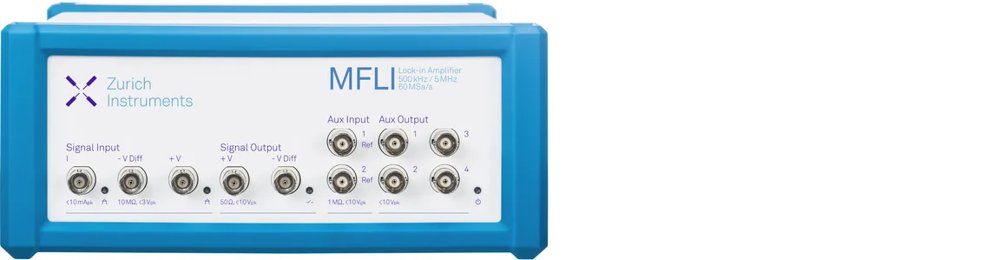
Zurich instruments’ lock-in amplifiers are ideal instruments for measuring the amplitude and phase of periodic signals from a large variety of optical experiments, covering the range from elementary to cutting-edge experimental designs. Thanks to their low input noise and large dynamic reserve, they can detect minute signals and achieve large signal-to-noise ratios (SNRs) quickly and reliably. Each instrument is equipped with a set of advanced measurement tools, such as an oscilloscope, a parametric sweeper, a spectrum analyzer, and more,allowing you to characterize your optical signals more comprehensively. Additionally, if an analog interface to other instruments is needed — for example, a control voltage for laser cavities or delay lines — internal measurement results or other customizable signals can easily be routed out from the instruments via the auxiliary output connectors. This toolset, together with several field upgradeable options, expand the functionality of the instruments well beyond lock-in amplification,making them a perfect fit for the demanding requirements of many applications. Each of these functionalities can be controlled through LabOne®,a proprietary software of Zurich Instruments.This platform-independent instrument control tool provides users with a powerful and intuitive user interface, together with support for the most popular programming languages. These features make Zurich Instruments' lock-in amplifiers extremely versatile, allowing them to be tailored to any experimental setup, reducing experiment complexity and decreasing the time to publication. Explore higher frequency domains of your optical experiment with high noise rejection and faster measurements: with signal inputs up to 8.5 GHz, Zurich Instruments’ lock-in amplifiers cover a wide range of modulation techniques and applications. Carry out multiple tasks in parallel with one instrument: for example, you can simultaneously perform lock-in detection and boxcar averaging on the signal from the photodetector while running a PID/PLL control loop to stabilize your laser cavity. The parallelization of several experimental aspects allows you to achieve results more efficiently and quickly. Ease of integration: thanks to our APIs (LabVIEW, MATLAB, Python,.NET, C), swiftly connect your lock-in amplifier with all the elements, e.g., delay lines and/or modulators, in your experimental setup.
CATEGORY
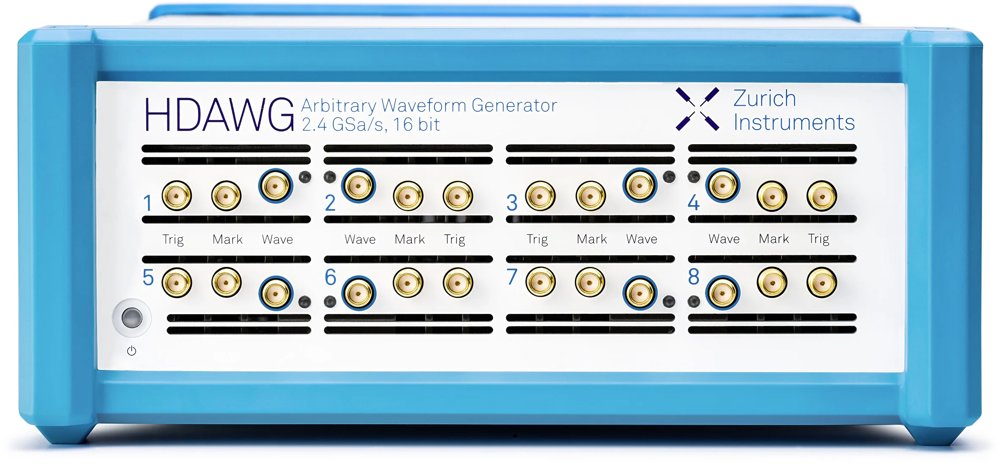
The HDAWG multi-channel Arbitrary Waveform Generator generates the fast pulses for the metallic gates which are used to control the QD energy levels and couplings and to drive the two-qubit gates. To counteract the effect of cross-coupling, additional pulses are applied to multiple gates. The HDAWG is able to modulate the microwave source in order to produce single-qubit gates. Different qubits can be addressed with frequency multiplexing. A single-sideband modulation scheme, in conjunction with the internal oscillators, suppresses unwanted images and facilitates a clean spectrum. Experience accurate spin control and enhanced fidelity, also for fast qubits, thanks to the fast and low-noise HDAWG outputs.
CATEGORY
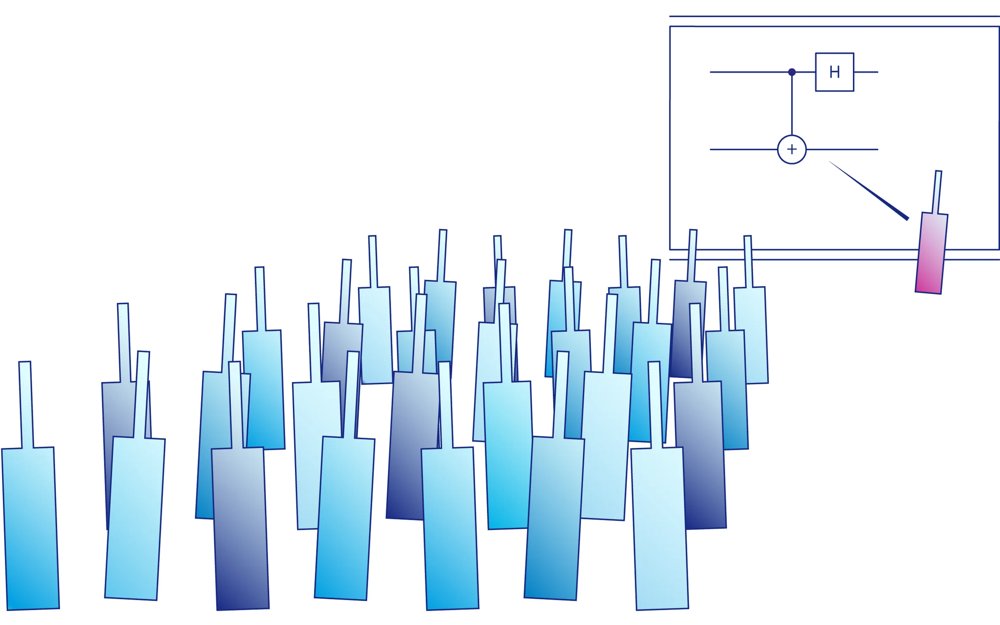
Operation from DC to 8.5 GHz 1 GHz bandwidth free from mixer calibration High output power for short qubit gates
CATEGORY