By 4Spin
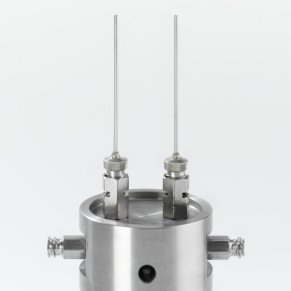
This emitter is most commonly used in the initial development and testing of nanofiber layers composed of two different materials. Each fiber in the structure of the resulting material is composed of one or the other material dispensed. Needle technology facilitates maximum spinnability. The main features: Very high spinnability Component connection using the Luer Lock® system Medium Throughput (typical dosing of 10 µl/min) Compatibility with Hamilton needles – gauges from 10 - 34 Comes with 2 Hamilton needles of gauge 17
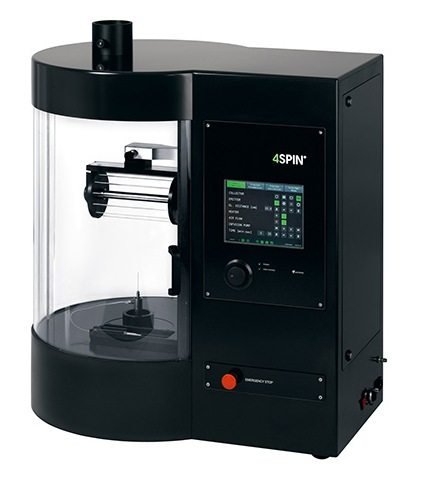
The Contipro 4SPIN LAB is a desktop electrospinning machine used in the nanofiber production and the preparation of nanofiber layers from solutions of biopolymers and synthetic polymers. It is a highly modular device composed of specially designed components. Selected process parameters are completely controlled by a central control system with intuitive handling based on a touch screen and multi-functional button. The 4SPIN has a large transparent circular chamber making the user experience so comfortable for daily use, no cables or clutter in the chamber, no leaning over your lab bench dealing with a small poky cabinet. The emitters and collectors are of the highest quality. Real time monitoring of temperature and humidity. Data logging to a PC. High voltage to 60 kV. Touch screen display with multiple user logins. These additional settings of process parameters significantly expand the opportunities for experimentation offered by the device and play a significant role in the creation and formation of fibers, as well as in the attainment of the required morphological parameters of the materials prepared. Main Functional Characteristics - electrospinning and electrolowing with the setting of a high voltage up to 60 kV - automatic configuration of collector distance, automatic discharge of residual charge - regulation of the flow velocity and air heating with electroblowing - monitoring and measurement of conditions during the nanofiber production process - easy-to-grasp intuitive control with the option of saving data to a PC - integrated dispensing system with the possibility of inserting syringes with varying volumes of solution - precise configuration of rotating collector speeds to affect the degree to which nanofiber structures are aligned - unique fiber collecting mechanism – the capacity to generate 3D structures that can be used for the development of scaffolds for biomedical use - see the full specifications here
CATEGORY
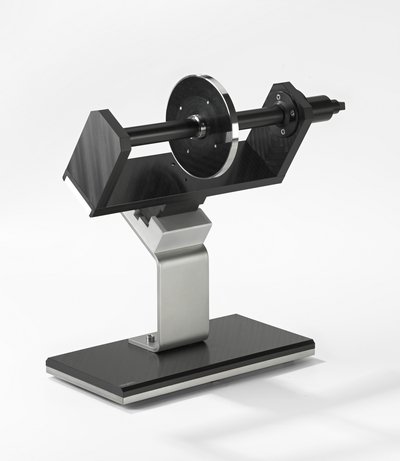
Nanofibers prepared by electrospinning typically have randomly oriented fibrous structure. They have large surface-to-volume (or weight) ratio and excellent porous characteristic, which have shown enormous potential in diverse applications. However, electrospun nanofibers are often prepared in the form of randomly orientated fibrous web, which are fragile and difficult to be tailored into fibrous structures with a larger diameter. A yarn electrospinning method which uses the rotating thin disc collector can be used to convert newly electrospun nanofibers directly into a yarn. This shape offers new possibilities for future applications. The C7 Rotating Thin Disc collector is a 12cm disc available in different width sizes. The 0.1 mm disc or ‘sharp edge’ produces yarns, the sides of the disc are made from plastic so only the edge is conductive and connected to zero potential of the power source. The discs are FIXED on the holder and are NOT removable, so if you need a different width size you will need to purchase a whole new unit. The Thin Discs come in the following sizes: 0.1 mm, 2 mm, 5 mm and 10 mm in width. The disc can rotate at speeds from 10 to 5000 rpm. At higher rotation speeds the fibers are highly uniform and aligned. The C7 Rotating Thin Disc is the best used to produce small highly homogenous samples. As a result, nanofibers deposited on the wheel edges are assembled in a high degree of fiber alignment due to the rotation of the wheel and limited width. Fibers are more concentrated on the narrow electrode than in the case of a cylinders C3, where fibers fly sideways as well and thereby also lose directivity. The main features: High degree of fiber alignment at high revolutions Higher fiber concentration on the smallest surface thus shorter deposition time and cost saving One parameter optimization (linear surface velocity) High thickness homogeneity Possible yarn production
CATEGORY
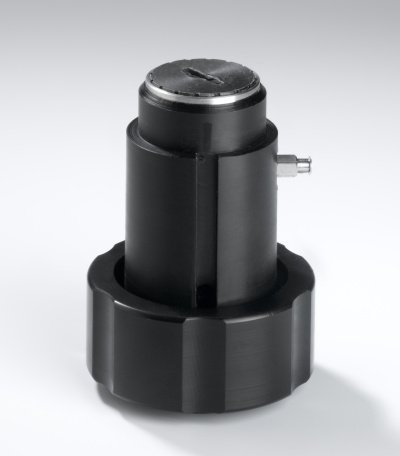
The design of the needleless multi-jet is unique. It uses internal distribution channels to feed a relatively large amount of spinning mixture to the thin edge of the conductive electrode. Numerous droplets are formed around the circular perimeter, from which a large number of fibres are created. The main advantage of this emitter is its tremendous productivity combined with high spinnability. The closed dosing system means that the parameters of the solution and the resultant material remain constant throughout the process. This emitter is used after the optimization of solution and material properties, when the stress is on maximum throughput and the preparation of large-weight samples in the shortest possible time. The E4 emitter can also be accompanied by an air duct feeding air at a controlled temperature and throughput to the area immediately around the droplet (electroblowing). The main features: Good spinnability Component connection using the Luer Lock® system Simple construction – Needleless system Very high throughput (typical dosing 150 µl/min) Electroblowing ready Patented
CATEGORY
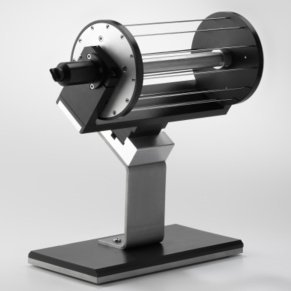
The C4 rotating collector is composed of thin wires arranged longitudinally and at the same distance from the axis of rotation. When the collector is rotated at very low speeds, fibers are also deposited between the conductive wires; the principle for the creation of aligned fibers is the same as in the case of the C2 static patterned collector. At higher speeds, electrostatic and mechanical forces are combined, increasing the degree of alignment of the individual fibers. To achieve very good fiber alignment, the collector speeds can be much lower than those of the rotating drum collector C3. In this case, the sample size is limited. The main features: Sample size up to (23 x 25) cm2 Very high degree of fiber alignment at high revolutions Ready to be used with collecting sliding tool Two parameter optimization (linear surface velocity and void gap size) The stainless steel wire gap size is fixed and non-removable (C4 options: 20mm, 40mm, 60mm and 80mm) A Sliding Tool in these sizes is an optional extra and can be used for collecting your sample.
CATEGORY
