CIPT probes are state-of-art MEMS devices consisting of 12 in-line gold-covered probe fingers (electrodes), each only ~10 µm long and 700nm or less in width. The very small scale of these probes allows for very gentle contacts, and makes them ideal for local (micro scale) electrical measurements Four different types of probes are available (with mean spacing ranging from 0.75 µm to 59 µm ). Upon request we can always design a probe that meets the requirements for your specific experiment. All CIPT probes are also available on a ceramic carrier which fits into Capres tools. Please note that the ability to establish electrical contact with the sample greatly depends on the sample surface. The contact force is generally too small to penetrate an oxide layer, therefore samples should be capped with a non-oxidizing conductor or a metal which forms a conductive oxide (Pt and Ru for example).

This probe features an AFM-type cantilever with a sharp pyramidal tip composed of four freestanding silicon nitride nanowires coated by conductive material. The nanowires form an electrical cross junction at the apex of the tip, addressable through the electrodes integrated on the cantilever. The cross junction on the tip apex can be utilized to produce heat and detect local temperature changes or to serve as a miniaturized Hall magnetometer enabling, in principle, thermal and magnetic imaging by scanning the probe tip over a surface.
CATEGORY
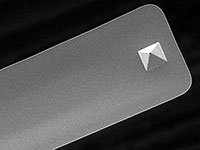
Scanning microscopy probes with a fluidic microchannel directly incorporated into an AFM-type cantilever allow controllable, local dispensing and aspiration of liquid through a submicron aperture at the probe tip. Our microfluidic probe can be used for various applications ranging from nanopatterning, ion conductance microscopy, patch clamp measurements, direct cell injection, cell staining and cell adhesion.
CATEGORY
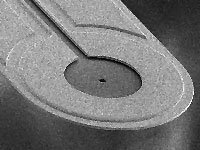
A drastic reduction of friction (superlubricity) on a scanning probe tip can be achieved by electrostatic force modulation. A novel AFM probe with an electrostatic circular membrane actuator monolithically integrated at the end of the cantilever allow an improved control of force excitation and consequently a more stable small-amplitude oscillation, which is essential for reduced friction.
CATEGORY
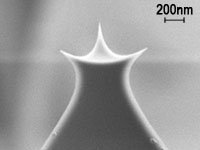
Scanning rates of the atomic force microscope (AFM) could be significantly increased by integrating the force sensing probe with microelectromechanical systems (MEMS). We present a micromachining method for batch fabrication of in-plane AFM probes that consist of an ultra-sharp silicon nitride tip on a single crystal silicon cantilever.
CATEGORY
