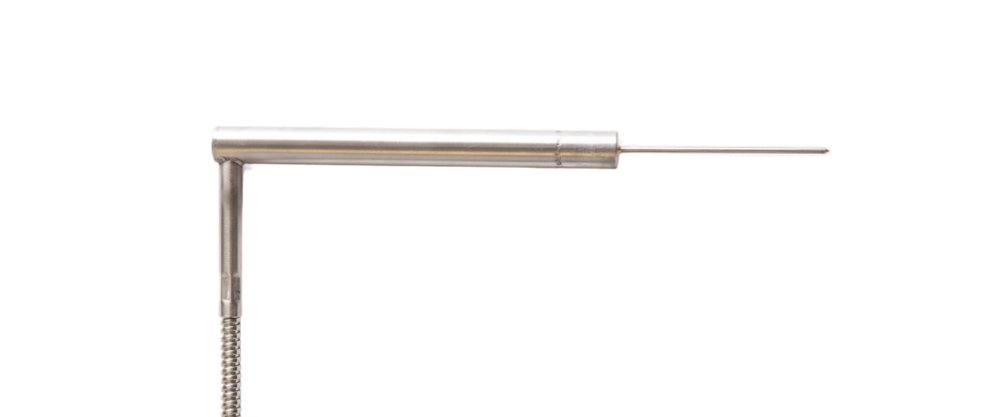
The ATC simplifies elevated-temperature thermal conductivity testing by automating temperature management and enabling precise measurements from room temperature to 300°C through seamless integration with the C-Therm Trident™ platform. ATC Specifications Dimensions - Exterior (Width x Depth x Height): 12.5" x 14.75" x 13.75" 31.8 cm x 37.5 cm x 34.9 cm - Exterior Lifted (Width x Depth x Height): 12.5" x 14.75" x 21" 31.8 cm x 37.5 cm x 53.3 cm - Sample Cell (Diameter x Height): 1.98" x 5" 5 cm x 12 cm - Approx. Unit Weight: 29.5 lbs / 13.4 kg Compatible C-Therm Trident Test Methods - Modified Transient Plane Source (MTPS) - Transient Plane Source (TPS) - Transient Line Source (TLS) - Transient Hot Wire (THW) Temperature Range - Room temperature to +300°C Operation – Heating/Cooling - Sound Intensity: Less than 65.3 dBa as measured 5 feet from ATC during cooling. - Heating Element: Insulated heating cartridge integrated into instrument core. No exposed heating elements. - Cooling Element: Circulating air. Operation – Lifting Enclosure - Control: Up/Down buttons on the side of the chassis. - Locking: Lock button on the side of the chassis unlocks the lifting controls. Above 60°C, the lifting enclosure will lock automatically. Frequently Asked Questions What temperature range does the ATC support? The ATC supports a temperature range between room temperature up to 300 °C. Can the ATC enclosure be raised while at an elevated temperature? No, the ATC enclosure automatically locks when the sample cell temperature reaches 60 °C. Are the heating elements exposed within the ATC sample cell? No, the ATC uses cartridge heaters integrated within the walls of the sample cell. How does the ATC cool the sample cell? The ATC uses a fan intake and circulating air for cooling. Does the ATC require a C-Therm Trident™ Thermal Conductivity Instrument to operate? Yes, the ATC integrates with the sensors of the C-Therm Trident™ Thermal Conductivity Instrument and requires the instrument to perform automated thermal conductivity measurements. What is the desktop footprint of the ATC? The ATC has a 1193 cm 2 desktop footprint, with a height of 34.9 cm when lowered and 53.3 cm with the enclosure raised. For reference, the Trident™ Thermal Conductivity Instrument has a desktop footprint of 853 cm 2.
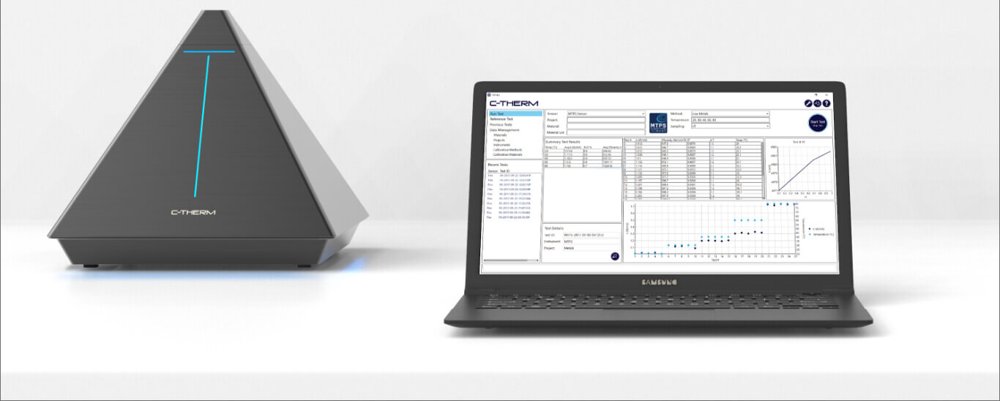
The C-Therm software is developed for the Trident system to control all 4 sensor types. The software is highly user-friendly and easy to navigate. It provides full data acquisition and analysis in one software.
CATEGORY
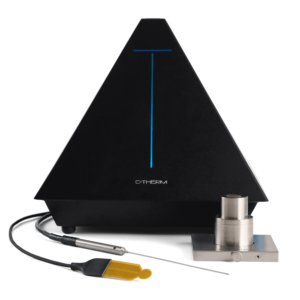
TCi Thermal Conductivity Analyzer Please note: Information is provided for archival purposes – visit our Trident™ page for information on C-Therm’s current product line in thermal conductivity instrumentation. Simply put - the fastest, easiest way to measure thermal conductivity. Fast, Accurate Testing 0 to 500 W/mK in seconds No Sample Preparation Unlimited sample sizes Wide Temperature Range -50º to 200ºC (Standard Sensor) NEW: Option to expand temperature range to 500 ºC Versatile Tests solids, liquids, powders and pastes and have the flexibility to operate in various environmental enclosures Easy-to-Use No calibration required Non-Destructive Leaves sample intact Highly Flexible Designed for lab, QC, and at-line testing Methods Modified Transient Plane Source (Conforms to ASTM D7984) Transient Line Source (Conforms to ASTM D5334, D5930 and IEEE 442-1981) Applications Platform Technology with Broad Application As a solution provider, C-Therm collaborates with researchers and corporations in numerous sectors to address specific challenges. The chart below offers a perspective on the breadth of applications, materials and roles C-Therm’s innovative technology can address. - C-Therm offers a range of high pressure cells to safely characterize the thermal conductivity of samples under elevated pressure environments up to 2000 PSI (~138 bar). - The fastest, easiest way to accurately measure the thermal conductivity of solids. - Test the thermal conductivity of liquids and powders with the small volume test cell. - Characterize the thermal conductivity of polymers. - Easily measure the thermal conductivity of metals such as stainless steel. - Measure the thermal conductivity of liquids by inverting the sensor in the provided 50 ml beaker (pictured) or with the SVTK. - Suitable for testing a wide range of sample materials; including solids, liquids, powders and pastes. - C-Therm TCi C-Therm’s innovative, thermal sensor technology is designed and applied to solve problems in a wide range of areas, including: - Assessment of thermal characteristics – accurately evaluating the thermal properties of materials, such as insulation or heat dissipating compounds for use in electronics - Accelerating R&D – speeding the development and scale up of products and formulations, such as pharmaceuticals, through rapid testing and real time results - In-process monitoring & control – online effusivity testing as a proxy determinate of quality and consistency of products during production - Material screening – checking incoming raw materials and finished goods for homogeneity - Inspection of inaccessible areas – “looking” through layers of a material or composite to reveal internal characteristics that would otherwise require disassembly or destruction of the sample to access - Service life monitoring – determining and monitoring the service life of critical materials, such as lubricants, to ensure they have not deteriorated beyond the required specifications Specifications Test Methods Modified Transient Plane Source (MTPS) Thermal Conductivity Range 0 to 500 W/mK Thermal Effusivity Range 5 to 40,000 Ws½/m²K Test Time 0.8 to 3 seconds Minimum Sample Testing Size 0.67″ (17mm) diameter Maximum Sample Testing Size Unlimited Minimum Thickness Nominally 0.02″ (0.5mm), dependent on thermal conductivity of material Maximum Thickness Unlimited Temperature Range -58º to 392ºF (-50º to 200ºC) With option to extend to 500ºC Precision Better than 1% Accuracy Better than 5% Extra Hook-ups Required None Software Intuitive Windows®-based software interface Easy export to Microsoft Excel® Additional functionality offers indirect, user-input capabilities for a number of other thermo-physical properties including: - Thermal Diffusivity - Heat Capacity - Density Input Power 110-230 VAC 50-60 Hzd Certifications FCC, CE, CSA International Standards Conforms to ASTM D7984 NASA (Sector: Aerospace) We purchased the C-Therm TCi Thermal Conductivity Analyzer after seeing a demonstration of how fast and easy it is to operate. The instrument provides unequivocal results and provides the flexibility to test powders and liquids. In terms of our satisfaction with the purchase. I'd give it a 10 out of 10 - extremely satisfied. Dr. Enrique Jackson Outlast Technologies (Sector: Phase Change Materials) The TCi is housed in our Golden facility and does most of the heavy lifting for our LHS® industrial product development and production QC for standard thermal conductivity measurements. The machine has been working fine. Mark Hartmann, Chief Technology Officer 3M Taiwan (Sector: Textiles) We use TCi extensively for our product development and to analyze products available on the market. TCi provides fast and accurate results. We are very confident in this instrument. Wayne Chen Accessories Controlling environmental factors during testing is critical to gaining meaningful, repeatable and comparable thermal conductivity results. With C-Therm’s line of accessories, precise control of temperature, compression, pressure and humidity is possible – with a wide range of accessories available. - Thermal Chamber - Liquid Cell - Compression Test Accessory - High Pressure Cell - Reference Materials Thermal Chamber The TCi offers users the flexibility to operate the sensor in various environmental enclosures (including thermal chambers and glove boxes). C-Therm recommends the Tenney Jr. Thermal Chamber and offers the product as an available accessory with the TCi Thermal Conductivity Analyzer. The thermal chamber can be controlled through the TCi software. Temperature Range: -73°C to 200°C Interior Dimensions W x D x H (inches): 16 x 11 x 12 Exterior Dimensions W x D x H (inches): 37 x 22.5 x 30.7 Crating Dimensions W x D x H (inches): 47 x 33 x 41 Cabinet Type: Standard Door Electrical Power: 115V-120V 1 Phase 60 Hz Amp Draw: 16 KW: 0.5 kW Liquid Cell Your perfect accessory for testing liquids. The Small-Volume Liquids Test Cell was originally developed with the US Navy Surface Warfare Division specifically for testing energetic emulsions and powders. The effectiveness of the accessory in reducing convection effect on testing samples make it ideal for characterizing the thermal conductivity of liquid samples regardless of the viscosity. The Liquids Test Cell is commonly applied in testing nano and heat transfer fluids, as well as emulsions. ( Note: does not include sensor or sensor base – sold separately.) Compression Test Accessory The Compression Test Accessory (CTA) is engineered and designed to enable users to precisely control the level of compression or compaction of a sample in characterizing the material’s thermal conductivity. The CTA is ideal for applications in the fields of advanced textiles, fabrics and thermal interface materials (TIMs) where representative thermal conductivity data requires precise control over the sample’s compaction. The CTA is compatible with solids, pastes, greases and powder sample formats. High Pressure Cell C-Therm offers a range of high pressure cells to safely characterize the thermal conductivity of samples under elevated pressure environments up to 2000 PSI (~138bar). C-Therm’s HPCs are popular with researchers in the Oil & Gas, Nuclear and Fuel Cell industries. Reference Materials As an option, C-Therm can provide a NIST (National Institute of Standards and Technology) Standard Reference Material for verifying the accuracy of the system. SRM 1453, Expanded Polystyrene Board. How the TCi Thermal Conductivity Analyzer Works C-Therm's TCi system offers fast and accurate measurement of the thermal conductivity of materials. The MTPS high precision method is the simplest and most versatile transient method. Modified Transient Plane Source (MTPS) Simple and Precise. The MTPS method employs a single-sided sensor to directly measure thermal conductivity and effusivity of materials. The MTPS method has the highest precision, highest sensitivity, shortest test time, and is the easiest to use among all three techniques. Principles of Operation TCi’s primary sensor employs the Modified Transient Plane Source (MTPS) technique in characterizing the thermal conductivity and effusivity of materials. It employs a single-sided, interfacial heat reflectance sensor that applies a momentary constant heat source to the sample. Typically, the measurement pulse is between 1 to 3 seconds. Thermal conductivity and effusivity are measured directly, providing a detailed overview of the heat transfer properties of the sample material. How It Works - A known current is applied to the sensor's spiral heating element, providing a small amount of heat. - A guard ring surrounds the sensor coil to support a one-dimensional heat transfer into the sample. The applied current results in a rise in temperature at the interface between the sensor and the sample, which induces a change in the voltage drop of the sensor element. - The rate of increase in the sensor voltage is used to determine the thermal properties of the sample. The voltage is factory-calibrated to temperature. The thermal conductivity is inversely proportional to the rate of increase in the temperature at the point of contact between the sensor and the sample. The voltage is used as a proxy for temperature and will rise more steeply when lower thermal conductivity materials (e.g. foam) are tested. Conversely, the voltage slope will be flatter for higher thermal conductivity materials (e.g. metal). With the C-Therm TCi, tabular thermal conductivity results are reported in real-time making thermal conductivity measurement fast and easy. No regression analysis is required.
CATEGORY
C-Therm's High-Pressure Cell for TPS - For measuring the thermal conductivity of metal hydrides as a function of pressure.
CATEGORY