By Nanomade
After connecting the sensor to the electronic board and the USB cable to the electronic board and to the computer, you can open the software folder from the USB key. In this key you will find the user manual, the Windows drivers, and the software in the file NANOMADE_DEVKIT. Double click on "UI_WIN_DEVKIT-CPF" to launch the software. The software opens on this screen recognizing the card under the name "COM6 - Silicon Labs". If you have more than one DevKit connected at the same time, a drop-down list will be available to choose which one you want to use. Click on "Connect" to go to the next step. Calibrate the sensors by clicking on the "Calibrate" button. You will then arrive at the main control panel. The software recognizes whether you have connected one or more unit sensors, a matrix or both. On this screen, the three main possible actions appear: You can adjust the gain of your sensors by a drop-down menu between 1 and 128. You can set the touch threshold between 1 and 8 and finally you can save the raw data on your PC. - The force gain: you can select a value between 1 and 128; a higher value will increase the signal magnitude; the force variations depends on the properties of the material between the finger and the sensor and have to be tuned accordingly of it. - The touch threshold: This is the activation threshold of the capacitive sensor. For sensors integrated in the PMMA: since the matrix and the units do not have the same thresholds, if only units are connected, the Touch threshold is set to 5 and FORCE gain to 8. If only one matrix is connected, the Touch threshold is set to 4 and FORCE to 16. If both are connected, by default these are the thresholds of the matrix. When you have set the parameters to the desired values, start the test by pressing the "Start" button. If you wish to adjust the values of these parameters you will have to stop the measurement with the "Stop" button, change the parameters, and then restart it. If you make any changes to the ZIF connectors (i.e. connect/disconnect one or more sensors) it is imperative to recalibrate the software by clicking on the "Calibrate" button. You can navigate between observing the behaviour of matrix and unit sensors. In general, the colour of the active sensor(s) varies from green to red depending on the pressure applied for the matrix sensor. For unit sensors the percentage will vary accordingly to the gauge scale. In the window dedicated to the unitary sensors, only the connected ZIF terminals are active. You can change the full scale of the gauge for each unit sensor. Set its value in mV under each gauge. To save the raw data of your tests, check the dedicated box before starting them. A window will open to save the excel file in the folder of your choice. Note that the raw data is filtered to arrive at the recordable.raw file. The excel file consists of 32 columns each indicating the force or capacity values of the different sensors. They are each referenced. Columns M_F_1 to M_F_8 indicate the force values of the 8 active zones in the matrix. The columns U_F_1 to U_F_8 indicate in the same way the force values of the 8 unit sensors accordingly to their ZIF port number. If a sensor is not active (or not connected) its force value is fixed at 3299 throughout the test. Columns M_C_1 to M_C_8 indicate in a binary way the capacity value of the active zones of the matrix. Finally, columns U_C_1 to U_C_8 indicate the capacity values of the individual sensors. The software integrates an error detection system for using the development kit.
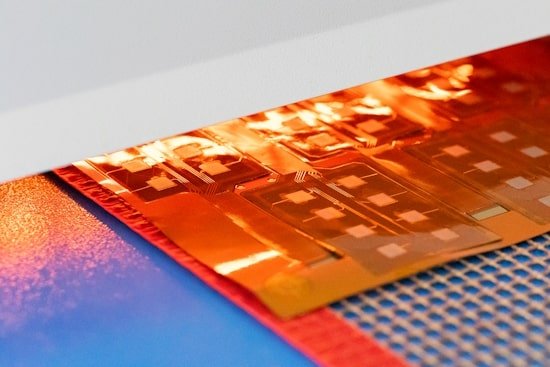
Ultra-sensitive deformation sensors. A thin, printed sensing layer that detects the slightest deformation and turns it into precise touch and force data, on any surface. Physical principle. Nanomade has developed a unique nanoparticle ink, coated onto a patented support fitted with conductive electrodes. As the ink evaporates, the nanoparticles settle evenly across the surface. A microcurrent triggers a quantum tunnel effect: the slightest nano-deformation changes the spacing between particles, causing an exponential shift in resistance. The result: tactile pressure sensors with unmatched sensitivity, the most sensitive in the world. Sensor structure. Nanomade strain sensors consist of a proprietary conductive ink containing nanoparticles deposited between interdigitated conductive electrodes on an insulating flexible substrate. Sensor characteristics. - Ultra-sensitive (10gf over 0.7 mm aluminium plate) - Ultra-thin (0.2 mm) - Flexible - Transparent Designed around your product. Every Nanomade sensor is custom-designed: size, shape and number of active zones are tailored to each client’s application. Whether it’s a curved surface, a narrow frame or a large panel, the sensor fits the product’s geometry and delivers exactly the features and gestures it needs, from a simple button to sliders and multi-zone controls. Integration principle. Our sensor’s strain-active zone detects micro-deformations of the material, turning the lightest touch into a precise pressure reading. Nanomade sensors are bonded directly to the back of the surface, hidden from view. When a finger presses on the front, the material bends by just a few microns. The sensor’s strain-active zone picks up these micro-deformations through the material and turns them into a precise touch and force reading. No cutouts, no openings, no change to the visible surface: the material stays intact and seamless, while gaining a fully interactive layer underneath.
CATEGORY
Structure monitoring: see stress before it becomes failure Nanomade deformation sensors detect the smallest deformations and impacts on a wide range of materials, from metals to carbon fiber. They give engineers real-time insight into the health of critical structures, so stress points and early signs of wear can be addressed before they become hazardous. Deformation Impact Easy integration, built for harsh conditions Our sensors install on existing structures without major modifications, making them ideal for retrofitting. They withstand temperature variations and humidity to deliver consistent performance in demanding environments. More coverage, less weight With flex lengths of up to 10 meters, our sensors reach remote areas such as the tip of an aircraft wing, with no electronics needed nearby. A single sensor can carry up to 250 active zones on an A5-sized surface, replacing multiple sensors and reducing installation complexity and the weight of electronics. Applications across industries In aerospace, our sensors track stress on wings to detect wear early. In construction, they monitor buildings for structural shifts due to weather or aging. In automotive, they help ensure the durability of critical components under dynamic conditions. Across all sectors, they help prevent failures, optimize maintenance and extend the lifespan of assets.
CATEGORY
Pulse: non-intrusive health monitoring Nanomade health sensors detect the micro-deformations of the human body to monitor key physiological parameters in real time: heart rate, respiratory rate, posture and more. Placed beneath up to 10 cm of memory foam, they need no contact with the skin. Heart-rate & variability Respiratory-rate & variability Actigraphy & Posturography Stress level detection How it works Using ballistocardiography (BCG), our sensors capture the tiny body movements caused by each heartbeat. Advanced signal processing and machine learning turn these signals into reliable, actionable health insights. Seamless integration Pulse fits into smart beds, office chairs or car seats, enabling continuous monitoring without disrupting daily life, such as tracking heart rate variability and stress overnight. From healthcare to the road Pulse supports remote patient and elderly care, helping medical teams and families follow vital signs remotely. In the car, it turns the seat into a driver monitoring system: it tracks heart rate, breathing and stress with no camera or wearable, so the vehicle can detect early signs of fatigue or a health issue and alert the driver. It also opens new wellness experiences, such as stress-aware massage beds or premium seating that adapts in real time.
CATEGORY

Robots are now expected to handle more tasks, objects and environments, with both strength and precision. Yet conventional force sensors saturate under heavy loads and lose the sensitivity needed for light or fragile items. Robotics needs force sensing that stays accurate across the full operating range. - Wide sensing range: Measure heavy loads without saturating. - Sensitivity at every load: Detect fine interactions, even under strain. - Adaptive grip: Adjust force to each weight and shape. - Continuous feedback: Real-time contact data, not snapshots. - Precision & safety: Combine strength with delicate handling. One technology, every form factor. Fingers, grippers, hands or full-body skin: our sensors conform to complex geometries and integrate where your robot needs to feel. Thin and flexible, Nanomade sensors conform to fingers, grippers, wrists or joints, even on complex surfaces. They integrate directly into the robot’s structure, preserving its mechanical design while turning it into a sensing surface.
CATEGORY
