Starfire Systems is pleased to announce the release of a new poly-carbosilane polymer system. SMP-750 is a valued addition to the family of SiC forming pre-ceramic polymers. This new system will build on the proprietary chemical process Starfire Systems uses to create its flagship product SMP-10 and will offer customers additional processing options for their high temperature requirements. SMP-750 is a hot-meltable poly-carbosilane precursor that transforms into thermally stable silicon carbide (SiC). SMP-750 is very viscous at room temperature but flows at moderate temperatures (>100°C) and cures at or above 200°C to form a thermoset solid. Cured SMP-750 can be fired in an inert environment to form an amorphous SiC at temperatures up to 1200°C. Conversion to a crystalline and nearly Stoichiometric SiC can take place at temperatures above 1450°C. A film can be produced from SMP-750 and can be used to produce fabric impregnated cloth (pre-preg) for composite fabrication. Additional fillers are not recommended to be added to SMP-750.
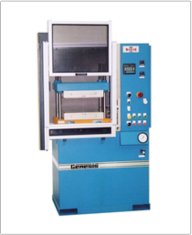
In order to press cure Starfire polymer systems, heated hydraulic presses are used. A single platen press with caul plates or a multiple-platen press can be used to fabricate multiple laminates simultaneously, or heated compression mold tooled presses can be used. Typical pressures required to press 2-D laminate structures are 250 psi (+/-50), and 650-1,000 psi (+/-100) for compression molding. Typical temperatures required for cure are 300°C (maximum) or less depending on the catalyst and resin selection, with ramp rates of as high as 5°C/min for heating, and 10°C/min for cooling. For compression molding operations, a press which has capability to "push" and "pull" is advantageous, but not required. Better than 0.001" out of flatness is suggested for high quality composites and thickness variation better than 0.002" is suggested for any platen press. (http://www.wabashmpi.com/index.htm)
CATEGORY
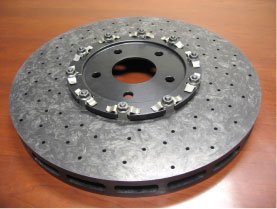
Pyrolysis of Starfire polymer is accomplished in standard ceramic kilns capable of flowing inert gas, such as Nitrogen or Argon, at atmospheric pressure. Programmable heating ramp rates must be 1-3°C/min with a maximum suggested temperature capability of 1,200°C. A high temperature internal can, or retort, is required to maintain inert gas environment, and must have a temperature capability of 1,250°C. Stainless Steel can be used if temperatures 1,000°C (maximum) are to be achieved, and inexpensive high nickel steels such as 309, or 310 are also suitable to achieve 1,200°C maximum pyrolyzing temperatures. A standard kiln volume of 10 ft3 is standard choice for pyrolysis of small volume programs. L&L Kilns supplies all kilns used by Starfire Systems. (http://www.hotkilns.com/index.html)
CATEGORY
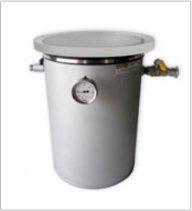
Vacuum infiltration of blanks is conducted in vacuum vessels rated to <0.5 torr. A vacuum pump capable to pump at up to 15cfm for a volume 5.5 ft 3 is required to maintain vacuum. Each vessel must have a valved tube inlet to introduce polymer, a valved tube exhaust to connect to the pump, and a pressure gage to verify vacuum levels have been achieved. It is also helpful for large vessels to have a valved drain to support polymer removal. (http://www.lacotech.com/)
CATEGORY
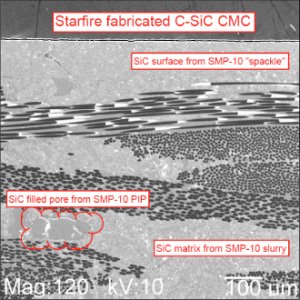
These proprietary Starfire® Systems polymers are our original technology and yield near stoichiometric SiC ceramics when converted. They are our highest strength polymers, thermally stable to 2500°C +, and available in new, hot melt versions. Starfire's advanced technology offers a polymer route to near stoichiometric silicon carbides, delivering the benefits of SiC ceramic composites without the sintering and machining challenges. Our polymers form a high-strength green part with cure temperatures as low as 200°C and then form SiCs with nanoscale grain sizes as low as 800°C. Highlights: - Ability to mold complex, near net-shaped ceramic composite components - Features a low temperature green cure - Ceramic is formed using low cost furnaces - Nanoscale ceramic grain yields tough parts - Products are flexible – they feature low viscosity for infiltration or hot melt for layups - Materials are lightweight, corrosion resistant, and temperature resistant - Materials increase friction while reducing wear Applications: - SiC ceramic matrix composite components - Infiltrate low cost preform for enhanced performance - Suitable for a variety of structural, thermal, or friction uses
CATEGORY
