By Universal Display Corporation
The standard approach for manufacturing a small molecule OLED, including a PHOLED, is based on a vacuum thermal evaporation, or VTE, process. With a VTE process, the thin layers of organic material in an OLED are deposited in a high-vacuum environment. An alternate approach for manufacturing a small molecule OLED involves solution processing of the various organic materials in an OLED using techniques such as spin coating or inkjet printing onto the substrate. Solution-processing methods have been in development for over 15 years. There are a number of challenges with this method, including the ability to meet the pixel performance required for commercial specification. For several years, we worked on P2OLEDs under joint development agreements with Dupont Displays and then Seiko Epson Corporation. If solution printing process does become commercially viable, our P2OLED phosphorescent materials are available for use.
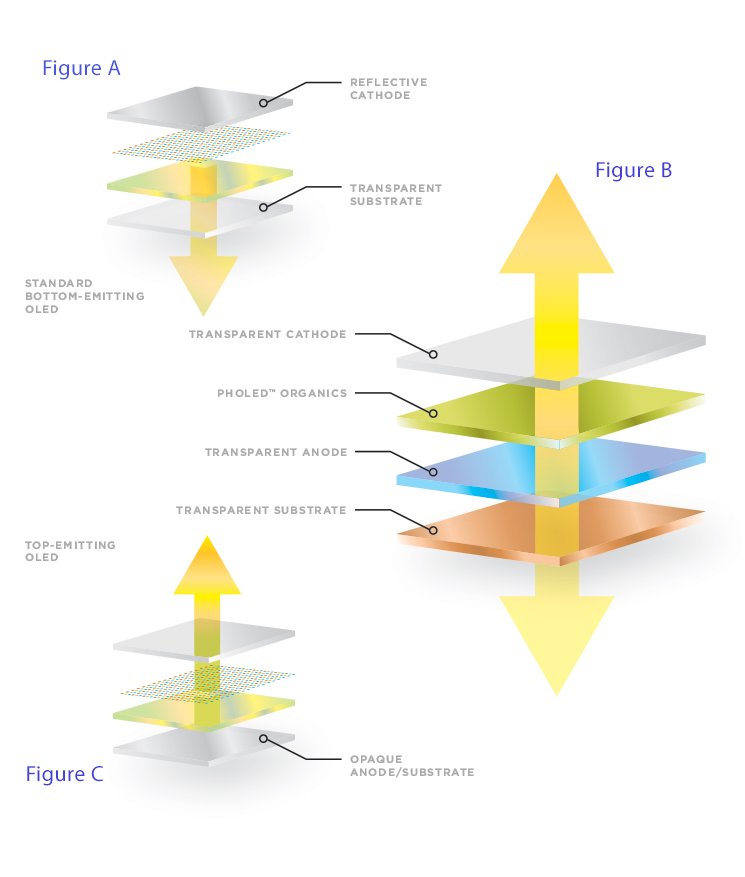
Transparent OLED (TOLED) technology enables three key features that have the potential to create a host of new product opportunities. - Top emission - Transparency - Stacking Universal Display’s TOLED® technology is based on a proprietary top contact, or cathode, that is optically transparent. In Figure A below, you see typical OLED, where the bottom contact, or anode, consists of a transparent metal oxide film and the top contact consists of a reflective metal. As a result, when light is generated by the OLED, it emits through the bottom transparent surface. TOLEDs, as shown in Figure B, use an optically transparent top cathode, meaning both top and bottom contacts allow light transmission. Transparency: Capable of 70% to 85% transparency when turned off, TOLED pixels are nearly as clear as the glass or plastic substrate on which they are built. When used in an active-matrix OLED configuration, the effective transmission of a TOLED display may, however, be somewhat reduced depending on the resolution of the display and TFT design. Bi-directional emission: Typically, the light generated by the TOLED emits from both surfaces. Enhancement films and other optical treatments may be used to direct more of the light in one direction than the other. Performance: TOLEDs also offer excellent opto-electronic performance properties, i.e., spectral color emission, luminous efficiency and lifetime – that compare well to those for bottom-emission OLEDs. Stacking: Fabricating one OLED on top of another OLED can be advantageous in terms of improving overall lifetime and also providing a broader range of output color spectrum.
CATEGORY
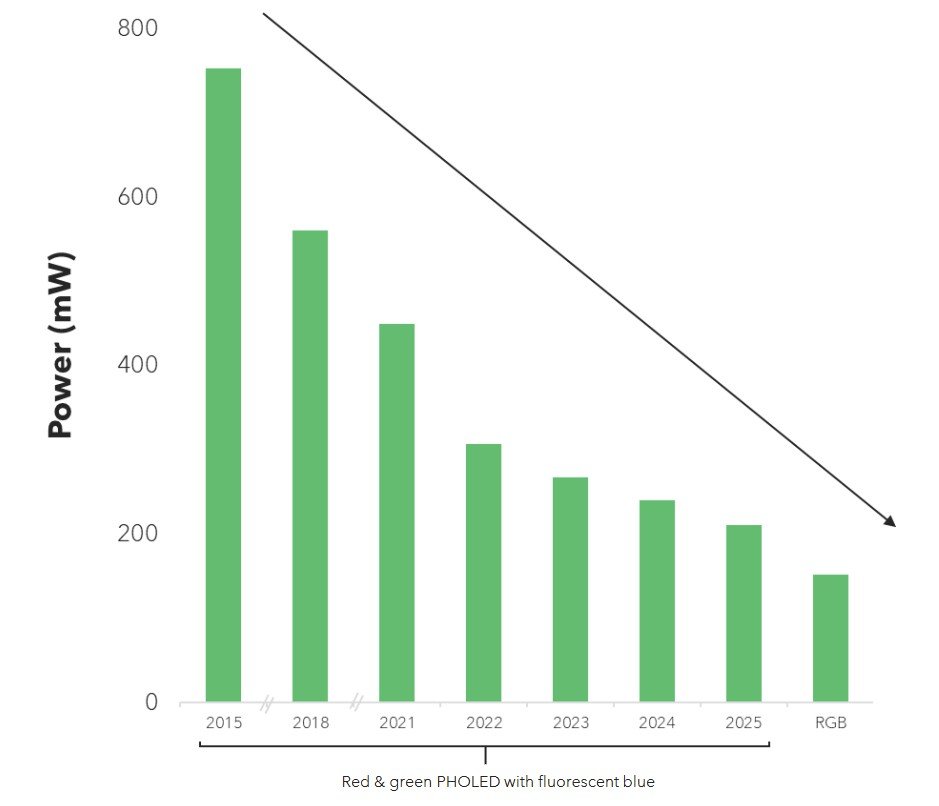
With Universal Display’s proprietary UniversalPHOLED® technology, OLEDs can also be more energy-efficient than LCDs. UniversalPHOLED Energy Efficiency Innovation Lower Power Usage - RED Phosphorescence reduces power consumption by 25% - Add GREEN: 45% cumulative reduction - Add BLUE: 75% cumulative reduction Enabled by PHOLEDs Smartphone Display Power Consumption - 2025 Performance: Displays using red & green phosphorescent OLED with fluorescent blue consume about 72% less energy compared to 2015. - Projected additional performance improvement: Displays using full red, green & blue PHOLED are projected to consume about 25% less energy compared to prior devices containing fluorescent blue. Chart and data based on a 5.0″ OLED display operating at 600 Candela per square meter with video (50% pixels on). PHOLED data is based on UDC estimates. PHOLED=Phosphorescent.
CATEGORY
With the same proprietary cathode that is used for transparent OLEDs, TOLED technology can be employed for use in top-emitting OLEDs. In a top emission OLED, as shown in Figure C, the anode and cathode work together to form an optical cavity, emitting light away from the substrate and the backplane, increasing the aperture ratio of the display. This is very good for mobile devices and screens where you can turn the display to ensure the best viewing angle, as it increases the light output and increases display efficiency at normal viewing angles.
CATEGORY
White OLEDs have the potential to offer significant performance advances to the general lighting arena. Since Edison’s development in 1879, its energy efficiency of the incandescent light bulb has not improved beyond 4% — equivalent to about 12 lumens/Watt (lm/W). Consequently, incandescent light bulbs are losing favor here in the U.S. and around the world. In fact, plans are underway to ban and/or phase them out altogether. Fluorescent tubes, capable of up to 120 lm/W, but typically in the 70-100 lm/W range, offer color qualities that are undesirable for many applications. They also present numerous environmental and disposal issues because they contain mercury. UniversalWOLED™ OLED lighting has the potential to reach more than 150 lm/W. We believe that OLEDs offer significant energy savings and environmental benefits to end users around the world. With lighting accounting for 15% of global electricity consumption and 5% of worldwide greenhouse gas emissions, WOLEDs could have real impact on reducing energy consumption. In the solid-state lighting realm, OLEDs and LEDs are complementary. OLEDs are excellent surface lights, while LEDs are bright point light sources. As noted by the U.S. DOE, OLEDs can be configured as larger-area, more diffuse light sources, which may be more practical for general ambient lighting because the soft light can be viewed directly, with less need for shades, diffusers, lenses, louvers, or parabolic shells. Since OLEDs can be very thin, they are more appealing, and can easily attach to wall surfaces and ceilings. This, coupled with the diffuse nature of OLED lighting, can enable an entirely new type of light and light fixture that’s both attractive and highly efficient. OLEDs can also be made in almost any shape, can be deposited on flexible substrates, and can be transparent, emitting light from both sides of the device—features that greatly expand the design possibilities, allowing for a completely new lighting experience. WOLEDs have sparked keen interest from the lighting and display industries and emboldened designers and developers to consider using them in novel ways. All thanks to attractive performance features, which include: Energy saving - Enabled by Universal Display’s high-efficiency PHOLED technology - Potential to achieve 150 lumens per Watt - May help reduce the consumption of non-renewable fossil fuel and greenhouse gas emissions Bright, uniform white color quality - Broad spectral emission with color rendering index (CRI) of 80 or even 90 easily achievable - Color temperatures ranging from the warm white of incandescent lamps to the cool white of fluorescent tubes and LEDs - Ability to produce excellent deep red (R9) component of light Color tunability and dimmability - Innovative WOLED architectures may enable custom color tuning – from cool to warm white, as desired, or even full color tunability - Brightness levels can also be adjustable and, unlike fluorescent lighting, become even more efficient when dimmed Innovative form factor - Excellent diffuse lighting sources - Much thinner and safer form factor than those found in bulky and fragile incandescent bulbs and fluorescent tubes - Enable a host of novel product uses - Ultra-thin, lightweight, and conformable on plastic and other flexible substrates - Can also be used as windows, providing sunshine during the day and lighting at night when integrated with our TOLED transparent OLED technology Environmental friendly green technology - Save energy helping to reduce our dependence on foreign oil and other non-renewable fuels - Reduce impact on the environment - Do not contain hazardous substances and pose disposal problems - Easier to transport than fragile glass lamps
CATEGORY
