By Hockmeyer Equipment Corporation
The HCPS model is capable of milling viscosities as high as 400,000 cps. The HCPS mill can be fitted with two different sweep blades; the Sidewall Scraper for thixotropic materials and the Anchor Helix Scraper blade for heavier, tackier materials. The HCPS is also fitted with an auger extending out of its upper draft tube. This enables the mill to pull material above the upper draft tube and feed it into the media field below for grinding. The HCPS has an auger in the mill’s upper draft tube enabling it to grab material from above the mill chamber and feed it into the media field. Without the auger, the efficiency of the mill would be greatly reduced. The auger has multiple effects on the immersion mill - Feeds highly viscous material into the grind chamber - Acts as a governor to control feed rate into the grind chamber - Acts as a seal to prevent floating or “burping” of media as mill is immersed - Entrapped air exits the bead field through the screens - Prevents film formation inside upper draft tube, enhancing cooling The upper draft tube is fitted with a wear resistant, hardened sleeve preventing abrasive material from wearing into the cooling chamber surrounding it. The auger is made of a much softer abrasion resistant synthetic material minimizing wear. The upper draft tube of the HCPS is cooled. Without the auger a film may form inside the upper draft tube while the mill is running, making the effect of cooling in the tube limited. With the addition of the auger a film does not form. Cool material is constantly scraped off and augered into the media field as it is replaced with incoming material creating both additional Forced Conduction and Force Convection Zones. Solution Advantages: The addition of the Anchor Helix Scraper or the Sidewall Scraper and the auger has greatly increased the ability of the Immersion Mill to effectively operate in viscosity ranges that were previously beyond its capabilities. The new HCPS High Viscosity Immersion Mills will allow companies to shift many products away from the roller mills. Not all roller mill formulations are capable of being run on the HCPS but many can be if the formulas are adjustable. Covered by one or more of the following United States patents: 5,184,783; 5,497,948; 5,820,040; 7,175,118 – Additional patents pending
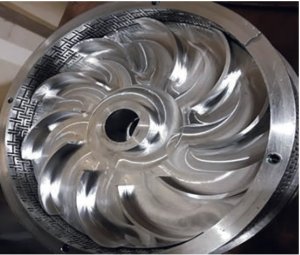
We have developed a new type of rotor-stator that works virtually the same way the NexGen Mill works using vacuum. With the NexGen rotor-stator (HNGRS) (patent pending), a few changes have made a big difference in particle size reduction. These include vacuum, cavitation, tight tolerances between the rotor and stator, vacuum chamber recirculation, dual pumping rotor, rapid supply tank recirculation, high open area stator for high throughput, inline pigment feed, and air removal from feedstock during batch processing. Vacuum: The HNGRS uses vacuum the same way the NexGen mill does. The rotor and stator are enclosed in a small vacuum chamber. The feedstock is pulled from the supply tank under vacuum and enters through the top of the rotor-stator and is pulled down onto the top of the rotor. The rotor spinning at high tip speeds accelerates the feedstock into the upper part of the stator and through the stator into the vacuum tank. The feedstock is then pulled onto the bottom of the rotor and pushed into the stator and through the stator back into the vacuum tank. Once the vacuum tank is full, the feedstock is pulled out of the vacuum tank and passes through the diaphragm pump back to the feedstock supply tank for rapid recirculation back into the rotor-stator. Vacuum on the HNGRS is different than vacuum on most rotor stators. As previously mentioned, almost all rotor stators use vacuum to pull the product from the feedstock tank into the rotor-stator. As soon as the feedstock hits the rotor, it goes from vacuum to pressure for the return trip back to the feedstock tank. With the HNGRS, vacuum pulls the feedstock from the supply tank. Once the feedstock hits the rotor, there is a drastic increase in velocity of the liquid, but it is still under vacuum because the entire rotor and stator are enclosed in a vacuum chamber slightly larger than the rotor-stator itself. The feedstock remains under vacuum as it passes through the stator and slams directly into the inside wall of the vacuum chamber. The feedstock never changes from vacuum to pressure until it passes through the diaphragm pump for the return trip to the supply tank. Air is removed from the feedstock and agglomerates are more easily broken down and wetted out because of the voids created when the air is removed. Cavitation: Cavitation is generated inside the vacuum chamber during dispersion. The rotor and stator are enclosed in a vacuum chamber. As the feedstock enters the top of the rotor, cavitation develops on the rotor. Cavitation can be controlled by the amount of vacuum pulled on the system, using a valve on the feedstock supply tank. Cavitation is a phenomenon where rapid pressure change creates voids in the liquid where pressure is very low. These voids are short-lived, and when they collapse, they generate a shock wave through the liquid that also helps in particle reduction, much like a sonication disperser. Tight Tolerances: Tight tolerances between the rotor and stator create the perfect environment for particle reduction. There are many different types of shear going on inside the HNGRS: impact, rolling shear, cutting shear, and internal shear from air expanding inside the agglomerates as a result of the vacuum. Tight tolerances between the rotor and stator increase the rolling shear, impact shear, and cutting shear. Dual Pumping Rotor: The HNGRS is designed with a dual pumping rotor that has veins on both the top side and the bottom side separated by a center plate so that the top veins pump out of the top side of the stator and the bottom veins pump out of the bottom side. This dual-sided rotor provides multiple feedstock passes through the rotor and stator before it leaves the vacuum chamber. Rapid Vacuum Chamber Recirculation: The rotor on the HNGRS is built to pump from both the top and the bottom. The feedstock is pumped into the rotor-stator from the top. As the vacuum chamber fills up, the bottom side of the rotor starts to pump. The feedstock recirculates through the vacuum chamber and in and out of the bottom side of the rotor many times before it is pulled – still under vacuum – through the outlet and to the pressure side of the pump and back to the supply tank. Rapid Feedstock Supply Tank Recirculation: The HNGRS is a very rapid recirculation inline rotor-stator. An eight-inch rotor can pump upwards of 300 gallons per minute in water with low vacuum. Recirculation speeds and vacuum work hand-in-hand. Higher vacuum generates lower throughput, and lower vacuum generates higher throughput. The throughput rate is controlled by the supply tank valve and the diaphragm pump rate. High Throughput Stator: The stator on the rotor-stator is much like the screens on a media mill. For a media mill screen, you want as much open screen surface area as you can get for faster product recirculation. This is also true for the stator on the HNGRS. The H stator design uses interlocking “H” shaped slots for maximum stator open area. The interlocking H slot design gives the stator both vertical and horizontal cutting edges and also plenty of closed surface area for particle collisions when they are coming off the rotor at very high velocity. The clearance between the rotor and stator are very tight, creating very high shear rates for particle reduction. Vacuum Pigment Feed: Vacuum pigment feed is an option with the HNGRS inline system. The pigment will enter the liquid stream ahead of the rotor-stator, mix with the liquids, and then hit the rotor and stator for particle reduction. Pigment feed rates depend on pigment type and feed characteristics of the dry powder. Air Removal from the Feedstock: The HNGRS works under vacuum as air accumulates in the upper part of the vacuum chamber until it comes in contact with the outlet. At this point, the air travels back to the feedstock supply tank in large bubbles and floats rapidly to the top of the supply tank and pops. It is normal to see batches shrink in size during the pre-dispersion process because of air removal.
CATEGORY
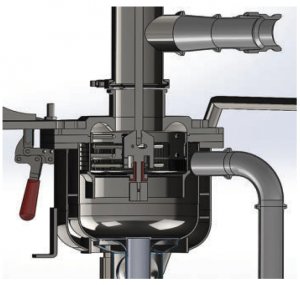
The Immersion Mill MicroMill was designed to run small batches in the one-liter to one-gallon range, and we estimated that the flow rate through the Immersion mill would be in the one-liter-per-minute vicinity. Because of the mill design, we were not able to get an exact number on the mill discharge, as some of the product went through the side screen and some went through the bottom screen. A one-liter batch of water in the Immersion Mill was estimated to turn over once a minute, which is very fast for a media mill. The Immersion mill was one of the first basket-type media mills on the market. It did not need pumps and hoses; it produced its own vacuum using a propeller in the lower draft-tube to pull the feedstock through the media field.
CATEGORY
Barry has been named on multiple patents for the Immersion Mill, NexGen™ Mill, NexGen™ RotorStator, Porous metal, and polymer screens for nano milling, and he also developed the HPAS 2000 particle analysis system.
CATEGORY
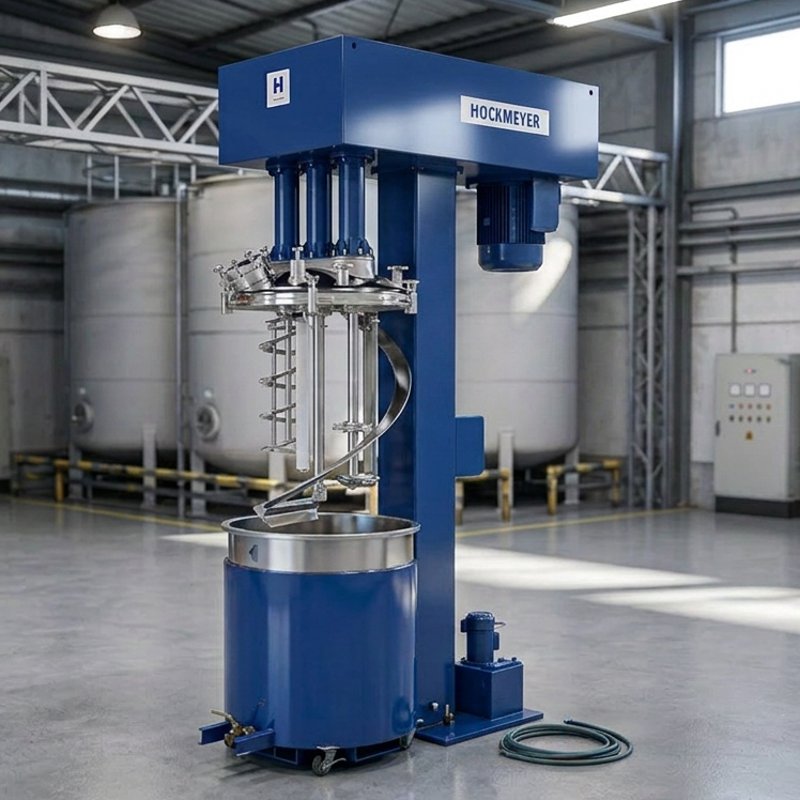
which uses a center-mounted low-speed Helical or Anchor Sweep blade that sweeps the mixing vessel wall, and two additional high-speed shafts. When using this disperser for your industrial milling project, a Rotor Stator can also be used as the third shaft to provide mechanical and high hydraulic shear which will be useful in the disintegration of solids into liquids or emulsification.
CATEGORY
