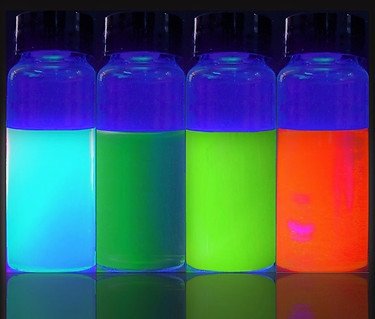
4nDOTS™ Fluorescent Nanoprobes are quantum-dots from semiconducting materials with diameters in the range of a few nanometers (few tens of atoms). 4nDOTS™ have unique properties, intermediate between those of bulk materials and discrete molecules that are partly the result of the unusually high surface-to-volume ratios for these particles [1-3]. The most striking feature is fluorescence, wherein the 4nDOTS™ can produce distinctive colors determined by the size of the particles. PHORNANO offers a variety of fluorescent nanoprobes featuring bright emissions, narrow emission sprectra, high purity, and good quantum yields. They are available in aqueous medium and are applied in photonics, displays, photovoltaics, microelectronics, quantum computing, biomedical imaging, biosensors, cosmetics, among many others. Tunable Bandgap: Due to their small size, the electrons in 4nDOTS™ are confined in a small space and the energy levels are quantized (Figure 1) [4, 5]. The discrete, quantized energy levels of 4nDots™ relate them more closely to atoms than bulk materials. As the size of the crystal decreases, the energy-gap between the highest valence band and the lowest conduction band increases, resulting in a color shift from red to blue in the emitted light. As a result, 4nDOTS™ can emit any color of light from the same material by changing their size. Because of the high level of control possible over the size of the nanocrystals produced, 4nDOTS™ can be tuned to emit any specific color of light [6] Excitation and Emission Spectrum: 4nDOTS™ show a broad excitation spectrum whereas the emission spectrum is narrow and separated from the peak of the excitation spectrum (typically > 100 nm), allowing easy separation between the two wavelengths. A single fixed wavelength light- or laser source in the UV/blue spectrum allows exciting a variety of different 4nDOTS™, each emitting in a different, distinct, defied and narrow wavelength (Figure 2a,b). As a consequence: - A lower cost, robust laser/light-source can be employed compared to the need of a tunable laser in the case of organic dyes. - Multiplexed imaging using a single light source can be used to excite multicolor 4nDOTS™ simultaneously without signal overlap. Their different narrow emission spectra can be distinguished, in contrast to the broad and thus overlapping emission spectra of organic dyes. - Emission spectra can easily be separated from the excitation spectrum, as they allow the excitation wavelength and the emission wavelength be separated by typically > 100 nm, in contrast to the case of organic dyes, where the excitation spectrum is narrow and often overlaps with the emission spectrum. Surface Chemistry: Conjugated 4nDOTS™ provide precise binding specificity to biomolecules (Figure 3 below). Figure 3: Schematic of a 4nDOT™: A: Core B: shell, C: Functionalizer, D: Agent for specific targeting (antibodies, primers, etc). 4nDOTS™ consist of some or all the elements shown above, depending on the costumer needs. Applications: 4nDOTS™ are particularly significant for optical applications owing to their bright, pure colors along with their ability to emit all colors of the VIS up to the NIR spectrum, coupled with their high efficiencies, substantially eliminated effect of photobleaching compared to organic dyes and high extinction coefficient. Examples include biomedical imaging, sensors, solid state lighting, displays and photovoltaics. [6, 7, 8] The small hydrodynamic radius of 4nDOTS™ make them suitable for different bio-medical applications like biomedical imaging, biosensors, etc. At present, fluorescence based biosensors depend on organic dyes with a broad spectral width, which limits their effectiveness to a small number of colors and shorter lifetimes to tag the agents. 4nDOTS™ can emit in the whole spectrum, are brighter and substantially eliminate photo bleaching over time thus proving them superior to traditional organic dyes used in biomedical applications.[9] Being zero dimensional, quantum dots have a sharper density of states than higher-dimensional structures. Their small size also means that electrons do not have to travel as far as with larger particles, thus electronic devices can operate faster. Examples of applications taking advantage of these unique electronic properties include transistors, photovoltaics, ultrafast all-optical switches and logic gates, and quantum computing, among many others. [10,11] 4nDOTS™ are fully biocompatible due to their aqueous medium and their controlled pH. This unique feature makes them ideally suited for use in in variety of bioimaging application (Figure 4) including: - ex vivo, in vitro long-term life cell imaging - in vivo animal targeting In strong contrast, organic dyes require fixing the cells and thus do not allow time studies over a longer period with the same cell cultures as it is possible using bio-compatible 4nDOTS™ Order Information: PHORNANO offers a portfolio of fluorescent 4nDOTS with predefined emission wavelengths, as well as customized 4nDOTS on demand. An overview is provided in Table 1. Table 1: 4nDOTS emission wavelength, Item number, particle concentration and color of emission. *) Emission wavelength can be customized between 490 nm (blue/green) and 620 nm (red). For emission wavelength of 580 nm (yellow), please ask for 4nDOT580. Other emission wavelengths are available upon request.
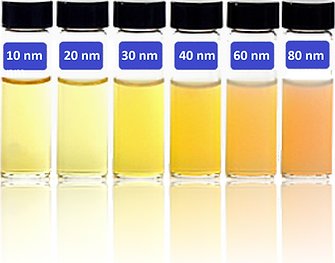
HighQuant monodisperse silver NPs of high concentration, free from agglomeration, and with a controlled low level of free Ag-ions. They are ready to unfold their full potential in your research, development, and use in industrial scale in your demanding applications. Batches of manufactured HighQuant NPs are precisely characterized using UV/VIS spectrometry to ensure consistent materials in every shipment. Absorbance data are regularly validated using transmission electron microscopy (TEM) images, dynamic light scattering (particle size analysis) and/or Zeta potential measurements. HighQuant nanoparticles focus on the most important characteristics offered by metallic nanoparticles: 1. SECURE / Undesired effects of silver nanoparticles (NPs) are mainly mediated by residual FREE IONS. HighQuant silver NPs eliminate adverse effects by a controlled and low level of FREE IONS. 2. SENSITIVE / Distinct strong Localized Surface Plasmon Resonance (LSPR) effect enables orders of magnitude improvement of the detection limit. 3. REPRODUCIBLE / Controlled and low level of residual FREE IONS, significantly improving the reliability of the experimental results and the reproducibility of their respective application. PHORNANO offers HighQuant silver NPs in aqueous suspension with a citrate-stabilized surface as shown in Table 2. When nanoparticles are in solution, molecules associate with the NP surface to establish a double layer of charge that stabilizes the particles and prevents aggregation. PHORNANO offers its HighQuant silver NPs suspended in aqueous medium. A citrate-based agent was selected as a stabilizer, because the weakly bound capping agent provides long term stability and is readily displaced by various other molecules including thiols, amines, polymers, antibodies, and proteins. HighQuant NP´s Optical Properties – Distinct strong Localized Surface Plasmon Resonance (LSPR) In contrast to dyes and pigments, optical properties of silver NPs mainly depend on their sizes and geometries. LSPR effect is most pronounced for metallic nanoparticles < 30 nm in diameter, due to their superior surface/volume ratio, compared to larger NPs. Therefore, PHORNANO focuses on high concentrated, high-LSPR NPs of ≤10 and 20 nm in diameter. The strong light-matter interaction of the silver NPs occurs because the conduction electrons on the metal surface undergo a collective oscillation when excited by light at specific wavelengths (Figure 2). This oscillation results in unusually strong scattering and absorption properties. That allows silver NPs to show effective absorbance (scattering & absorption) cross sections several times larger than their physical cross section. For most applications, HighQuant NPs guarantee high absorption intensity also for longer wavelengths, as their absorption maximum is stronger than those of larger NPs, which present their weaker peak absorption at longer wavelengths. By selecting the size of spherical silver NPs, their LSPR peak absorbance wavelength can be tuned from < 400 nm to 500 nm and influences the appearance of the sample under visible light (Figure 3). HighQuant Silver NP´s Applications HighQuant Silver nanoparticles are being used in a large variety of technologies and incorporated into consumer products that take advantage of their desirable optical, electronical, thermal and antimicrobial properties. - Diagnostic Applications: HighQuant Silver NPs are used in bio-imaging, biosensors and as biological tags for quantitative detection. - Antimicrobial Applications: HighQuant Silver NPs are incorporated in apparel, footwear, paints, wound dressings, appliances, cosmetics, and plastics for their antibacterial and antifungal properties. - Conductive Applications: HighQuant Silver NPs are used in conductive inks and integrated into composites to enhance thermal and electrical properties. - Optical Applications: HighQuant Silver NPs are used to efficiently harvest light and for enhanced optical spectroscopies including metal-enhanced fluorescence (MEF) and Surface-Enhanced Raman Scattering (SERS) PHORNANO offers HighQuant silver NPs in aqueous suspension with a citrate-stabilized surface as shown in Table 2. Table 2: HighQuant NP diameter, Item number, and mass concentration. Other dimensions as well as custom core/shell, alloy nanoparticles comprising different metals or nanorods are available upon request. Please ask for a quotation.
CATEGORY
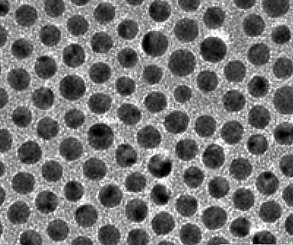
Due to the quantum size and surface effect, noble metal nanoparticles have optical, electromagnetic and chemical properties that are different from those of their bulk-material counterparts. Transmission electron microscopy (TEM) image of spherical gold nanoparticles is shown in Figure 1. They show high efficiency in absorbing and scattering light with their absorbance spectrum tunable by their shape and size. Nobel metal nanoparticles show enhanced physical properties, Local Surface Plasmon Resonance (LSPR) effects, which result in enhanced absorption, high chemical stability, catalytic activity and nonlinear optical effects as a result. These properties make them of value in microelectronics, sensors utilizing their LSPR properties, in biomedical imaging and diagnostics at the cellular and molecular level as well as in therapy in pharmaceutical applications and in cosmetics. HighQuant monodisperse gold nanoparticles are manufactured with highest precision, free from agglomeration, ready to unfold their full potential in your research, development, and use in industrial scale in your demanding applications. Each single batch of HighQuant Gold nanoparticles is precisely characterized using UV/VIS spectroscopy, regularly calibrated with Transmission Electron Microscopy (TEM), dynamic light scattering (DLS, particle size analysis) and/or Zeta potential measurements. Optical Properties of HighQuant Gold Nanoparticles In contrast to dyes and pigments, optical properties of noble metal nanoparticles are mainly dependent on their sizes and geometries. The strong interaction of the noble metal nanoparticles with light occurs because the conduction electrons on the metal surface undergo a collective oscillation when excited by light at specific wavelengths (Figure 2). Known as a plasmon resonance, this oscillation results in unusually strong scattering and absorption properties. That allows noble metal nanoparticles to show effective absorbance (scattering & absorption) cross sections several times larger than their physical cross section. By selecting the size of spherical gold nanoparticles, their plasmon resonance peak wavelength can be tuned from ≈500 nm (blue-green light) to ≈600 nm (red light) and influences the appearance of the sample under visible light (Figure 3). By manufacturing rod shaped gold nanoparticles, the spectrum will be modified in shape. The plasmon resonance peak wavelength can be shifted to longer wavelength and a multi-peak structure of the spectrum can be observed, determined by the dimension of the nanorods (Figure 4). Surface Chemistry of HighQuant Gold Nanoparticles When nanoparticles are in solution, molecules associate with the nanoparticle surface to establish a double layer of charge that stabilizes the particles and prevents aggregation. PHORNANO offers several gold nanoparticles suspended in aqueous medium. A citrate-based agent was selected as a stabilizer, because the weakly bound capping agent provides long term stability and is readily displaced by various other molecules including thiols, amines, polymers, antibodies, and proteins. Applications of HighQuant Gold Nanoparticles Gold nanoparticles are being used in a large variety of technologies and incorporated into applications ranging from consumer products to high end biomedical applications that take advantage of their desirable optical and electronic properties. - Diagnostic Applications: Gold nanoparticles are used in bio-imaging, biosensors and as biological tags for quantitative detection. - Conductive Applications: Gold nanoparticles are used in conductive inks and integrated into composites to enhance thermal and electrical properties. - Optical Applications: Gold nanoparticles are used to efficiently harvest light and for enhancement of optical properties including metal-enhanced fluorescence (MEF) and surface-enhanced Raman scattering (SERS). Order Information for HighQuant Gold Nanoparticles: PHORNANO offers a portfolio of gold nanoparticles and elongated rods with predefined dimensions, as well as customized nanoparticles on demand. All nanoparticles are prepared in aqueous medium with a citrate-stabilized surface. A correlation of mass concentration to particle concentration is displayed below in Table 2 Table 2: Nanoparticle diameter, Item number, mass concentration, and particle concentration. Other dimensions available upon request.
CATEGORY
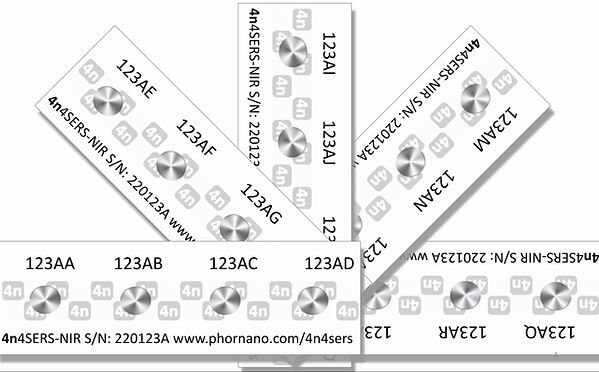
Surface Enhanced Raman Scattering (SERS)became an even more powerful method for chemical and biological sensing applications. 4n introduces HIGH PERFORMANCE (HP) SERS using a unique SIGNAL ENHANCING HEAT SINK (SEHS). SERS is now an extemly effective and fast tool to detect molecules by efficiently enhancing the Raman signal from the analyte applied to the 4n4SERS substate. 01 | SECURE |Robust and easy to use: The SIGNAL ENHANCING HEAT SINK protects the analyte from overheating The highest DAMAGE THRESHOLD among SERS substrates supports best results at high power levels from the Raman laser. 02 | SENSITIVE |enhancement of the Raman signal for orders of magnitude: Distinct strong LOCALIZED SURFACE PLASMON RESONANCE (LSPR) effect of HighQuant nanoparticles in combination with high power levels from the Raman laser. 03 | REPRODUCIBLE results gueranteed by the high quality of the nanoparticles utilized and a prolongued averaging time supported. The analyte remains protected from overheating due to the unique SIGNAL ENHANCING HEAT SINK technology. 4n4SERS High Performance SERS substrates combine ease of use with with versatility and economy by offering 4 large active SERS sensitive spots embedded in a single flexible and adheseve 4n4SERS substrate, compatible to a standard microscopy slide (Figure 2). The novel SIGNAL ENHANCING HEAT SINK technology allows to utilize the full potential of high power Raman lasers in the NIR range from 785 to 1064 nm. Please ask for other wavelengths. 4n4SERS High Performance SERS substrates feature a unique SIGNAL ENHANCING HEAT SINK technology, unlocking the full potential of most Raman lasers by scaling the damage threshold to Laser power density beyond 3 kW/cm². This corresponds for example with a laser power of 500 mW at a spot size of 150 µm. 4n's SIGNAL ENHANCING HEAT SINK technology allows to use the same high laser power as for standard Raman measurements, resulting in a gain of 1-2 orders of magnetude in Raman signal strength, compared to power limited SERS substrates. Supported by the high quality and concentration of HighQuant metallic nanoparticles, 4n4SERS substrates can detect analytes in extremely low levels of concentration. As an example, 100 ppb of melamine can be detected at a power level of 50% from the Raman-laser in water (Figure 5). Again, the reproducibility of the measurement which was carried out on 3 independent test spots at the limit of detection is remarkable and shows a reproducibility of of better than +/- 13% for a confidence level of 1 x σ. This Result was achieved with the proven standard 4n4SERS substrate. Order Information: HIGH PERFORMANCE 4n4SERS substrates offer an excellent platform for obtaining the most from your Raman setup: 1. SECURE /Robust and easy to use. With their EXTREMELY HIGH DAMAGE THRESHOLD, 4n4SERS substrates won't let you down, even with when full power of your Raman laser is utilized for best results 2. SENSITIVE Distinct strong LOCALIZED SURFACE PLASMON RESONANCE (LSPR) effect of HighQuant nanoparticles un-locks orders of magnitude improvement of the limit of detection. 3. REPRODUCIBLE results mean improved efficiency, less time and money spent due to excellent BATCH TO BATCH REPRODUCIBILITY. Multiple use allows you to utilize 4 individual active SERS chips embedded in each flexible and adhesive SERS stipe, compatible to a microscopy slide. For more details, please download our 4n4SERS datasheet (PDS) below or ask for a quotation. Custom designs and wavelengths: please enter in contact with us in case you are interested in different designs and Raman wave-lengths. We are glad to discuss custom versions, optimized for your application.
CATEGORY
NEW 4n4SERS 4x4 = 16 x INCREASE in PERFORMANCE Figure 1 Due to the Localized Plasmon Surface Resonance (LSPR) effect, noble metal nanoparticles have optical and electromagnetic properties that are significantly different from those of bulk materials. They provide a significnat enhancement in surface-enhanced Raman scattering (SERS) as a result. These properties make them of value in diagnostics at the molecular level by taking advantage of the enhanced optical properties of HighQuant NPs. 4n4SERS 4x4(right image) generates significantly higher field strength compared with the proven 4n4SERS substrates (left image). As a result, the enhancement factor is further increased. Consequently the limit of detection using 4n4SERS 4x4 is significantly reduced.
CATEGORY
