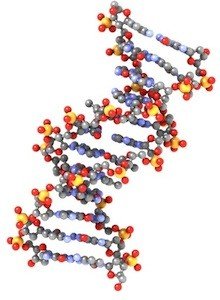
SonoPlot's Microplotter systems meet the needs of researchers looking to dispense precise picoliter volumes of fluid at specific locations on a surface. The Microplotters handle sensitive biomolecules without causing deactivation through heat or shear while dispensing. This, coupled with the repeatability of the dispenses, makes these systems ideal for manufacturing protein or DNA microarrays, spotting samples or matrix for MALDI-ToF mass spectrometry, or printing microscale biosensors. Advantages Over Quill-pin and Piezoelectric Technologies The dispensing mechanism used within the Microplotter systems is significantly different from standard quill-pin or piezoelectric technologies. A Microplotter uses controlled ultrasonics to pump fluid to the tip of a sharp glass micropipette, where the liquid meniscus is bowed out. The dispenser is then brought down to a surface and either a droplet is touched off or the dispenser is moved across the surface to draw a continuous line or arc. The dispenser does not touch the surface when leaving behind droplets in this manner, so it is a much more gentle process than quill-pins, which often require harder mechanical tapping on a surface. A Microplotter can print on soft or fragile materials, like hydrogels, nitrocellulose, or gold-coated glass, without marking or otherwise damaging the surface. Sub-picoliter droplets can be dispensed by a Microplotter system, leaving behind features smaller than 20 microns in width. This is significantly less than the droplet size produced by current quill-pin or piezoelectric microarray spotters. These small features are repeatable, with the Microplotter Proto capable of coefficients of variability for volumes dispensed of less than 10%. Droplets are not ejected through the air toward the surface like in piezoelectric dispensers, so a wider variety of solutions can be printed in a Microplotter without the need to worry about clogging. Saturated salt solutions and high-viscosity materials like genomic DNA can be printed without tuning the system or solutions. Finally, the Microplotter systems, particularly the Microplotter Proto are available at a significantly lower cost than most piezoelectric- or quill-pin-based systems.
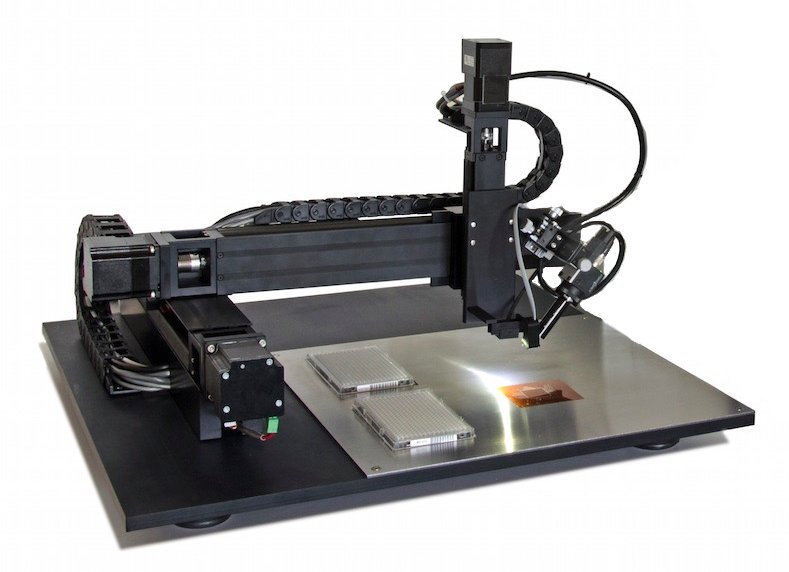
The SonoPlot® Microplotter Pro is a precision picoliter fluid dispensing system for the printed electronics markets with significant advantages over existing products in deposited feature size and type, regularity of volumes dispensed, and flexibility for the user. The core of the Microplotter is a dispenser that uses controlled ultrasonics to deposit fluid in a noncontact manner. This patented technology can produce picoliter droplets that form features on a surface as small as 5 µm wide. When combined with automatic surface height calibration, coefficients of variability for deposited feature diameters as small as 10% can be achieved. A wide range of fluids can be used, including aqueous solutions and many organic-solvent-based mixtures. Fluids that other dispensers struggle with, such as saturated solutions for MALDI-ToF matrices, or fluids with viscosities up to 450 cP, can be deposited with ease. The ultrasonic pumping action is also an efficient cleaning mechanism for quickly depositing many solutions sequentially. In addition to spots, the Microplotter Pro can draw true continuous features, such as lines, arcs, and bends. These are uniform elements, not made from overlapping droplets like other technologies, and are particularly well-suited to the polymer electronics field. Software SonoPlot's SonoGuide control software is designed to be flexible and powerful, while still being easy to use. Features of this software include: - Importing and printing of DXF and Gerber layout files - A graphical preview of patterns as they are drawn, coupled with a live video feed from the printhead - Capturing still images or recording digital video from the attached CCD camera - Controls for both completely manual and automatic movement and printing - Automatic surface tilt or curvature mapping - A human-readable text format for defining custom patterns All updates to this software are free to system owners, and we pride ourselves on responding to customer feedback by regularly adding new capabilities and improving existing ones. Technical Specifications Feature Size 5 µm - 200 µm Feature Types Droplets and contiguous lines, arcs and bends Deposition Volume 0.6 pL Deposition Variability As low as 10% Viscosity< 450 cP Positioning 35 x 30 x 7 cm (X, Y, Z axes), 5 µm resolution Calibration Automatic surface height calibration Camera USB 3.0 with digital video capture Software SonoGuide Control Software Dimensions 86.4 x 71.1 x 48.3 cm (34 x 28 x 19 in.) Weight 91 kg (200 lbs) Power 3.0 A for 100-120 V or 1.5 A for 220-220 V
CATEGORY
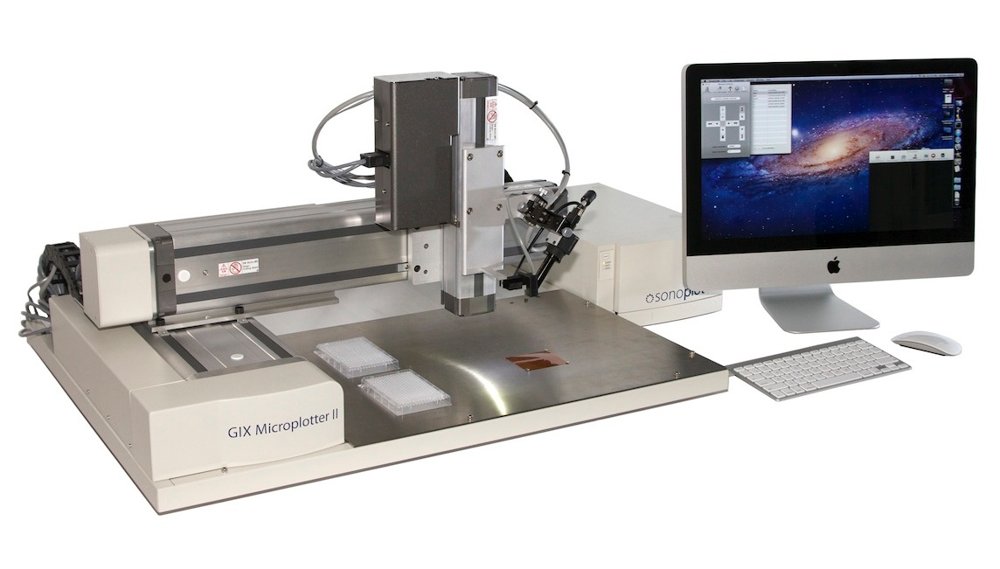
The SonoPlot® Microplotter II is a precision picoliter fluid dispensing system for the microarray and polymer electronics markets with significant advantages over existing products in deposited feature size and type, regularity of volumes dispensed, and flexibility for the user. The core of the Microplotter is a dispenser that uses controlled ultrasonics to deposit fluid in a noncontact manner. This patented technology can produce picoliter droplets that form features on a surface as small as 5 µm wide. When combined with automatic surface height calibration, coefficients of variability for deposited feature diameters as small as 10% can be achieved. A wide range of fluids can be used, including aqueous solutions and many organic-solvent-based mixtures. Fluids that other dispensers struggle with, such as saturated solutions for MALDI-ToF matrices, or fluids with viscosities up to 450 cP, can be deposited with ease. The ultrasonic pumping action is also an efficient cleaning mechanism for quickly depositing many solutions sequentially. In addition to spots, the Microplotter II can draw true continuous features, such as lines, arcs, and bends. These are uniform elements, not made from overlapping droplets like other technologies, and are particularly well-suited to the polymer electronics field. Technical Specifications Feature Size 5 µm - 200 µm Feature Types Droplets and contiguous lines, arcs and bends Deposition Volume 0.6 pL Deposition Variability As low as 10% Viscosity < 450 cP Positioning 35 x 30 x 7 cm (X, Y, Z axes), 5 µm resolution Calibration Automatic surface height calibration Camera USB 3.0 with digital video capture Software SonoGuide and SonoDraw Dimensions 86.4 x 71.1 x 48.3 cm (34 x 28 x 19 in.) Weight 91 kg (200 lbs) Power 3.0 A for 100-120 V or 1.5 A for 220-220 V
CATEGORY
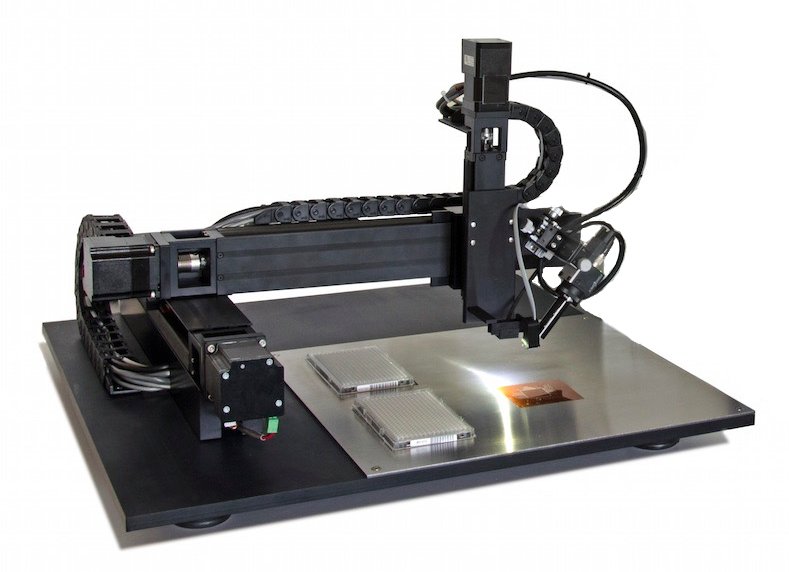
SonoPlot's SonoGuide control software is designed to be flexible and powerful, while still being easy to use. Features of this software include: Importing and printing of AutoCAD® DXF and Gerber layout files A graphical preview of patterns as they are drawn, coupled with a live video feed from the printhead Capturing still images or recording digital video from the attached CCD camera Controls for both completely manual and automatic movement and printing Automatic surface tilt or curvature mapping A human-readable text format for defining custom patterns All updates to this software are free to system owners, and we pride ourselves on responding to customer feedback by regularly adding new capabilities and improving existing ones.
CATEGORY
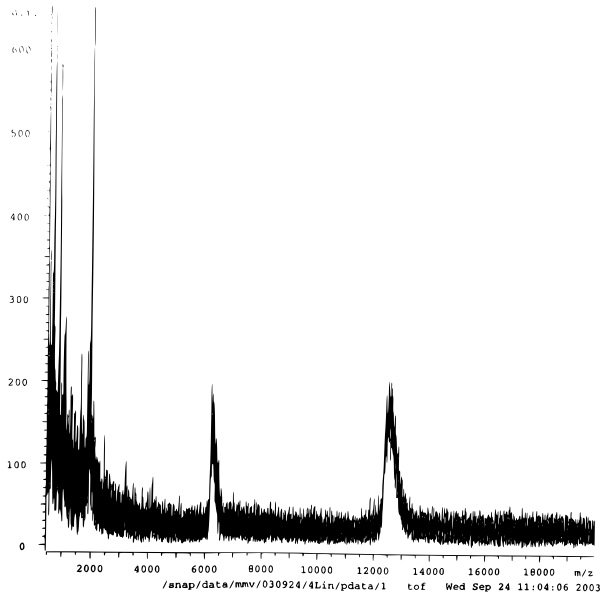
A Microplotter was used to enhance the sensitivity of matrix-assisted laser desorption / ionization (MALDI) mass spectrometry. MALDI mass spectrometry is a technique used to analyze the molecular weights of unknown chemicals or biomolecules, even when the molecules of interest weigh more than 10 kDa (10,000 molecular weight). To do this, analyte and matrix are deposited onto a metal plate, called a target, and a pulsed laser beam is directed at the matrix. This ejects both the matrix and analyte from the surface and ionizes the analyte material. A spectrometer reads the mass to charge ratio of the ejected molecules, which allows researchers to identify the composition of the analyte. A Microplotter was used to dispense spots with diameters ranging from 20 to 70 microns of both analyte and matrix. It was observed that the smaller the spot size, the sharper the resulting peaks in the mass spectrometer readout. Sharper peaks can lead to better identification of proteins with similar molecular weights, as one example.
CATEGORY
