By AcZon srl
AcZon proprietary core-shell silica nanoparticles (SiNPs) represent a novel class of probes for biological applications. SiNPs are spherical and their diameter varies between 10 and 70 nm; they are made up of two structural compartments: the core and the shell. During the synthetic procedure, the chemical-physical characteristics of the SiNPs can be personalized according to the intended use. They can be modified, both internally (core) and externally (shell) in step with customer requirements. The nanoparticle itself acts as a shield which protects the molecules hosted in the inner part. As a result, all the molecules included in the nanoparticle core are not affected by external agents as pH and even by continuous light irradiation. Thanks to the spherical shape of nanoparticles and the consequent elevated surface/volume ratio, more active molecules (such as enzymes, drugs, chelating agents, etc) can be conjugated to a single targeting molecule ensuring a consistent effect enhancement.
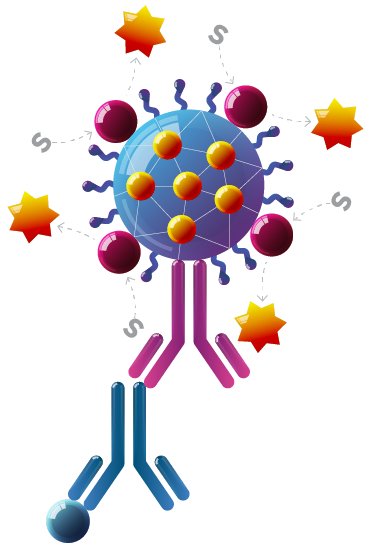
NanoLISA & NanoLISA-F: Elevating ELISA Performance NANOLISA & NANOLISA-F In AcZon NanoLisa & NanoLisa-F, a higher number of enzymes are available per secondary antibody unit. In addition, the intrinsic fluorescence of the nanoparticles allows the detection of the reagent with a double platform. Two faces of the same reagent AcZon nanoparticles are spherical and hence have a surface area-to-volume ratio of 3r, where r is the radius. As r decreases, the surface area-to-volume ratio increases allowing the conjugation of a higher number of molecules. In NanoLisa, AcZon optimized the double conjugation of enzymes (horseradish peroxidase - HRP or alkaline phosphatase - AP) and secondary antibodies on the nanoparticle shell. The augmented surface allows for additional enzymes per antibody unit resulting in amplified signal. In addition, the intrinsic fluorescence of nanoparticles offers the possibility to detect analytes through this feature which more linearly correlates with analyte presence, likely because it is a direct assessment of protein expression than enzymatic reaction. It also provides a greater dynamic range, offering superior sensitivity independently from protein amount in the sample. Additionally, fluorescence-based methods facilitate multiplexing, allowing researchers to evaluate more than one protein at the same time. This means that scientists can avoid time-consuming stripping techniques which can damage the protein of interest. Thanks to the NanoLisa line reagents (available for both HRP and AP and conjugated to different secondary antibodies) the researcher can choose the detection method which best fits the assay needs.
CATEGORY
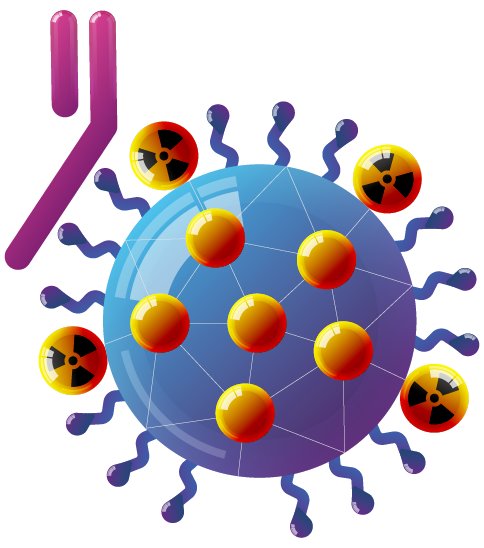
NanoRad: Radiolabeled Nanoparticles for Imaging In AcZon NanoRad, the nanoparticle shell is conjugated to chelating agents to allow the linking of radionuclides and the subsequent application on small animal models in microPET. The intrinsic fluorescence due to the nanoparticles enable for the post-mortem detection by fluorescence microscope analysis of explanted tissues. Molecular imaging is a biomedical research discipline which has quickly emerged to allow for the monitoring, characterization, and quantification of biomarkers and biological events in living organisms. It includes a large plethora of techniques, each one of which provides different information on anatomy, function, or metabolism of living beings. Multimodality, as the combination of more than one of these techniques, has proven to be one of the best options to offer unparalleled results. As well described by Aritizia and co-workers in recent times, positron emission tomography (PET) offers whole body functional and quantitative imaging opportunities but lacks spatial resolution, whereas fluorescence imaging, which provides high-resolution images, is limited by light penetration in tissues especially in bigger living beings. NanoRad hosts in the silica core fluorescent molecules and, on the external shell, it is functionalized with a chelating agent (e.g. NODA-GA, DOTA, others) to allow the easy coupling with radio isotype directly in the customer facility. In addition, thanks to the modularity of the reactive moieties available for bioconjugation, NanoRad can be completed with a targeting molecule (e.g. antibody, oligonucleotide, others) on the shell. The final result is a multimodal reagent allowing for PET in vivo detection and, after radioactive decay and animal sacrifice, for fluorescence detection in fluorescence and confocal microscopy.
CATEGORY
AcZon’s fluorescent silica nanoparticles are considered a dramatically versatile tool which allows a multitude of applications. Thanks to the possibility to synthesize various kinds of nanoparticles and the ability to control their size, to modify surface characteristics and to conjugate them to different biological entities as antibodies, oligonucleotides and drugs (just to name a few) this tool will dramatically revolutionize the biomedical field. The intrinsic spherical shape of the nanoparticles brings with it the increased surface/volume ratio allowing the conjugation of many species (antibodies, proteins, chelating agents, drugs, enzymes others) on the external surface and to include lot of different molecules (dyes, drugs, others) in the core.
CATEGORY
