The Communications Terminal program is a convenient way to remotely interface with Quantum Composers pulse generators and is provided with every pulse generator. To install the Communications Terminal program run the “Serial Comm Terminal Setup” executable located on the cd rom under Software\Comm Terminal. The program will be installed on to your hard drive under the program files (x86) directory (\Program Files (x86)\Quantum Composers\Comm Terminal) in Windows 7 and the standard program files directory for all other versions of Windows. Upon initialization of the software for the first time the program will state that a comm port needs to be selected. A communication port must be selected before the communication properties can be configured. In order to use the Communications Terminal program to communicate with Quantum Composers’ pulse generators the communication properties need to be configured. The communication properties can be accessed under the tools menu button. The baud rate for the software needs to be set to match the Baud rate settings of the unit. The software default Baud rate is set to 115200. The unit baud rate settings can be accessed by pressing the function button then the system button on the unit itself. The number of data bits needs to be set to 8, the parity set to none, and the number of stop bits set to 1. The command terminators should be set to 0D,0A to ensure proper line termination. Communicating with the pulse generator can be achieved in one of three ways; single commands sent manually, up to 5 commands sent in a cycle (or number of cycles), or by loading a command file. Single commands can be sent manually by typing the command into the send command field and pressing enter. The sent command and the unit response we appear in the communications box. Up to 5 commands can also be sent to the unit sequentially by using the common command strings portion of the program. Type up to five commands (in F1 through F5) in the order in which the commands are to be sent to the unit. Select the cycle box next to the commands that are being sent to the unit and press the start button under Cycle Controls. The commands will be sent to the unit one time in the order they were placed in the command string. The number of cycles can be changed in the #Cycles box. Large numbers of commands can be sent sequentially by using the command file function. Command files are lists of commands saved in a text file. The files are loaded by selecting file, open command input file. The command file will open in the lower right hand corner of the program and show the command list. Press the start button under the cycle controls to send the commands to the instrument. The commands and responses will appear in the lower left hand box. The commands will appear in black text and the responses will appear in green text. To send the command string to the unit continually change the number of cycles to 0. The Communications Terminal software works with all communication ports on all standard Quantum Composer’s pulse generators. The 9200 Sapphire series pulse generator can be controlled by the Communications Terminal software using the 9200 commands even though that model comes with its own unique graphical user interface (GUI) software package. The Communications Terminal software is one way Quantum Composers has made controlling/communicating with our pulse generators remotely quicker and easier for users.
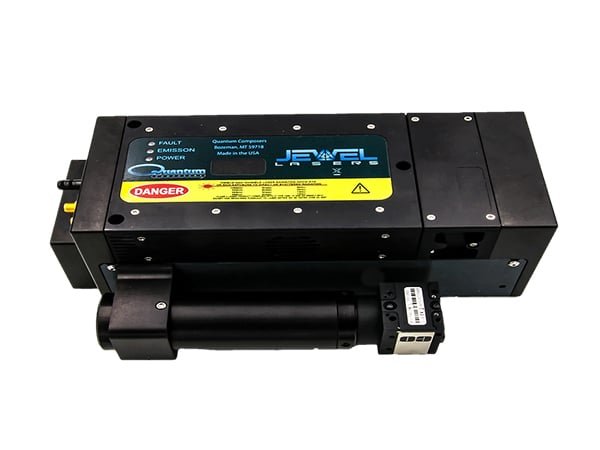
The MiniJewel System is a compact, multiwavelength imaging system, powered by our MiniJewel laser, with a choice of wavelengths and modules for complete beam control. The fundamental output is 1064, with optional nonlinear modules for 1064/532, 532/355, or 532/266. MiniJewel systems are perfect for setting on top of microscopes; they are small, compact, and easy to customize. Build a system to suit your exact requirements, using the many modules and options available. System Features Multi-wavelength systems, wavelength attenuation, fixed or adjustable polarization, beam blending, and camera port option. Applications include microablation, machining, marking, and more. Specifications Jewel Sealed, conductively cooled resonator integrated with drive and control electronics Laser - MiniJewel Wavelength Two wavelengths (1064/532, 532/355, or 532/266) Beam selection and energy control using filter wheel and dual wavelength attenuator Rep rate 1-20 Hz Nominal 21-50 Hz (1) Energy per pulse (typical) 1064nm ≥1.2mJ Energy is specified at the output of the LS-635B system and does not include losses from customer supplied optics. If required energy specification can be increased. 532nm ≥1.2mJ Energy is specified at the output of the LS-635B system and does not include losses from customer supplied optics. If required energy specification can be increased. 355nm ≥0.4mJ Energy is specified at the output of the LS-635B system and does not include losses from customer supplied optics. If required energy specification can be increased. 266nm ≥0.4mJ Energy is specified at the output of the LS-635B system and does not include losses from customer supplied optics. If required energy specification can be increased. Pulsewidth 1064nm ≤12ns Full width half maximum 532nm ≤11ns Full width half maximum 355nm ≤10ns Full width half maximum 266nm ≤10ns Full width half maximum Pulse to pulse stability Full aperture 50% 25% 10% 1064nm ≤3% ≤3.5% ≤4% ≤6% RMS pulse-to-pulse stability for 98% of pulses after warm-up, with a 100 shot sample window 532nm ≤3.5% ≤4% ≤4.5% ≤6.5% RMS pulse-to-pulse stability for 98% of pulses after warm-up, with a 100 shot sample window 355nm ≤4% ≤5% ≤6% ≤8% RMS pulse-to-pulse stability for 98% of pulses after warm-up, with a 100 shot sample window 266nm ≤4% ≤5% ≤6% ≤8% RMS pulse-to-pulse stability for 98% of pulses after warm-up, with a 100 shot sample window Diode lifetime 500,000,000 pulses X-Y Slit Laser - MiniJewel Range 0 to 2.5mm 0 to 4.0mm (optional) 0 to 50μm with 50x objective Accuracy ±(25µm + 0.01 size) Resolution 25µm 0.5µm with 50x objective Tact Time ≤1.0s Full range of travel Initialization ≤6.0s From power-up Theta Slit Laser - MiniJewel Rotation Range -45 to +45 degrees Accuracy ±1.0 degree Resolution 0.5 degrees Tact Time ≤1.0s Full range of travel Initialization ≤6.0s From power-up Filter Wheel Laser - MiniJewel Positions 4 Tact Time ≤1.0s Full range of travel Initialization ≤6.0s From power-up
CATEGORY
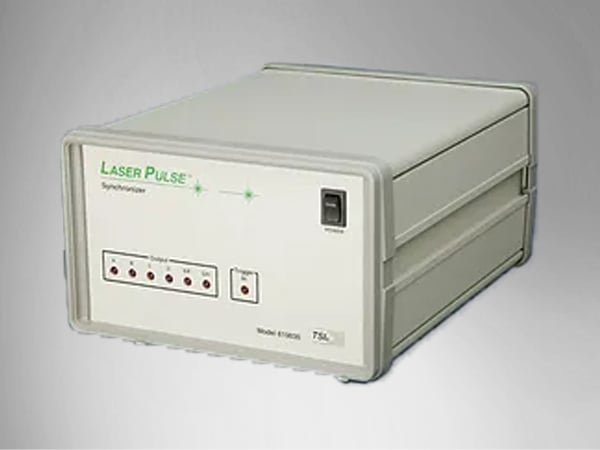
Our laser systems feature our Jewel line of DPSS Nd:YAG pulsed, lasers, designed for customers seeking compact, rugged solutions for micromachining and other laser applications.
CATEGORY
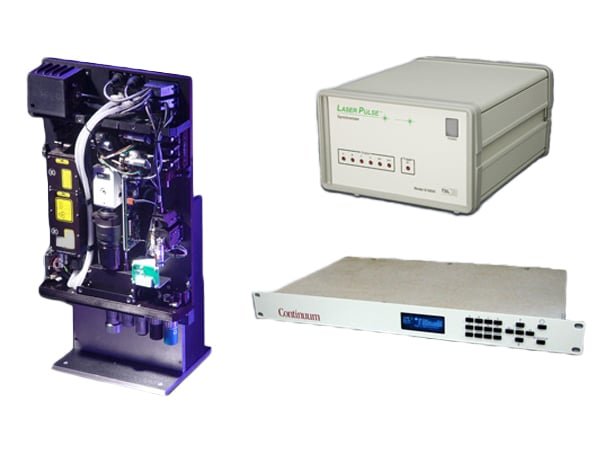
We can repackage, rebrand, or design from the ground up pulse generators, lasers, systems, and laser system modules to fit your unique application. Each component is offered commercial or custom.
CATEGORY
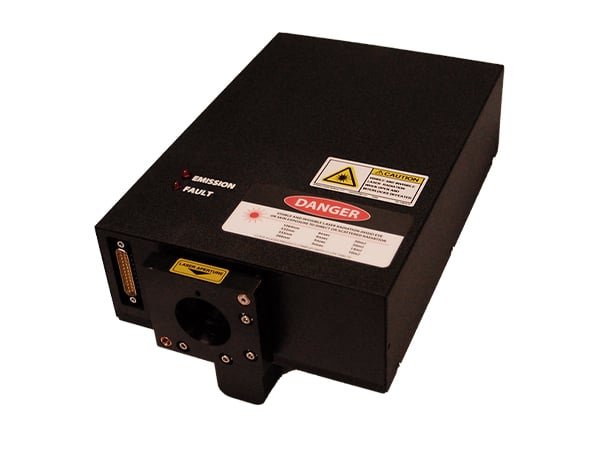
LS-635B is designed for reliable failure analysis and design validation applications with excellent beam uniformity. The LS-635B offers ultimate configuration flexibility, with variable configurations based on 1064/532/355/266nm wavelengths.The laser head is just 81mm x 194mm x 298mm and comes with either a 2U rackmount or tabletop power supply. - Compact DPSS Laser - High beam quality - Standard high energy (up 1.2mJ) - Enhanced pulse-to-pulse stability - Saving up to 6 user-defined cutting recipes - 1064/532nm; 1064/355nm; 532/266nm - 2.5mm standard shutter (4mm optional) - Rotating XY aperture, standard - Video port with c-mount adapter - Passive conductively cooled laser - Low Energy Consumption ( <100W) - Long lifetime 500,000,000 pulses - Low maintenance (no water leaks) - Smart controller (optional) with intuitive, touch-screen software. - Easy access to all parameter setting - Four function buttons for simplified operation - Remove EPOXY on surface by 266nm - Remove RGB color filter and keep metal line by 266nm - Laser marking for NGD (likes INK function) by 532nm - Remove polyimide passivation surface by 266nm Specifications Laser - Jewel Sealed, conductively cooled resonator integrated with drive and control electronics Wavelength: Two wavelengths (1064/532, 532/355, or 532/266) Rep rate: 1-20 Hz Nominal, 21-50 Hz Limited (2) Energy per pulse: 1064nm ≥4.0mJ (1064nm only), ≥1.25mJ (dual wavelength); 532nm ≥1.25mJ; 355nm ≥0.4mJ; 266nm ≥0.4mJ Pulsewidth: 1064nm ≤ 12 ns; 532nm ≤ 11 ns; 355nm ≤ 10 ns; 266nm ≤ 10 ns Pulse to pulse stability: 1064nm ≤3.0% ≤3.5% ≤4.0% ≤6.0%; 532nm ≤3.5% ≤4.0% ≤4.5% ≤6.5%; 355nm ≤4.0% ≤5.0% ≤6.0% ≤8.0%; 266nm ≤4.0% ≤5.0% ≤6.0% ≤8.0% Diode lifetime: 500,000,000 pulses Attenuator Attenuation Range: 0 to 100% Accuracy: ±0.5% Resolution: 0.20% Tact Time: ≤1.0s Initialization: ≤6.0s Filter Wheel Positions: 5 Tact Time: ≤1.0s Initialization: ≤6.0s X-Y Slit Range: 0 to 2.5mm, 0 to 4.0mm (optional) Accuracy: ±(25µm + 0.01 size) Resolution: 25µm Tact Time: ≤1.0s Initialization: ≤6.0s System Size: Laser Head 140mm x 87mm x 233mm; Power Supply 132mm x 58mm x 31mm Weight: Laser Head 3.5 kg; Power Supply ≤0.5 kg Operating Voltage: 110-240VAC, 50/60Hz Operating Power: <100 watts Computer Interface: Standard RS232
CATEGORY
