By Dectris Ltd.
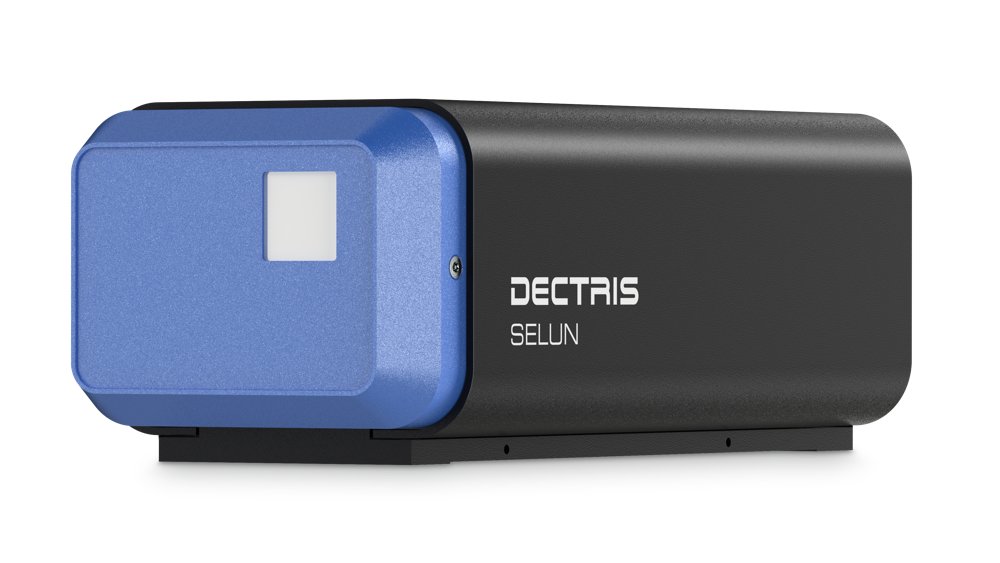
SELUN’s standout feature is the continuous frame rate of 120 kHz with a duty cycle of >98.8%. This can be achieved through on-chip 2x2 pixel binning in combination with a novel in-pixel compression scheme. The detector features a continuous 190x190 pixel matrix with a 100 µm pixel pitch and is compatible with both silicon and highZ sensors to provide optimal quantum efficiency, both at low (8-25 keV) and high (10-80 keV) photon energies. Detector Specifications Active area (W x H) [mm²]: 19.0 x 19.0 Pixel array (W x H): 2x2 binned: 94 x 94, Full: 190 x 190 Pixel size (W x H) [µm²]: 2x2 binned: 200 x 200, Full: 100 x 100 Count rate (max.) [ph/s/pixel]: 2x2 binned: 1.8 x 10 8, Full: 4.5 x 10 7 Energy range [keV]: 10 - 40 Threshold range [keV]: 5 - 25 Frame rate (max.) [Hz]: 2x2 binned: 120,000, Full: 30,000 Readout time: continuous readout, >98.8% duty cycle Image bit depth [bits]: 32, 16 Sensor thickness [µm]: 1,500 (CZT) Vacuum compatibility: yes Dimensions (W x H x D) [mm³]: 114 x 92 x 241.5 Weight [kg]: 3.7 Removable window: no All specifications are subject to change without notice.
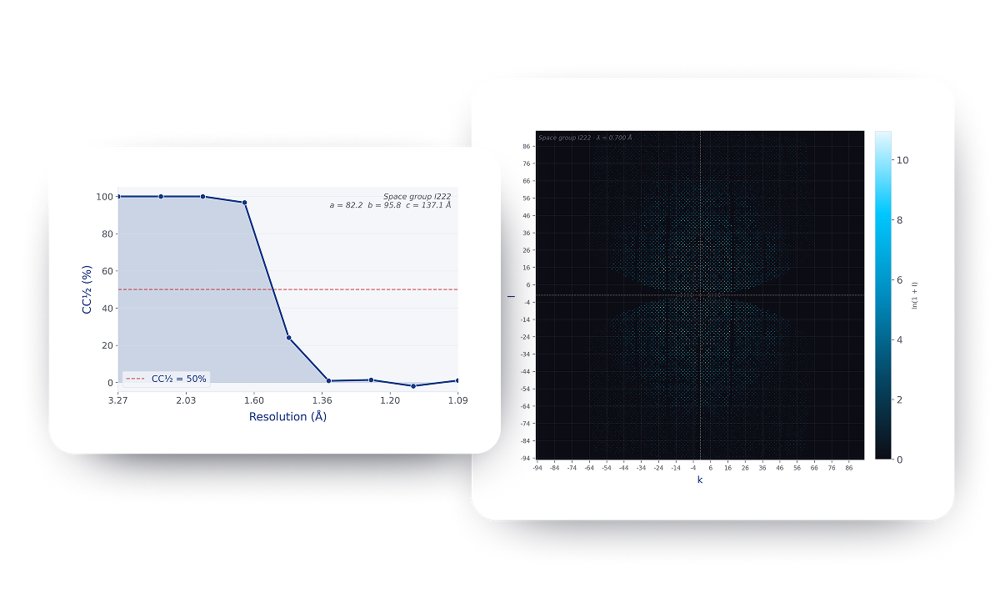
XDS stands for X-ray Detector Software for processing single-crystal monochromatic diffraction data recorded by rotation method: Developed and maintained by Wolfgang Kabsch, with core contributions from Kay Diederichs, XDS is the one of the gold standards for MX data processing. To guarantee its long-term availability, DECTRIS has entered an exclusive licensing agreement with Max Planck Innovation, Wolfgang Kabsch, and Kay Diederichs to steward, distribute, and support the software for the decades ahead. - Free and unlimited academic use - No time limitation or version expiration - Used for 50% PDB structures from synchrotron MX data How can I use XDS? Download & Run XDS runs on most Linux and MacOS distributions. To obtain XDS, simply request your download link below, unpack the software and run. Commercial users can obtain a yearly license from DECTRIS. Run online via DECTRIS D.LAB Use XDS in your browser with no installation, no environment maintenance and ready-to-run XDS templates, inlcuding automated visualization of results. The free academic tier of DECTRIS D.LAB includes up to 100 free XDS runs per month. How to ensure XDS produces consistent results? We believe that cross-version verification is one of the most rigorous reproducibility tests available for experimental data processing today. For the first time, users of XDS can verify the consistency and reliability of data processing results over current and past software versions. DECTRIS D.LAB hosts stable, prepackaged XDS releases alongside 50+ reference datasets, so anyone can inspect the software's behavior in detail accross different beamlines, detector types, sample systems, and data foramts. This work has been guided and enabled by Gleb Bourenkov, Gerard Bricogne, Ashwin Chari, Kay Diederichs, Wolfgang Kabsch, and Clemens Vonrhein. FAQs - Frequently Asked Questions Does an XDS license expire? No. Going forward all new XDS releases from DECTRIS can be used for an indefinite period - there are no time limitations or restrictions for both academic and proprietary users. Is XDS free to use? For academic users, XDS is free to use for an unlimited period. DECTRIS is bound by contract with Max Planck Innovation to ensure that XDS remains freely available to the academic community for a minimum of 10 years. Commercial users must acquire a yearly subscription license from xds@dectris.com. However, both academic and proprietary users share the identical executable files. Do I need to download a new license with every release? No. XDS does not require a license file, serial numbers, license keys, etc. All you need is to download the latest version of XDS and run it. It is up to you how often you want to update XDS. Is there a difference between the academic and commercial version of XDS? No. Both academic and commercial users must use the same files and binaries - there is no diference in functionality. As a beamline hosting industrial users, do I need to buy a license? No. If your customers own a valid license of XDS, you do NOT need to own a commercial license. How can I check if my beamline customers have a valid XDS license? Due to the striking differences in global data privacy laws, we are not allowed to share customer information with third parties. We trust you and your customers in ensuring that XDS is used according to our terms of use. What is the lifetime of academic and commercial licenses? Any new XDS version can be used for an indefinite amount - there is no expiry date. Commercial licenses are on a yearly subscription basis.
CATEGORY
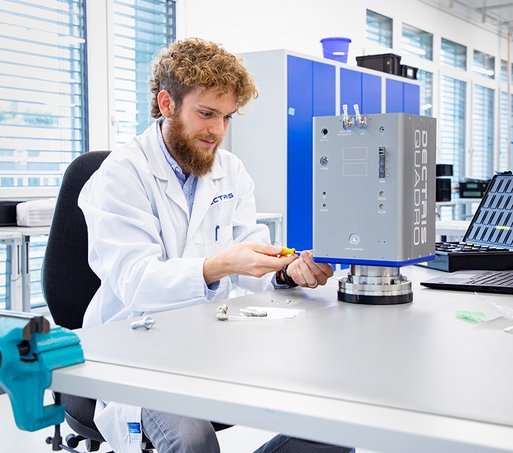
DECTRIS QUADRO® is a large-area, hybrid-pixel direct electron detector designed for electron diffraction and microscopy applications that demand true single-electron sensitivity. By counting individual electrons directly, DECTRIS QUADRO eliminates readout noise and dark current that limit conventional cameras. This allows researchers to resolve intense diffraction peaks and faint diffuse scattering within the same frame at speeds up to 4,500 Hz. Featuring a completely redesigned form factor with retractable mechanics, the latest generation of DECTRIS QUADRO ensures seamless mechanical integration into a wide range of electron microscopes. Across a multitude of published studies, DECTRIS QUADRO noise-free counting, radiation hardness, and speed have proven decisive where samples or physics tolerate no compromise. These features enable users to solve crystal structures from beam-sensitive organic and biogenic materials, tracking picosecond phonon and plasmon dynamics, and capturing real-time battery and catalyst transformations in-situ. From dedicated diffractometers to state-of-the-art transmission electron microscopes, DECTRIS QUADRO gives researchers ultimate confidence that their data reflects physical reality, completely free from detector artifacts. - Noise-Free Single-Electron Counting: Every pixel counts individual electrons directly, with zero readout noise, dark current, or gain variations. Weak, diffuse signals remain perfectly visible right next to strong Bragg peaks. - High-Speed Dynamics: Full-frame readout up to 4,500 Hz enables continuous-rotation electron diffraction, fast 4D STEM, in-situ imaging, and ultrafast pump-probe experiments without sacrificing data quality. - Low-Dose Efficiency and Longevity: High Detective Quantum Efficiency [DQE(0)] combined with a radiation-hard design allows DECTRIS QUADRO to extract maximum structural information at the low electron doses required by organic crystals, MOFs, and damage-prone specimens. Detector Specifications Number of pixels (W x H): 512 x 512 Active area (W x H) [ mm² ]: 38.25 x 38.25 Pixel size (W x H) [ µm² ]: 75 x 75 Sensor material: Silicon (Si) Energy range [ keV ]: 30 - 300 Frame rate (max.) [ Hz ]: 2,250 (16-bit); 4,500 (8-bit) Frame rate (ROI, max.) [ Hz ]: 9,000 (16-bit); 18,000 (8-bit) Count rate (max.) [ el/s/pixel ]: 10 7 Detective Quantum Efficiency, DQE(0): 0.81 at 100 kV, 0.85 at 200 kV Detector mounting: Retractable All specifications are subject to change without notice.
CATEGORY
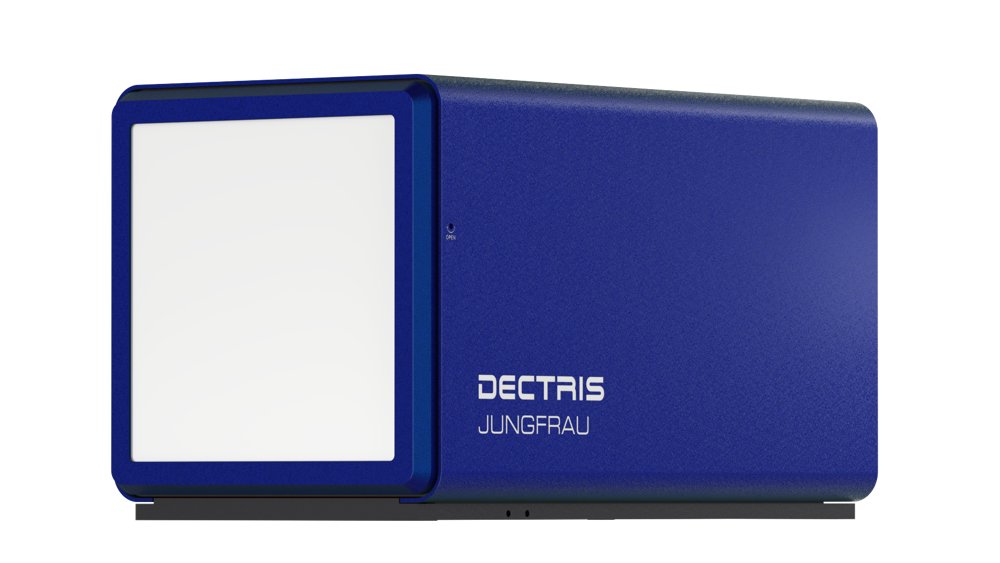
The DECTRIS JUNGFRAU® is our first charge-integrating detector, built for the extreme flux of 4th-generation synchrotrons. Per-pixel charge integration with three-level dynamic gain switching captures single photons and the most intense Bragg peaks in the same frame, without saturation, at a continuous 2,000 frames per second across the full 4-megapixel area. Each 75 µm pixel selects one of three calibrated gain stages depending upon the charge it collects: single-photon sensitivity at low flux; more than 10⁴ photons per pixel per frame at the top end. Charge integration has no instantaneous count-rate limit to plan around, and the sustained 2,000 Hz readout reliably records every frame of your experiment for seconds, minutes, or even hours. On-detector autosummation combines sub-frames on the fly, extending effective dynamic range and delivering fully calibrated images at the frame rate you need. This detector is specifically built for applications that demand highest local intensities, such as serial synchrotron crystallography (SSX); high-flux MX at kilohertz frame rates; pump-probe experiments; time-resolved SAXS/WAXS: Full-frame speed; uncompromised dynamic range; DECTRIS reliability. - Full-speed, full-frame: Continuous 2,000 fps across the full 4 MP frame - for every frame of the measurement, not just a fixed burst. - High dynamic range for the highest flux: From single photons to over 10⁴ photons per pixel per frame with no instantaneous count-rate limit: A powerful complement to photon counting. - Photon counts, out of the box: Energy calibration, pedestal correction, flat-field, and autosummation turn raw signal into photon counts for you: - no offline processing is required. - Easy to integrate, reliable: JUNGFRAU uses the same SIMPLON API, HDF5/NeXus, and Streaming interfaces as EIGER2 and PILATUS4; delivered and supported to DECTRIS standards. Detector Specifications: Active area (W x H) [ mm² ]: 155.1 × 162.6 mm² Pixel array (W x H): 2068 × 2168 pixels Pixel size (W x H) [ µm² ]: 75 × 75 µm² Inter-module gap (Hor./Vert.) [ pixels ]: 12/ 40 pixels Energy range [ keV ]: 7 - 18 keV Frame rate (max.) [ Hz ]: 2,000 Hz, continuous, full frame Readout time: Continuous readout, duty cycle 98% Image bit depth [ bits ]: 32 / 16 bit Sensor material: Silicon Sensor thickness [ µm ]: 450 µm Dimensions (W x H x D) [ mm³ ]: 300 × 313 x 551 mm Weight [ kg ]: Approx. 30 kg Cooling method: Liquid coolant, 17 °C Number of detector modules (W x H): 8 (2 × 4 matrix) Max. signal [ keV ]: 10,000 photons/pixel/frame @ 12 keV Response non-linearity [ % ]: 1% across the dynamic range Trigger modes [ TTL ]: Software and hardware trigger (TTL) Control & data interfaces: SIMPLON API, HDF5/NeXus, ZMQ stream, Monitor Max. data rate [ (GB/s) ]: 18 GB/s (16-bit, 2 kHz) Detector control unit: 1 rack-mounted server Detector operation: At ambient temperature; dry-air supply required All specifications are subject to change without notice. Extension below 7 keV is being characterized. Max signal inversely proportional to photon energy.
CATEGORY
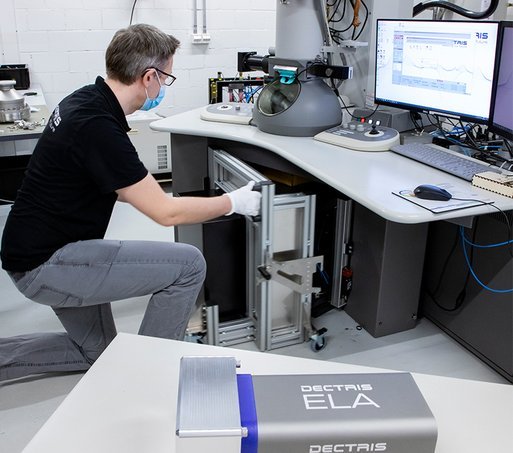
DECTRIS ELA® electron-counting detector offers best-in-class performance in terms of detector noise, frame rate, and dynamic range. It can handle a probe current well over 100 pA, and it simultaneously captures weak and intense reflections to enable advanced diffraction and imaging studies. In addition, it allows for fast elemental mapping in one go, which is especially crucial when working with beam-sensitive materials. ELA hybrid-pixel detector is specifically optimized for Electron Energy Loss Spectroscopy (EELS) and Four-Dimensional Scanning Transmission Electron Microscopy (4D STEM). - Captures everything: thanks to its dead-time-free readout, ELA detector collects all the information your sample can deliver. - Fast: ELA detector’s high frame and count rates reduce experiment time significantly and allow for increased instrument throughput. - Easy: ELA detector’s Application Programming Interface (API) enables straightforward integration into any modern data pipeline or electron microscopy suite. Detector Specifications Number of pixels (W x H): 1,028 x 512 Active area (W x H) [ mm² ]: 77.1 x 38.4 Pixel size (W x H) [ µm² ]: 75 x 75 Sensor material: Silicon (Si) Energy range [ keV ]: 30 - 300 Frame rate (max.) [ Hz ]: 2,250 (16-bit); 4,500 (8-bit) Frame rate (ROI, max.) [ Hz ]: 9,000 (16-bit); 18,000 (8-bit) Count rate (max.) [ el/s/pixel ]: 10 7 Detective Quantum Efficiency, DQE(0): 0.81 at 100 kV, 0.85 at 200 kV Detector mounting: On-axis, post spectrometer All specifications are subject to change without notice.
CATEGORY
