By IONTOF GmbH
From nm to µm – DSC, the high-performance work horse for inorganic depth profiling with O 2 and Cs The dual source ion column (DSC) is the latest high current sputter source for all inorganic depth profiling applications. The ion optical column is equipped with two ion sources, an electron impact gas ion source for operation with O 2, Ar or Xe and a thermal ionization caesium ion source. It features an in-column faraday cup for superior ease of use. The M6 can be operated at a repetition rate of up to 50 kHz in full interlaced mode which guarantees the highest possible data rates and optimum sample structure sampling. The example shows a depth profile of a buried multilayer structure. Due to the high repetition rate the structure can be resolved despite of the high sputter rate (100 nm/min).
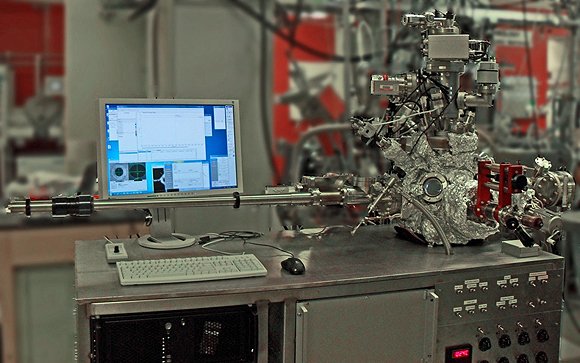
High performance Low Energy Ion Scattering (LEIS) Quantitative top atomic layer characterisation The Qtac is a high sensitivity Low Energy Ion Scattering (LEIS) instrument. It is extremely surface sensitive, providing quantitative elemental characterisation of the top atomic layer. This instrument has been developed to include small spot analysis, surface imaging, and both static and dynamic depth profiling. Its unique surface sensitivity makes the Qtac the perfect tool to study surface processes. The Qtac provides valuable information in many production and research areas on materials such as catalysts, semiconductors, metals, polymers, and fuel cells. Key features are - Quantitative, elemental characterisation of the top atomic layer - Spectroscopy, imaging and depth profiling capabilities - Time-of-flight mass filtering for improved sensitivity - Analysis of rough and non-conductive materials Energy Analyser The unique Qtac energy analyser design is based on the advanced Calipso technology. At the optimum scattering angle, the analyser has an acceptance over the full azimuth while maintaining a well-defined scattering angle. This, together with parallel energy detection, simultaneously provides high sensitivity and high mass resolution. The possibility of using heavier noble gas ions, which is usually not possible with conventional ion scattering spectrometers, is essential for unambiguous identification of all elements. The dedicated analyser design allows for non-destructive, reproducible and quantitative analysis of the top atomic layer. Time-of-Flight Mass Filter In conventional LEIS, secondary ions, generated by the impact of the noble gas ions, lead to a high background for low scattering energies. This background reduces dynamic range and detection limits, in particular for light elements. The Qtac is equipped with a time-of-flight detection system, which separates the scattered noble gas ions from this background. This unique feature significantly improves the elemental detection limits and the dynamic range of the instrument. LEIS Dual Beam Depth Profiling The Qtac can be equipped with a high current ion optical column fitted with an Ar electron impact gas ion source. This ion gun is used for ultra-low energy sputtering in combination with LEIS analysis. In this dual beam depth profiling mode high resolution chemical depth profiles are obtained. In contrast to SIMS, there is no need to use reactive sputter species, which would lead to changes in sputter rate and ionisation yield close to the surface. The Qtac100 provides easy quantification even in the first few nanometres of the profile.
CATEGORY
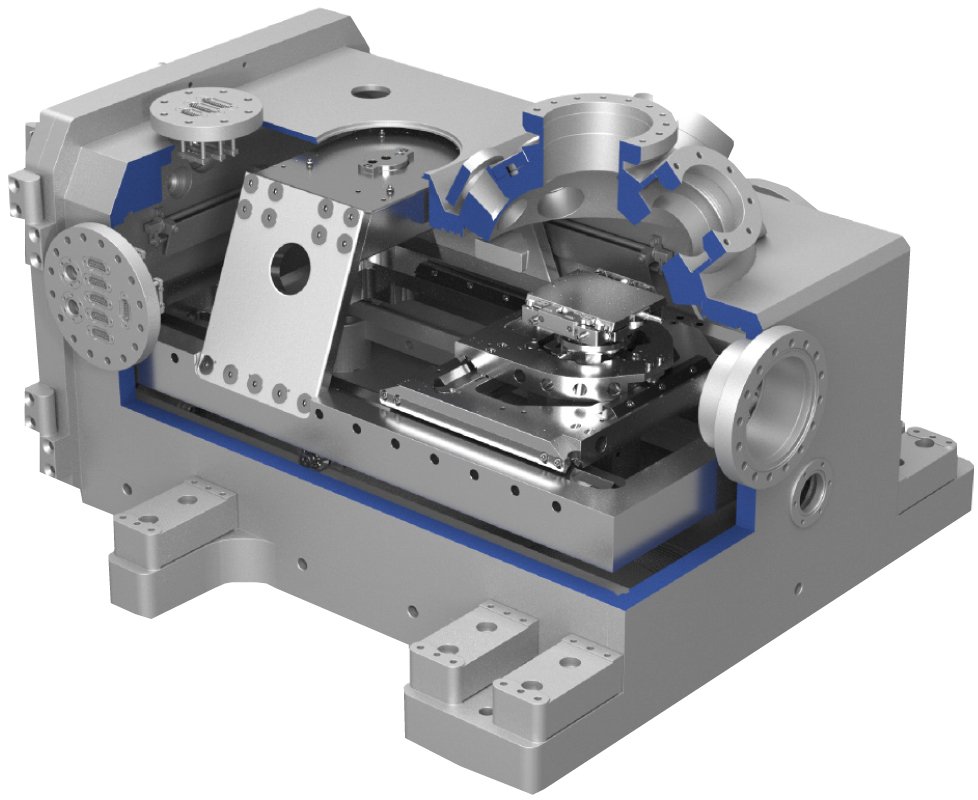
The tool for nano characterisation Information regarding the chemical composition, physical properties, and three-dimensional structure of materials and devices at the nanometre scale is crucial for new developments in nanoscience and nanotechnology. In a 3D SIMS measurement, the initial topography of the sample surface, as well as topographic changes during the experiment, cannot be easily identified. Scanning Probe Microscopy (SPM) provides complementary information about the surface topography and can also be used to measure the physical properties of the analysed sample. Through the combination of these two techniques true in situ three-dimensional chemical imaging becomes possible. The M6 Plus platform combines the high-end performance of the M6 with the possibility to perform in situ SPM measurements. The large area SPM unit has a scan range of up to 80 x 80 x 10 µm 3 and is ideally suited to provide topographic information for true 3D SIMS measurements. 1 Powerful tool for nano characterisation 2 All standard SPM modes e.g. AFM, KPFM, multi-frequency 3 Large SPM scan range of 80 x 80 x 10 µm 3 4 Unique surface profiler mode for large SIMS sputter crater measurements 5 Full compatibility with all M6 options Micrometre position accuracy: The piezo sample stage of the M6 Plus with sub-micron position accuracy ensures fast and precise movement between the TOF-SIMS and the SPM measurement position. The stage has a 10 nm encoder resolution and travel speeds of up to 10 mm/s which guarantees a high level of precision and stability. True 3D chemical imaging: The example below shows a three-dimensional analysis of a germanium structure inside a silicon matrix. The structure has a strong initial surface topography which leads to an incorrect representation of the chemical composition if TOF-SIMS data are used alone. By combining the chemical information of TOF-SIMS with the dimensional information of SPM a true three-dimensional chemical image can be generated. Surface profiler mode: The SPM module of the M6 Plus also allows for detailed analysis of large sputter craters. In the so-called surface profiler mode multiple SPM scans are stitched together to measure long SPM line scans. This unique SPM mode is extremely valuable to precisely determine the depth of sputter craters or to measure crater roughness on the nanometer scale. The example shows a SPM surface profiler scan of a 1.1 µm deep sputter crater in silicon. The line scan consists of multiple individual SPM scans. The recording time for the entire scan was less than 3 minutes and revealed a surface roughness of 0.7 nm (RMS) outside and 10.3 nm (RMS) inside the crater.
CATEGORY
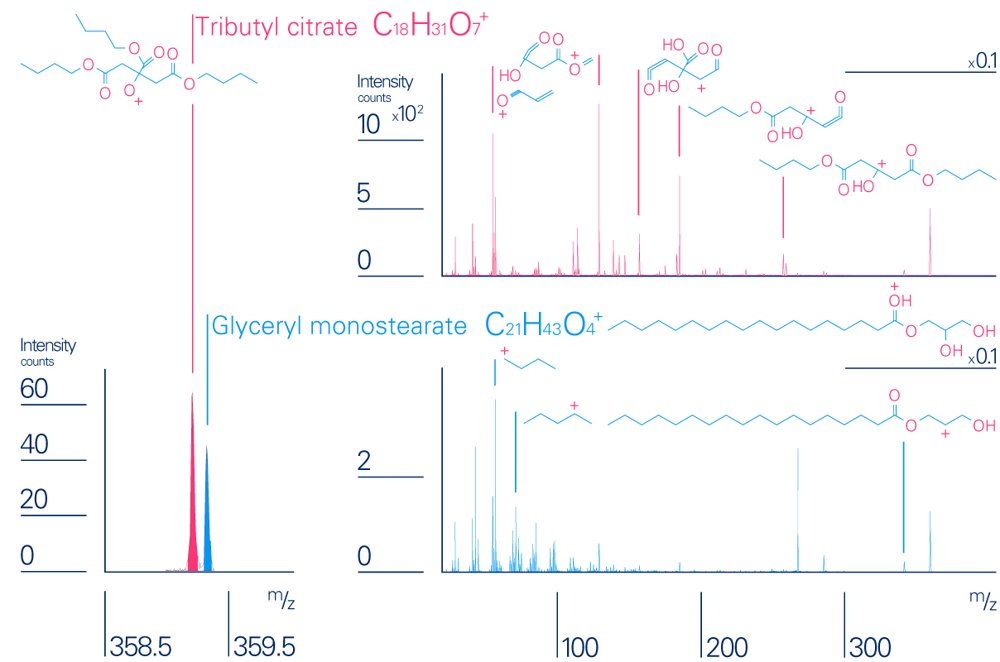
High transmission, high mass resolution precursor selection and MS/MS imaging Time-of-Flight SIMS is an excellent technique for the characterisation of organic surfaces and layer systems. However, interpretation of organic spectra can be quite challenging and requires a reasonably experienced user. To facilitate data interpretation IONTOF provides different tools such as spectra libraries, a fully integrated Multivariate Statistical Analysis (MVSA) software package and the ultimate performance Orbitrap TM extension for the M6, which provides highest mass resolution ( 240,000), highest mass accuracy (< 1 ppm) and high-end MS/MS. With the TOF MS/MS option IONTOF also offers a cost effective MS/MS solution for the M6. The option is ideally suited for quick confirmation of anticipated contaminants or compositions and fast MS/MS imaging or depth profiling applications. Key features of the TOF MS/MS are: 1 High transmission ( 80%) and sensitivity 2 High mass resolution precursor selection to avoid MS2 fragmentation pattern interferences 3 Sequential, full MS1 and MS2 data streams with individually optimised analysis conditions 4 Fully automated multiple precursor MS/MS acquisition 5 No limitation for the MS1 performance regarding angular acceptance, transmission or mass resolution High resolution precursor selection The example shows the MS/MS analysis of a mixture of tributyl citrate and glyceryl monostearate. Both molecules show a characteristic molecular peak at the same nominal mass. With the unique high mass resolution precursor selection it is possible to generate individual MS2 spectra of the different molecules and to avoid fragmentation pattern interferences. MS/MS imaging The example shows a high resolution MS/MS imaging analysis of Tinuvin 770 blooming on a small field of view (100 x 100 µm 2), demonstrating the superior transmission of the IONTOF TOF MS/MS system. The corresponding MS2 spectrum allows for the clear identification of characteristic molecular fragments.
CATEGORY
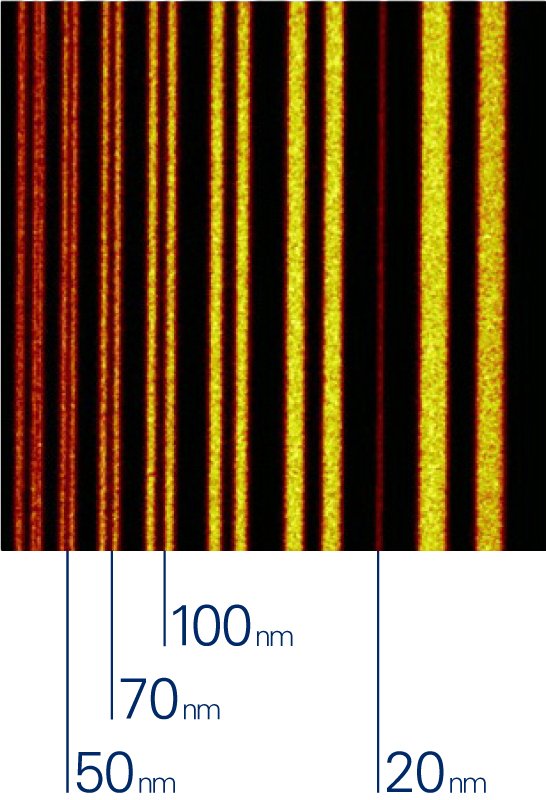
The benchmark in cluster ion beam technology 50 nm lateral resolution guaranteed and two times higher data rates The Nanoprobe 50 is the latest generation bismuth cluster ion source for the M6. The source provides pulsed primary ion currents of up to 40 pA and an ultimate lateral resolution of well below 50 nm. The bipolar bunching system can operate at repetition rates of up to 50 kHz, allowing for extremely high data rates and improved detection limits. The Nanoprobe 50 is the ideal primary ion source for high lateral resolution microanalysis and imaging as well as high mass resolution surface spectrometry and depth profiling. 1 50 nm lateral resolution guaranteed 2 40 nA DC current and up to 40 pA pulsed current 3 Bipolar bunching system for improved spectrometry performance and ease of operation 4 In-column measurement of mass separated, pulsed primary ion currents More flexibility and fully automated beam alignment The Nanoprobe 50 is also equipped with a high-precision aperture exchange system which provides a superior level of flexibility in combination with fully automated beam alignment. The operator can select from nine different apertures, which are then quickly (less than 2 s) aligned with nanometer precision, to have the best source setup for the analytical task at hand.
CATEGORY
