The FTA100 Series provides the Quality Assurance market with a low cost, reliable video-based contact angle and surface tension meter. Computer software analyzes drop shapes to give data without operator intervention or judgment. These instruments are simplified versions of the FTA200 Dynamic Contact Angle Analyzer. They are smaller, rugged, and weigh less. Transportable cases are available so they can be shipped or carried easily from site to site by the user. A pre-aligned, fixed optical system is used along with fixed lighting. These do not need normal user adjustment. Fluid is dispensed from industry standard pipette syringes. These can be preset to dispense specific volumes. Each of the models has specimen stage hardware intended for specific applications. The same software capabilities are provided in all models. The models include - FTA125: general purpose, compact - FTA135: semiconductor wafers - FTA136: low contact angles on glass - FTA137: directly measure on very large objects Common Features to All 100 Series Contact Angle Measurements The specimen is placed on a stage and raised to an appropriate level by the rack-and-pinion lift. The FTA100 series handles large samples by design. The unique optical design of the instrument looks down on specimens with prisms rather than requiring the specimen to fit between the light source and the camera. A prism turns the viewing angle to the normal side view for sessile drops, except in the case of the FTA136 which is strictly top view. With the specimen in place, the operator dispenses a drop by turning a knob or pushing a button on the pipette dispenser (several types are available as options). The software automatically analyzes the drop shape and computes the contact angle. Contact angles can be measured over the entire range from 0° to 180°. Optical issues make it difficult to obtain an accurate image at very low contact angles, say 5° and lower. Glare across the top of the image is a problem. The liquid is also very "thin" at the edges, leading to low contrast compared to higher angles. Thus, while there is no analytical limit to measurements at low angles, there are practical issues that limit the utility of automatic analysis. The operator can always perform a manual analysis by pointing at the drop edges at these low angle images. Low contact angles on transparent objects are more easily measured with the top view FTA136. Both fully automatic and manually-assisted analysis is possible. Manually assisted analysis can always measure over the entire range; it is automatic analysis that has difficulties at the extreme limits. Since automatic analysis of low contact angles is important in some industries, such as the glass industry, the top view FTA136 provides an attractive alternative. Droplet volumes will typically range from 3 to 15 micro liters. Needles are available in various diameters. An optional calibration standard, consisting of a sapphire ball embedded in a plate, is available so the system accuracy can be checked at any time by the user. Surface Tension Measurements Surface tension measurements are provided through pendant drop shape analysis. A calibration standard of high purity water is provided to ensure accuracy of the system. Surface Energy Surface energy is computed automatically whenever the test fluid is identified to the computer. The popular surface energy models are provided. A database is automatically created of your surface energy calculations. Data Reporting A log of date-and-time stamped measurements is automatically recorded on disk whenever enabled by the user. This ASCII text log can be printed or copied to floppy diskette. The user can also "freeze" a drop image and save the image to disk in a standard format for printing or use by other programs. This allows confirmation by others of the contact angle and the use of drop images in documentation. The log file can be imported into Excel where averages may be computed for statistical quality control. Software The software will run on Windows 98/ME/NT/2000/XP. On-line operator's manual and Help file are included. Software updates and upgrades are furnished without charge to users. Software licenses are sitewide, meaning the software may run on any number of the owner's computers. The FTA100 series will either capture and analyze single images ("snapshots") or sequences of images ("movies"). The former are suitable for static situations and the latter are used for dynamic samples such as absorption. A USB camera is available as an option. A few images per second can be captured (versus 60 per second with the standard NTSC video camera). The exact speed depends on computer used. The advantages, to some users, of USB cameras are they will run from a laptop (for portable applications) and a color camera is USB standard. Computer The instrument uses either an NTSC analog video camera (traditional type) or, optionally a USB camera. The NTSC analog video camera requires a PCI slot in the host computer. The USB camera requires an available USB port. In either case, a few watts, is safely drawn from the host computer. The computer is normally user-furnished, but complete systems including the computer are available from First Ten Angstroms. The USB camera option can be operated from a laptop. Supplied Equipment - Instrument chassis - Adjustable specimen stage (except FTA136 which rests on specimen) - High resolution camera and lens - Adjustable volume pipette syringe - PCI bus frame grabber (unless USB camera chosen) - Software running on Windows 98SE/ME/NT/2000/XP - User manual
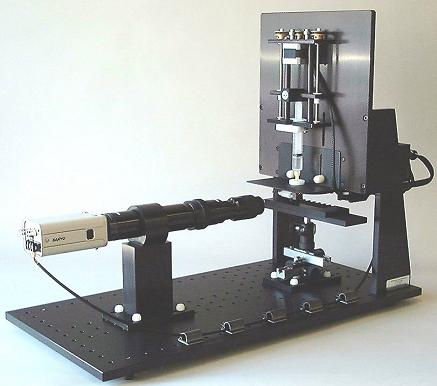
The FTÅ200 is a flexible video system for measuring contact angle, surface and interfacial tensions, wettability, and absorption. Refined software makes this an affordable solution to many industrial and academic measurement tasks. The FTÅ200 is a "what you see is what you get" instrument. The action appears live on the computer screen and the salient images are captured to the computer's memory for later image analysis. The time scale can vary from 1/60 second (60 images/second) to hours and can be varied nonlinearly to efficiently follow absorptions. The system can capture both static and dynamic behavior of liquid interactions. Analysis is based on the drop shape's size and shape, and data can be plotted with built in graphing facilities or exported to standard database and spreadsheet programs. Being a Windows program, it is easy to transfer data and images to other applications and across networks. The system functions as a transient analyzer, meaning it continually captures images and can recall any number of past images after a trigger event. A variety of dynamic events can furnish the trigger. One such trigger is real-time software detection of the drop detaching from the dispense tip. The automatic syringe pump, a timer, and user input, can also furnish triggers. Completely automatic image analysis is available, but manual and partially automatic modes are provided to accommodate difficult images Explicit graphics show the operator where the automatic algorithms found the drop and specimen edges. The analysis will function on true grayscale images which show sample detail, as opposed to only silhouette style images. In most cases, the standard deviation for contact angle measurements will be less than 1 degree and standard deviation for surface tensions less than 0.5 mN/m. Actual results will vary with sample preparation, image focus, and isolation from vibration and air currents. Useful resolution is 0.1 units in both cases. The software can measure or calculate many quantities of interest from the drop shape including: - Static or equilibrium contact angle - Capillary contact angle - Advancing contact angle - Receding contact angle - Pendant drop surface tension - Pendant drop interfacial tension - Drop volume interfacial tension - Sessile drop surface tension - Sessile drop spreading - Sessile drop adsorption - Surface energy from contact angles - Work of adhesion/adhesion tension - Critical micelle concentration - Zisman critical wetting tension Many of these are available as functions of time, that is, they are dynamic measurements. The system consists of a measurement platform and a frame grabber (video capture) card running in a personal computer. The computer may be user-furnished, requiring a PCI bus, or turnkey systems are available. The system can be configured in many ways, which is part of the power of the FTA200 solution. This is a toolkit for the surface scientist and readily adapts to new configurations. The standard FTÅ200 hardware includes: - High resolution camera and zoom microscope - PCI frame grabber card (computer optional) - Computer controlled syringe pump - Adjustable specimen stage - Computer controlled lighting Large specimens and nonflat specimens can be accommodated and a variety of special lens are available. The software will run on Windows 98SE/ME/NT/2000/XP. On-line operator's manual and Help file are included. Software updates and upgrades are furnished without charge to users. Software licenses are sitewide, meaning the software may run on any number of the owner's computers.
CATEGORY
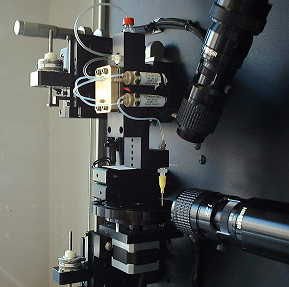
The FTA4000 is a video drop shape analysis system optimized for extremely small drops. Both sessile drop contact angle and pendant drop surface tensions can be measured. Surface regions as small as 50 microns in diameter can be probed with drop volumes as low as 10 picoliters. The image below shows the pump and circular sample stage directly below the yellow hub dispense needle. Liquid Dispense Controlled delivery of the test fluid becomes difficult at smaller droplet volumes because of the increased interfacial pressure expressed by the Young-Laplace equation. The unique NanoDispense electronic pump provides control for contact angle measurements for sessile drop volumes in from below 10 picoliters to many nanoliters. The tip has a motorized Z axis. It is positioned in X and Y by micrometers. The pump accepts a variety of Luer-hub needles from small stainless steel needles to glass capillaries. Sample Stage A round stage, approximately 100mm in diameter, rotates samples under the dispense tip. Samples are mounted around the periphery of the stage. The stage is rotated and positioned in Z by stepper motors. The stage can be easily removed to allow the user to fit their own or to mount fixtures on the stage. Approximately 35mm of Z travel is provided by the motor. Optics Two microscopes are fitted as standard equipemnt: an analytical microscope to capture the drop shape image and look-down alignment microscope to view the specimen and the droplet from a 60 degree angle. The analytical microscope has a zoomed horizontal field of view from 2mm down to 200 microns. The viewing angle is adjustable to 0° or 3° with respect to the specimen surface, so it is looking horizontally at the drop. This image is back-lit by a high intensity LED source The look-down alignment microscope has a zoomed horizontal field of view from 6mm down to 1mm. An incandescent top light is provided. This is a diffuse light and gives better images in look down mode than a focused light would. The look-down microscope has a seperate video channel and appears in a seperate window within the program than the main analytical image. Both microscopes feature internal focus for easy setup. You can capture and save images from both cameras. The image below shows the look down image of a glass capillary tip approaching a semiconductor sensor sample. Enclosure The entire instrument is enclosed to protect the measurement from air currents and rapid temperature changes. The design is clean room compatible. All components are mounted on a single vertical surface plate for rigidity and ease of access. The standard FTA4000 hardware includes: - High resolution analytical camera and zoom microscope - High intensity LED backlight - PCI frame grabber card (computer optional) - NanoDispense piezo-electric controlled drop dispense - Stepper motor driven pump and tip Z axis - Stepper motor driven rotation and Z sample stage - Look-down alignment camera and zoom microscope - Look-down diffuse illumination source Software Image capture is dynamic with variable resolution from 1/60 second to hours per image. Individual images or sequences up to hundreds of images long may be captured. All analysis is performed on images already captured in memory. Images may be captured from both microscopes. The software will run on Windows 2000/XP. On-line operator's manual and Help file are included. Software updates and upgrades are furnished without charge to users. Software licenses are sitewide, meaning the software may run on any number of the owner's computers. Analysis Functions - Static or equilibrium contact angle - Advancing contact angle - Receding contact angle - Sessile drop spreading - Surface energy from contact angles - Work of adhesion/adhesion tension - Zisman critical wetting tension Optional Equipment The following options are available. The high speed camera options are useful for ink jet studies. The X-Y motorization on the sample stage is useful for studying semiconductor chips where you want to place the droplet on a specific feature. If you have needs not covered here, please contact FTA. - 360 Frames Per Second camera - Split beam optics to accomodate external high speed camera such as Redlake's - High intensity halogen source (approximately 150W) for high speed imaging - X-Y Sample stage motorization (Z standard)
CATEGORY
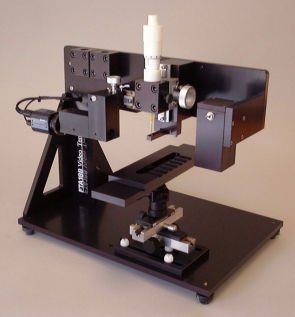
The FTA188 uses a classical horizontal optical bench design. A precision microscope provides a 6mm horizontal field of view. A rack-and-pinion stage focuses the microscope. The microscope and camera ride on a unique pivoting stage that quickly and easily sets the viewing angle anywhere from horizontal to 6 degrees look-down. This is useful for looking across large samples. An array of very bright LEDs provide backlighting with high uniformity across the field of view. Sample positioning is afforded by an X-Y-Z rack-and-pinion stage. Samples on this stage can be up to 150mm across and 25mm thick. The mechanical design leaves the entire right side of the instrument open. This allows very large samples to be handled with optional stages and it provides unparalled access to the measurement region. The operator can always clearly see the drop. Liquid dispense is provided by Gilmont manually operated micrometer syringes. This syringe snaps into place on a rack-and-pinion Z stage to set the exact height of the dispense tip and to touch off sessile drops for contact angle analysis. Holders are provided for two spare syringes so the user can have pre-loaded liquids for a full three-liquid Lewis acid/base analysis. The micrometer syringe provides precise dispense volumes to a practical resolution of 1ul. All sample stage, chamber, and pumping accessories of the FTA200 can be fitted to the FTA188. The one capability excluded is the zoom microscope of the FTA200. A special adaptor mounts to the FTA188 vertical surface plate to mount FTA200 chambers and pumps. Specimen stages directly bolt to the baseplate as the hole patterns are the same. Automatic contact angle and surface tension analysis is provided by the software which can run on any Windows 98/ME/NT/2000/XP computer. All analysis capabilities of the Fta32 Video software package are available, including graphing, data export, and surface energy calculations. Either static snap shots or dynamic movies can be captured and analyzed. An image analysis based software trigger starts movies upon sessile drop touch off. The user sets the image capture rate, which can be up to 60 independent images per second. Movies may be indefinitely long. The following options are installable by the user and can be easily added at any time: extra dispense syringes contact angle reference standard x2 adaptor lens for 3mm field of view USB camera for laptop operation and/or color imaging cuvette holder micrometer driven sample stage The following options require additional wiring and must be upgraded at the factory, but can also be added at any time: XYZ motor driven specimen stages autofocus for microscope motor driven syringe dispense pump peristaltic dispense pump
CATEGORY
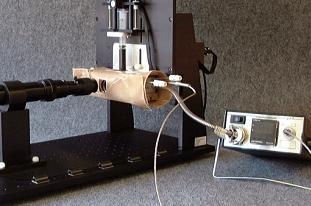
The Environmental Chamber (sometimes simply called the E Chamber) is a flexible chamber for the FTA188 and the FTA200. Depending on the system, it is run from a separate stand alone controller, as shown in the photo below, or from the Fta32 software. In either case, the temperature is precisely controlled to a fraction of a degree C. The recommended maximum temperature is 300C, but higher temperatures can be obtained with a boost transformer for the heater. In general, high temperatures, say above 250C, require much longer to reach (perhaps 30 minutes) and this becomes as much of a limitation as anything. If you need to operate above 300C, you should consider a tube furnace. FTA has kits that work with Lindberg/Blue M tube furnaces, to name one recognized supplier of laboratory furnaces. The sample stage is on a linear slide that can be moved from the outside. Up to five separate contact angle samples can be loaded and measured in one thermal cycle. The above photo shows the chamber mounted on an FTA200. The Kevlar insulating jacket is fitted in the image. The jacket serves two purposes: it minimizes heat loss and it serves as protection against burns caused by accidental touching the hot chamber. The chamber comes with a removable syringe shield, as shown in the photo below. The shield is the black cylinder rising up from the top of the chamber. Glass syringes fit snugly into the shield, with their needle penetrating the chamber top. The shield is essentially at the same temperature as the chamber, so the lower portion of the syringe is pre-warmed to the chamber temperature. The test liquid will always be at the chamber temperature because the stainless steel needle will have equilibrated to the chamber and will, in turn, warm the test liquid. The shield can be removed when it is desired to use an electrically heated syringe heater, available as an option. The option has its own RTD temperature sensor and controller, so it can be set at any temperature above the ambient. The chamber also has a loop in its walls for circulating bath liquid. This can be used as an alternative to electrical heating, or when it is desired to refrigerate the chamber below ambient. The bath is user furnished or a separate option. Two gas ports are provided for purge gas, typically to reduce oxidation of heated samples. The chamber is not gas-tight, so it should only be used with safe gases like nitrogen and argon. However the leakage rate is low, so gas consumption is not normally a problem. The chamber is not liquid tight, so it is not suitable for liquid-liquid interfacial tension work. FTA offers other chambers for these measurements. However, ordinary liquid-vapor measurements can be made in the chamber. Order number 20-04.
CATEGORY
