By DREEBIT GmbH
The IIF-S is the most compact one of DREEBIT's standard ion irradiation facilities. It can be equipped with Dresden EBIS/T ion sources providing various ion types from low-charged ions or molecule fragments up to highly charged ions. Depending on the ion source operation mode, continuous ion beams or ion pulses are transported through the beamline using ion optical elements (Einzel lenses, deflector elements) and ion beam diagnostics (Faraday cups). Ion species separation is realized by a Wien filter. The complete ion beamline, the ion source, as well as the target chamber are all designed for ultra high vacuum operation. A command and control system is delivered to operate the IIF-S via computer and automatically analyze the produced spectrum of ions. The following table gives an overview of typical ion output values of the facility equipped with a Dresden EBIS-A. The values depend on the chosen source parameters which were optimized for each individual charge state in the given table. Higher and lower ion outputs are possible if another ion source is chosen. The values were recorded before deceleration into the target chamber. Ion Species / Ions / s (DC) / Ions / s (Pulsed) H+ (fully ionized) 2 · 10 10; 1 · 10 10 at 100 Hz H 2+ 2 · 10 10 He 2+ (fully ionized) 6 · 10 8 C 4+ (He-like) 1 · 10 9 at 2 Hz C 6+ (fully ionized) 1 · 10 8 at 2 Hz Ar+ 2 · 10 9 Ar 8+ (Ne-like) 2 · 10 8; 1 · 10 8 at 10 Hz Ar 16+ (He-like) 7 · 10 6 at 1 Hz Ar 18+ (fully ionized) 1 · 10 5 at 1 Hz Kr 26+ (Ne-like) 2 · 10 6 Xe 44+ (Ne-like) 6 · 10 4 at 0.2 Hz Au 51+ (Ni-like) 7 · 10 5 at 1.4 Hz Au 60+ 4 · 10 3 at 0.4 Hz
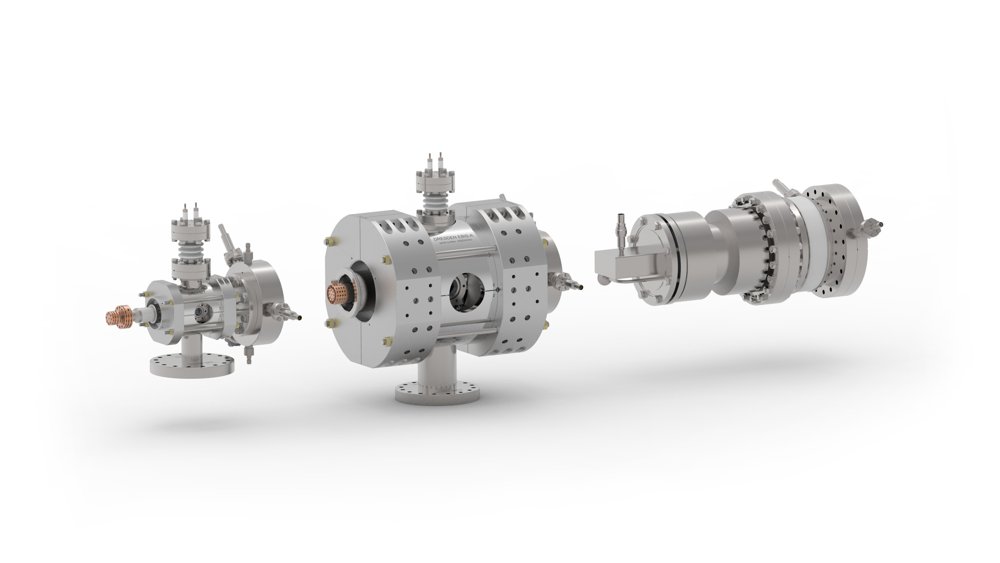
Room Temperature and Superconducting Ion Sources Made in Germany Ion Sources DREEBIT scientists have been developing ion sources for customer-specific applications for 20 years. All listed standard source models can be modified to suit your requirements. For questions or special requests please contact our staff! Dresden EBIT The Most Compact Ion Source of the Dresden EBIS/T Family The Dresden EBIT is a compact electron beam ion trap originally designed for x-ray spectroscopy purposes. As an ion source it represents a very cost-efficient alternative for the production of low, intermediate, and highly charged ions or molecule fragments if the ion output is not the most critical point of an application. Dresden EBIS-A A High Performance Permanent Magnet Electron Beam Ion Source The Dresden EBIS-A is an electron beam ion source able to produce ions of high charge states of practically all elements of the periodic table. It delivers beams of protons, alpha-particles, various highly charged ion species, as well as molecular fragments. Dresden ECRIS-2.45M A Full Permanent Magnet ECR Ion Source The Dresden ECRIS-2.45M is an electron cyclotron resonance ion source designed to produce low charged single particle and molecular ion beams in the range from about 10 microampere up to several milliampere, depending on the extracted ion species.
CATEGORY
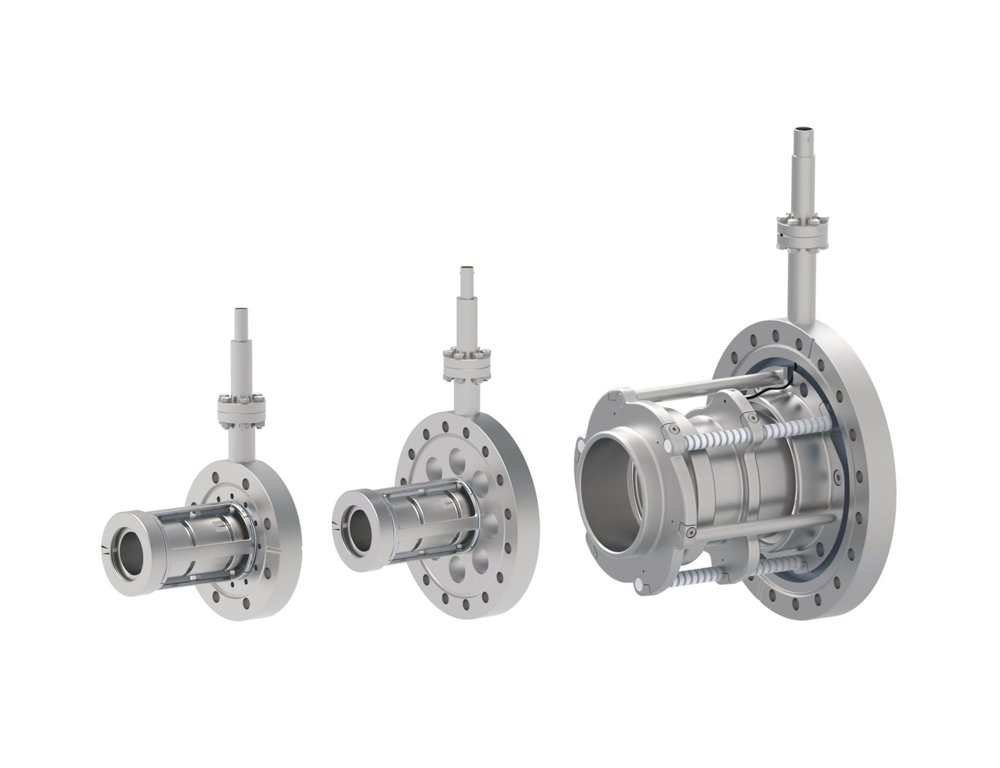
Beam Diagnostics Equipment for Analyses of Low and High Current Charged particle Beams Beam Diagnostics From simple current measurements to imaging-based analyses for detailed investigations of beam properties - DREEBIT offers various tools for physicists and engineers working with charged particle beams which can easily be integrated into existing facilities. Faraday Cup Faraday Cup for Low Current Measurements The Faraday cup is a device for measuring charged particle beam currents and charges in real-time. 4 Sector Faraday Cup Faraday Cup with 4 Additional Electrodes for Beam Positioning This Faraday cup is used for broad, off-axis charged particle beams which need to be focused and deflected in the right direction. It consists of a central electrode and four surrounding outer electrodes indicating the beam size and position in relation to the beamline center. High-Current Faraday Cup A Water Cooled Faraday Cup for High-Current Applications This chilled Faraday cup is a device for measuring high ion beam currents. The heating power from an incident ion beam of up to 1.5 kW can be dissipated while evaluating the signal. 4 Jaw Slit System Two Dimensional Beam Formation and Analysis The 4-Jaw Slit System is used for analyzing as well as forming the size and shape of a charged particle beam. It consists of four plates which can be moved individually from an out-of-beam position into the beam. Beam Imaging System Real-Time Charged Particle Beam Imaging The Beam Imaging System (BIS) allows the user to detect and evaluate particle beam cross sections in real-time in a high vacuum or ultra high vacuum environment. It creates an image of the beam by converting the incident beam signal into visible light. Pepperpot Emmitance Meter A Real-Time Beam Monitoring and Emittance Measurement System The Pepperpot Emittance Meter allows to evaluate beam parameters of particles as well as x-rays in real-time. A pepperpot-like mask separates the beam into beamlets. With an image of the beamlets taken by a CCD camera, a phase space analysis can be carried out and the beam's emittance and twiss parameters can be calculated. Retarding Field Analyzer Energy Distribution Analysis of Charged Particle Beams The Retarding Field Analyzer (RFA) is an electrostatic charged particle beam energy analyzer which allows for measuring the kinetic energy distribution and the energy spread of the particles up to a beam energy of 15 keV per charge state. Wien Filter A Compact Setup for Precise A/q Separation The Wien Filter is a charged particle separator with a crossed electric and magnetic field configuration (ExB). One ion species of interest with a specific velocity due to its mass-to-charge ratio passes the Wien Filter straightforward, all other species are deflected and absorbed between the Wien filter apertures.
CATEGORY
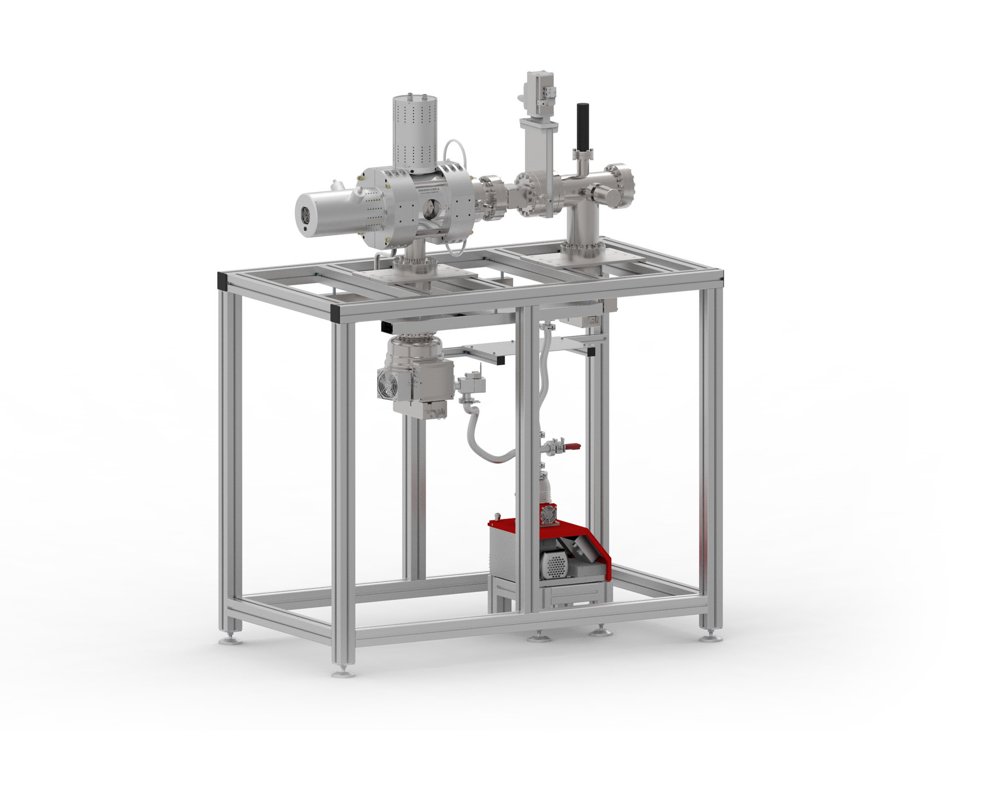
Standard Ion Beam Facilities to be Equipped with EBIS/EBIT or ECR Ion Sources Including Hardware and Software for Remote Control
CATEGORY
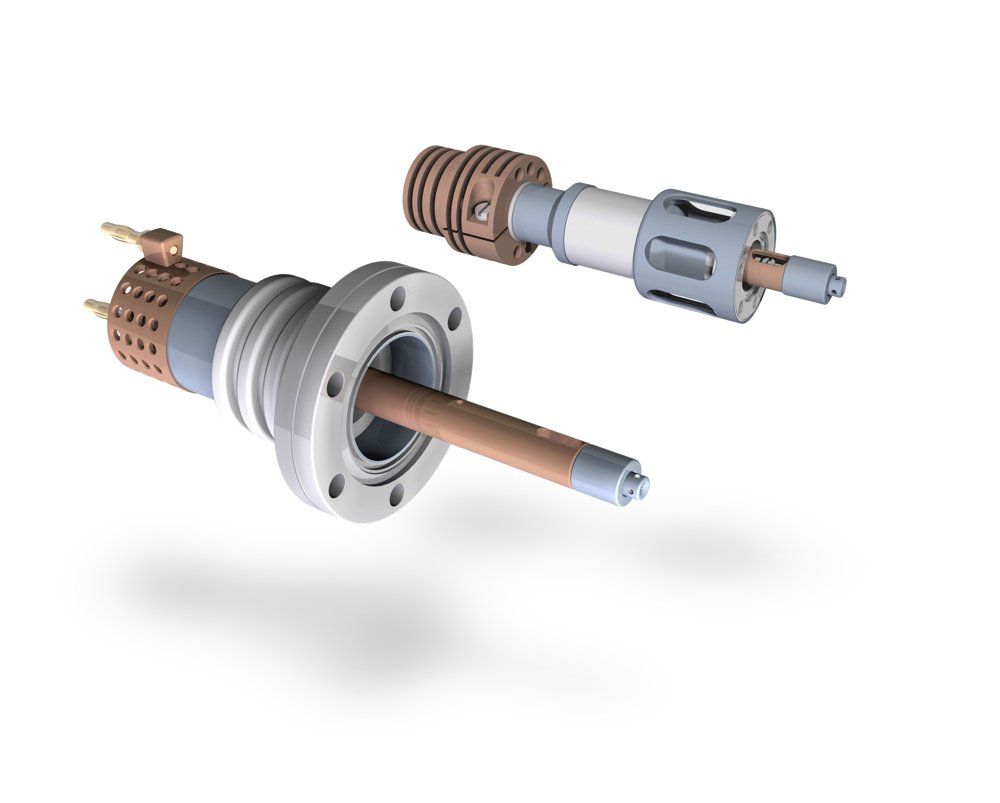
Additional Equipment and Spare Parts to Complete DREEBIT Products This is a summary of equipment and supplies available to complete various DREEBIT products. The listed items range from spare electron guns for Dresden EBIS / EBIT machines to electronics used for x-ray spectroscopical measurements. Spare Electron Guns EBIT and EBIS-A Spare Guns for Quick Cathode Replacement EBIS and EBIT cathodes have a limited lifetime and need to be replaced after several thousand hours of source operation. A spare electron gun with a readily installed new cathode can be used for instantaneous replacement to have the ion source back in operation as quick as possible. Beam Apertures Apertures for Charged Particle Beam Formation or Diagnostics Charged particle beam apertures can be used for several applications, for instance as entrance apertures for Faraday Cups, as cut-off apertures to reduce or form the particle beam sizes or as masks for irradiation of targets. Pepperpot Masks Multi-Hole Masks for Particle Beam Diagnostics Pepperpot Masks are multi-hole masks to separate particle beams into multiple beamlets. Particle beam separation is used in pepperpot devices to measure the transversal momentum distribution of incident particle beams and the beam emittance as well as for special cases of target irradiation. TERX Detection System Time and Energy Resolved X-ray Measurement The TERX detection system combined with an appropriate x-ray detector is used to measure x-ray spectra at Electron Beam Ion Sources in dependence on the ionisation time and in dependence on the electron energy.
CATEGORY
