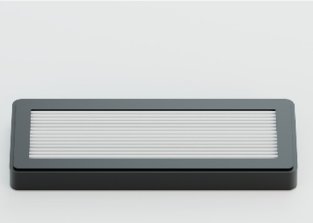
The installation and setting up of the Aplo Flow PREP system should take around 30-60 minutes. ONI recommends that two people remove the instrument from its box: One to lift the instrument out and one to hold the box in place. Dimensions: Width 360 mm; Depth 460 mm; Height (lid closed) 310 mm; Height (lid open) 610 mm; Weight 12.5 kg. Power Requirements: Input Voltage 100 / 240 VAC; Operating Voltage 24 VDC; Frequency 50/60 hertz; Required Amps 6.25 A. Environmental Conditions: Aplo Flow is designed for indoor use only. Temperature 18 – 30° C or 64 – 86° F; Relative Humidity 20 – 60% RH. Hardware overview includes Lid (provides access to the deck and protects the reagents during a run), Tinted windows (provides cover for light sensitive reagents), LED indicator (provides visual feedback during a run by changing the color), Air vent (air intake for the fan and HEPA filter), USB cable inlet (USB connection to a computer), Bristle plate (allows pass-through to the interior of the system), Power switch (powers the instrument on/off), Power inlet (connects to the power adapter), Serial plate (identification label for the instrument), Travel locks (used to hold parts in place during transport and to prevent damage to the system. Two locks are used to hold the axis drivers, and another one holds the pipette mechanism. Locks must be removed before turning on the system), Pipette head (stainless steel interchangeable pipetting head with on-board control unit), Deck (five SBS positions including a waste tub. The deck contains positioning clips that ensure sturdy positioning with minimal effort), HEPA filter (in a closed compartment. Minimizes contamination from the external environment), Gantry (sliding gantry for the x-axis and pipette head with z-axis). On installation and setting up: The pipette head is shipped in a separate small box held securely in the first layer of the Aplo Flow shipping box. Installation is simple and requires no tools.
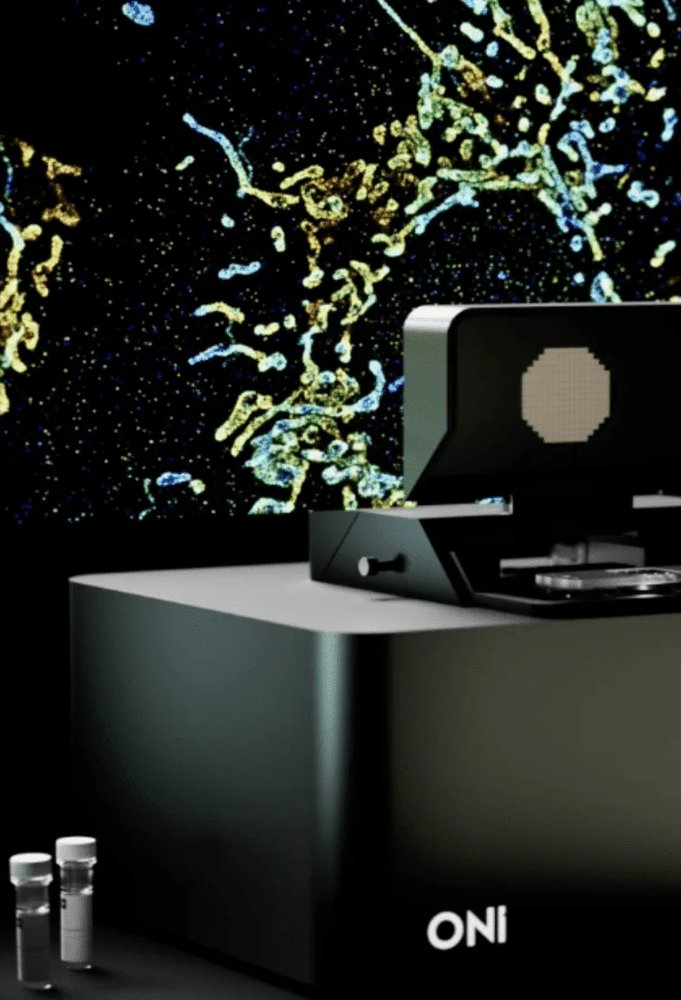
Acquisition, analysis and reporting in one place Flexible software for every environment Sample to answer CODI is a comprehensive software solution with automated image acquisition, analysis and reports anyone can use Flexible data access CODI runs in the cloud to allow analysis from everywhere, or offline to support local data and instrument control Analysis & reporting simplified Analysis app workflows can be customized to analyze hundreds of datasets and generate reports with ease Sharing and collaboration CODI cloud makes it easy to organize datasets and analyses into collaborations and instantly share them with collaborators. One platform, two ways to work CODI cloud CODI offline Analyze your data, your way Use CODI in the cloud or offline to acquire, analyze, organize, and report your data. Save analysis settings for specific experiments and apply them to newly acquired datasets to support reproducibility. Easily organize, analyze, and export images and reports. CODI cloud enables streamlined analysis, collaboration, and access from anywhere, while CODI offline runs locally in restricted-connectivity or air-gapped environments. What’s in CODI CODI space Datasets & collaborations Analysis workflows Share & export results With CODI you are able to Understand the morphology of my structure Understand how my molecules of interest organize Clean up my data to improve signal-to-noise ratio Identify EV subpopulations based on size or biomarker content Understand the morphology of my structure Single-molecule localization microscopy techniques, such as dSTORM, PAINT or PALM, pinpoint the position of individual molecules, providing morphological information of structures and the organization of proteins. To assess the distribution of a specific protein within a structure, a simple density profile measurement can be performed. 3D imaging and visualization further enhances the nanoscale information of structure morphology and protein organization. Understand how my molecules of interest organize One of the most powerful applications of SMLM is investigating spatial distributions down to the nanometer scale. The raw point cloud of localizations serves as the basis of nanoscale morphological analysis. CODI offers different clustering analyses including DBSCAN and our in-house extension of HDBSCAN called Constrained Clustering. Clustering on localization data allows researchers to find biological structures and quantify their morphological properties (size and shape), as well as determine presence or absence of specific markers of interest. Clean up my data to improve signal-to-noise ratio A critical part of SMLM imaging is removing noise to obtain accurate information and sensitivity for the analysis. To this end, the CODI analysis workflow includes a single-molecule filtering step that enables real-time visualization as users tune the filtering parameters, as well as default filters that serve as a great starting point for keeping only the most accurate data. Identify EV subpopulations based on size or biomarker content The EV Profiling App on CODI is the perfect analysis workflow for EV samples with various subpopulations, allowing you to quantify size and biomarker distributions from a collection of single EVs. The App includes a range of tools from drift correction, single-molecule filtering, clustering, cluster filtering, and counting of biomarker distribution. In addition, the batch analysis tool allows analysis automation by applying the same analysis settings to multiple datasets. CODI Apps CODI contains several app workflows to streamline and simplify single molecule data analysis. Each workflow is a unique combination of tools for a specific kind of dataset, all starting with the basics of spatial drift correction and single-molecule localization filtering.
CATEGORY
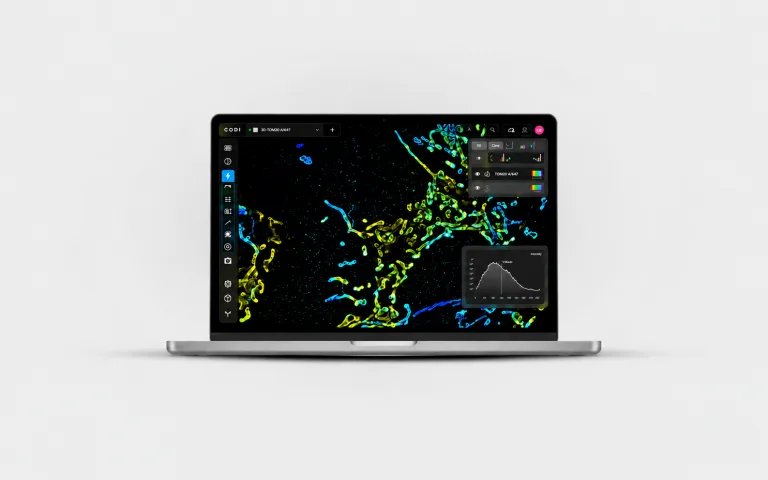
Powerful analysis, entirely within your environment CODI Offline brings the CODI experience directly to the Aplo Scope PC for laboratories with restricted connectivity, strict IT policies, or air-gapped environments. Control the instrument, acquire data, run supported workflows, analyze results, and generate reports without requiring an internet connection. Raw and processed data remain stored locally. - Operate without an internet connection - Keep raw and processed data stored locally - Support air-gapped and restricted-connectivity environments - Use a familiar interface consistent with CODI Cloud
CATEGORY
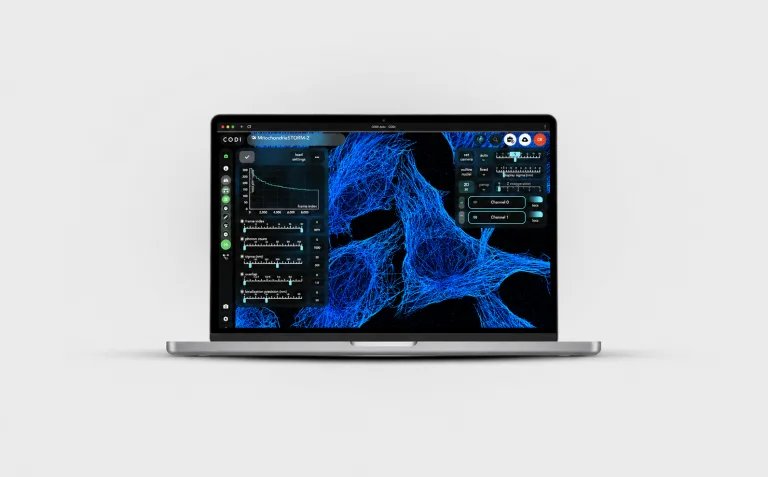
Connected analysis, built for collaboration CODI Cloud provides a streamlined environment for visualizing, analyzing, and managing your super-resolution data. Access datasets through the cloud, run supported analysis workflows, and move from acquisition to quantitative results in one connected experience. - Access and analyze your data through the cloud - Run supported visualization and analysis workflows - Easily manage and revisit datasets and results - Ideal for connected labs and collaborative workflows
CATEGORY