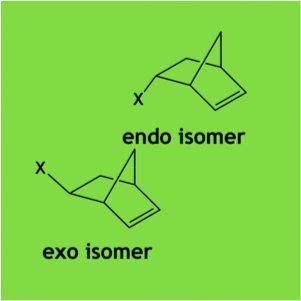
Our breakthrough catalyst technology enables us to polymerize functionalized norbornene monomers to make polynorbornenes (PNB) or cyclic olefin polymers (COP). To facilitate the demand for polymers and their applications, a broad array of functionalized norbornene monomers are available (e.g., acetate, ester, alcohol, ether, amine, alkyl, ketone, anhydride, silyl ether, epoxide, phenyl, vinyl). Contact us if you have a high value application requiring functionalized norbornene synthesis.
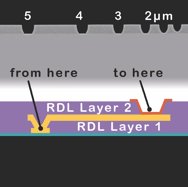
Redistribution is a process that utilizes photo-patternable dielectrics to encapsulate electrically conductive relocation traces. Polynorbornenes are finding their advantage in an industry moving toward smaller features and lower cure temperatures (170-200 ̊C). PDM-5013 has an inherently high Tg from its rigid polycyclic olefin backbone. Unlike its competition, it doesn’t need a high cure temperature to increase the Tg. This low cure temperature, balance of strength (100 MPa) and elongation beyond 40% makes it an attractive candidate for next-generation technologies.
CATEGORY

This polymer is specially formulated to combine adhesion and photo-patternability. After spin-coating onto a wafer or other preferred substrate, it undergoes i-line photolithography. Once features are defined by developing in tetramethylammonium hydroxide (TMAH), the wafer can be baked, diced and subject to thermo-compressive bonding (140 ̊C/sec). After a no-outgassing low temperature (175 ̊C) cure, a high strength bond is created between substrates, which can endure wire-bonding or solder reflow temperatures (4MPa at 260 ̊C).
CATEGORY

This system is designed to be 100% reactive with no need for solvent. Our proprietary blend is <30 cP, but can also be tailored to a variety of viscosities for several dispense techniques, including ink-jetting and traditional jet-dispensing. After a brief thermal cure, it polymerizes and solidifies to a thermoset in place. On its own, the polymer is capable of UL-94 V-0 rating. Its dielectric constant and low loss are comparable to PTFE, but its low viscosity may provide processing advantages.
CATEGORY
Typical polymer solutions are Newtonian fluids meaning that viscosity is linearly proportional to shear rate. In the case of PDM-5055, when the shear stress is removed, viscosity increases dramatically. This behavior is known as thixotropy. Most commonly, thixotropy can be observed in a stubborn bottle of ketchup. However, this behavior can be practically utilized in thread adhesives, paint and solder pastes. In all cases, when the shear forces are removed, the material has a tendency to stay put.
CATEGORY
