Real-time, continuous monitoring of aerosol chemical composition with improved mass resolution for better H:C, O:C, and NH4+ quantification Applications - Continuous on-line measurement of ambient aerosol mass concentrations and chemical composition including ammonium, nitrate, chloride, sulfate, and organic species - Routine air quality monitoring - Field measurements of aerosol chemical composition from high pollution at urban sites to pristine background at remote locations - Aerosol chamber studies - Mobile laboratory measurements - Optical/CCN closure - Source characterization - Industrial process monitoring Advantages - Improved elemental analysis (O:C, H:C) and NH4+ compared to standard Q- and TOF-ACSM - Aerodynamic particle lens for efficient gas-particle separation - Mass spectrometric analysis (0-400 amu) - Automated zeroing (filter) - Minimal maintenance; remote control ready - Direct linear detection of sulfate, nitrate, ammonium, chloride and organic aerosol species through two-step thermal vaporization (~600 C) and electron impact ionization process Detection Limits (µg m-3, 10 minute, 3σ) Organics: 0.14 Sulfate: 0.0087 Nitrate: 0.016 Chloride: 0.010 Ammonium: 0.0045 Mass Resolution - Up to 2000 m/∆m Mass Range - Adjustable, typically 1-400 m/z Data Rate - Adjustable, typically 10 minutes Data Format - HDF5 mass spectral data, delimited text for mass loadings - Custom acquisition and analysis software Software - Specialized routines for high resolution data analysis (O:C ratios) Sample Flow - 85 cc min -1 (volumetric flow) Aerosol Size Range - 70-700 nm vacuum aerodynamic diameter (standard lens) - 110-3500 nm (PM2.5 lens option) Size/Weight - Benchtop 26 in x 20 in x 24 in; 210 lbs [65 cm x 51cm x 60 cm; 95 kg] Electrical - 600 W max, 350 W typical - 90-260 VAC, 50-60 Hz * Specifications depend on instrument settings and are subject to change without notice. Comparison of higher resolution TOF-ACSM-X ion fitting compared to the lower resolution fitting of the TOF-ACSM and the high-resolution AMS and LTOF-AMS. The higher resolution fitting of the TOF-ACSM-X provides improved signal-to-noise reporting for ammonium, nitrate, and sulfate species, as well as the ability to perform elemental analysis and unconstrained source apportionment with PMF. The spectra above are a 10-minute data average and show how NH4+ can be separated from other interfering ions using the peak-fitting algorithm. Comparison of the detection limit for NH4, SO4, and NO3 for the TOF-ACSM-X in both high-resolution (HR) and unit mass resolution (UMR). The UMR is similar to the detection limits observed on the TOF-ACSM. The better detection limits are due to the increased resolution and ability to separate interfering ions.
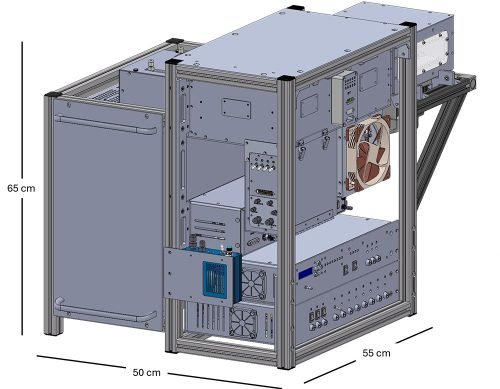
An ultra-compact, field-deployable PTR-TOF-MS combined with online TD-GC for the in situ monitoring of volatile organic compounds (VOCs) Aerodyne Research offers an instrument package that combines recent innovations in online gas chromatography (GC) with an ultra compact PTR-TOF-MS resulting in a highly field-deployable system for in situ measurements of VOCs. The system automatically alternates between two acquisition modes on a user-defined interval: 1. direct high-time resolution detection by PTR-TOF-MS 2. isomer resolved detection by GC-PTR-TOF-MS The GC system, equipped with integrated thermal desorption (TD) preconcentration, offers pseudo-continuous molecular speciation for isomer-level resolution while maintaining parts-per-trillion (ppt) limits of detection across wide volatility and functionality ranges. Online gas chromatograph (GC) system with integrated thermal desorption (TD) preconcentration coupled with an ultra compact proton transfer reaction time-of-flight mass spectrometer (PTR-TOF-MS) Compact GC-PTR Advantages - Field-deployable. Compact, robust design makes advanced, research-grade measurements possible in challenging and remote environments. - Fully automated switching between GC-PTR and direct-PTR measurements, providing automated acquisition of both online isomer-resolved data without sacrificing high time resolution detection. - Innovative VUV ionization cell provides exceptional sensitivity and stability, without humidity dependence. - GC thermal desorption preconcentration increases system sensitivity while the GC preseparation enhances compound resolution and aids interpretation of complex spectra. - Low detection limits: < 1 - 5 ppt (10 min) GC-PTR; 50 ppt (1 min) direct-PTR detection. - Low power (< 500 W, typical) and compact footprint (65 x 50 x 55 cm). - Fully automated analysis software provides real-time processing for a faster, more efficient data output.
CATEGORY
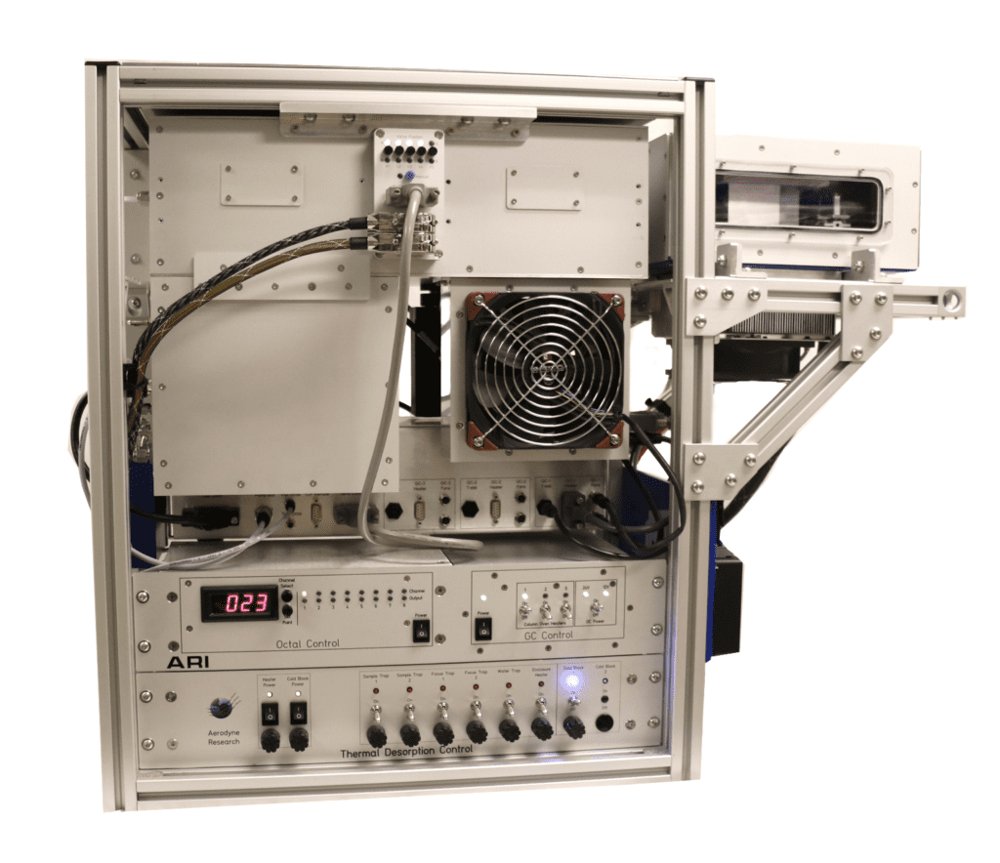
A field-deployable modular GC with thermal desorption pre-concentration for time-of-flight mass spectrometry with specialized software included for operation and data analysis. Aerodyne Research offers a modular gas chromatograph (GC) with thermal desorption preconcentration (TDPC) that combines recent innovations in fast GC separation with highly selective and sensitive detection in a field-deployable package for the measurement of VOCs and OVOCs. Aerodyne works with its customers to provide a GC system with a custom separation method appropriate for their analytical needs. The instrument delivers with the required capillary column installed and analytical methods pre-loaded into the Windows-based control software, for a true turn-key operation. Flexibility – up to three GC columns depending on application, pre-concentration methods (e.g. thermal desorption vs cryo-mechanical), detector type(s) Field deployable – ruggedized GC with small, light-weight footprint for automated operation Detector compatibility – true plug-and-play operation with all Aerodyne TOF-MS systems Dual detectors – designed to operate automatically with two detectors for a more complete data set Turn-Key – ready-to-run on delivery due to pre-installed analytical column(s) with custom pre-loaded method(s) Speed – flow path allows user to perform multiple GC operations at once; the benefit of this parallel operation is a faster GC cycle (10 – 30 min) without loss of performance. Analysis software included - Wavemetrics Igor Pro analysis software (TERN) allows for retention time correction, automated baseline and de-convoluted peak fitting for overlapping chromatographic peaks. Compatible for analysis of both high resolution (HR) and unit mass resolution (UMR) data.
CATEGORY
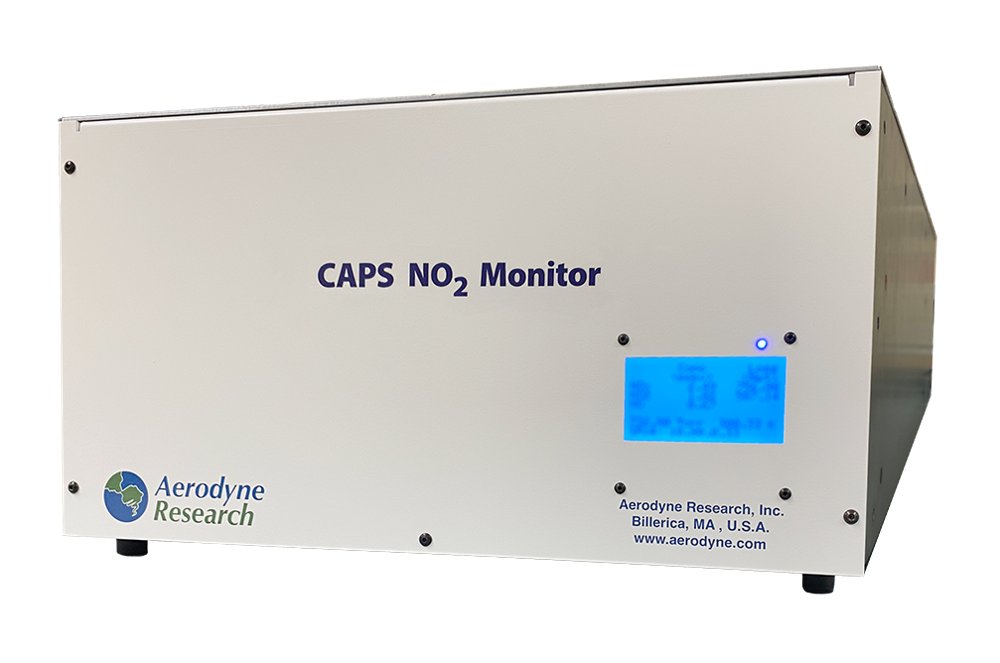
Fast, Accurate and Precise Continuous Measurement of Nitrogen Dioxide - Measurement of concentrations from pptv to 10 ppmv - High linearity (better than 1%) - Aquisition rate of 1 Hz - Direct measurement of NO 2; no chemical conversion required - Essentially interference-free - Automated and autonomous operation - Minimal maintenance (periodic change of filter and scrubber) - No toxic gas emissions - Customization available Measurement Specification: Ambient 0-3,000 ppbv; Fast Response (FR) 0-3,000 ppbv; Extended Range (EX) 0-10,000 ppbv Range (ppbv): Ambient 0-3,000; Fast Response (FR) 0-3,000; Extended Range (EX) 0-10,000 Resolution (ppbv): Ambient 0.01; Fast Response (FR) 0.01; Extended Range (EX) 0.01 Precision (2σ, 1 s) (ppbv): Ambient < 0.2; Fast Response (FR) < 0.5; Extended Range (EX) < 3 Time Response (10-90%): Ambient 7-8 s; Fast Response (FR) 1-2 s; Extended Range (EX) 1-2 s or 7-8 s Baseline Drift: Baselines Taken as Often as Required Span Drift: Negligible Linearity: < ± 5 ppbv at 1000 ppbv Flow Rate (lpm): Ambient 0.85; Fast Response (FR) 1.25; Extended Range (EX) 0.85 or 1.25 CAPS monitors are used worldwide in research laboratories and deployed in field campaigns at fixed sites, in mobile laboratories, and on ship and aircraft platforms. Automated and autonomous operation with minimal maintenance.
CATEGORY
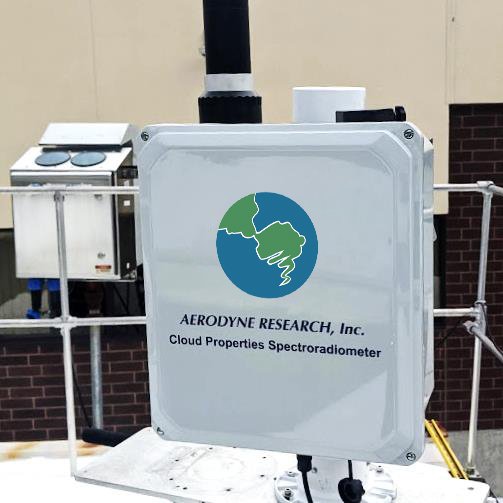
Accurate and Precise Continuous Monitoring of Cloud Properties: Optical Depth, Effective Radius, Phase - Measures VIS spectra (400-1700 nm) - Provides 1 Hz sample rate - Resolves thick/thin cloud ambiguity - High Temporal Resolution; Typical SNR (530 nm) 1000 at 1 Hz - Proven radiometric stability under harsh field conditions; frequent recalibration not required - Sealed IP65, IP66, IP67, IP68 enclosure - Includes radiometric calibration and a laptop computer fully loaded with executable software for control, data processing and user calibration - Demonstrated agreement with co-located AERONET sensors within 1% when comparing in-band solar radiance at 440 and 870 nm TWST Measurement Specification CPS Sensor Spectral Range 400-1000 nm / 950-1700 nm Spectral Resolution ~2 nm / ~6 nm Field of View.5 deg. FWHM Spectral Bands used in COD Retrieval 440, 760, and 870 or 780 nm COD Precision 1% (typical, depends on update rate) Operating Range Clear sky to COD 100 Data Logging Rate 1 Hz (typical), variable sampling internal from 1 to 60 seconds Method for Phase Retrieval 1600 nm spectral band Phase Designations Ice, Mixed, Liquid Method for R eff Retrieval Minimization of error between spectral radiance measurements and forward model
CATEGORY
