The functional unit of the aµtoPulse is the filter chip, which is engineered to meet the needs of the scientific community, delivering unparalleled speed, efficiency, and control for the most demanding low-volume workflows. Double Diaphragm for Faster Processing At the heart of the aµtoPulse chip are two diaphragm pumps that work in a synchronized fashion—while one expels fluid, the other refills. This eliminates downtime, enabling continuous flow and a concentration speed that is more than 1.5 times faster than that of single-diaphragm µPulse chips. Lowest Hold-Up Volume in Industry The aµtoPulse chip offers two distinct membrane pathways to suit a broader range of sample volumes and applications. - Small membrane area: 3.5 cm² - Large membrane: 8.5 cm² For high-volume samples, both membranes (with 12 cm² filtration area) work in parallel, enabling high-flux concentration. To reach ultra-low final volumes, the system intelligently transfers the sample to the smaller membrane. This selective routing allows the aµtoPulse chip to consistently reach a final volume of just 250 µL, the lowest hold-up volume ever achieved in TFF. Sensitive Handling The aµtoPulse chip features enhanced fluidic control through an innovative µPumping technique, enabling precise volume and flow control. Integrated channels allow reliable priming and sample recovery for all types of samples, including high-viscosity fluids. In addition, pressure-based flow control on the feed and retentate paths allows for operation across a range of flow rates and pressures. Integrated Transfer Tubing for Contamination-Free, Flexible Volume Processing The re-invented disposable filter chips integrate stainless steel transfer tubing to create an entirely consumable fluid path that prevents cross-contamination. For protocols requiring chip reuse, the tubing is fully compatible with the aµtoPulse’s automated Cleaning-In-Place (CIP) system. With dedicated cleaning stations connected to external reservoirs, the chips can be reliably cleaned between runs, thereby extending the utility of consumables without compromising performance. The transfer tubing design enables sample processing from various tube sizes. The left set of transfer tubes connects to 15 mL or 50 mL tubes for sample input. The middle one is designed for low-volume 1.5 mL tubes, and is essential for achieving ultra-low final volumes down to 250 µL. The right part of the transfer tubing is used to transfer the buffer or an extra sample, enhancing workflow flexibility. Versatile Membrane Compatibility and Wide MWCO Range The filter chips are designed to handle a broad range of buffers and solvents, making them suitable for diverse applications. The modified polyethersulfone (mPES) and regenerated cellulose (RC) membranes offer excellent resistance to harsh chemicals while ensuring high recovery rates. Additionally, the filter chips support a variety of molecular weight cutoffs (MWCOs). mPES membranes are available in pore sizes ranging from 5 to 300 kDa, while RC options include 5 to 100 kDa MWCO membranes, providing flexibility for various experimental needs. Feature RC mPES Pore Structure Symmetric Asymmetric Temperature Tolerance Low to Moderate High pH Resistance Moderate Tolerance to Extreme pHs High Tolerance to Extreme pHs Chemical Compatibility High Moderate Charge Uncharged The Sulfone Group is Negatively Charged at pH 7.0 Hydrophilicity High Moderate Thermal Stability Lower Compared to PES High Thermal Resistance Fouling Very Low Low Protein Binding Very Low Low Extractables Very Low Low Flux Rate Moderate High Suitability Preferred for Charged Proteins, Nucleic Acids, and LNPs Preferred for Uncharged Biomolecules
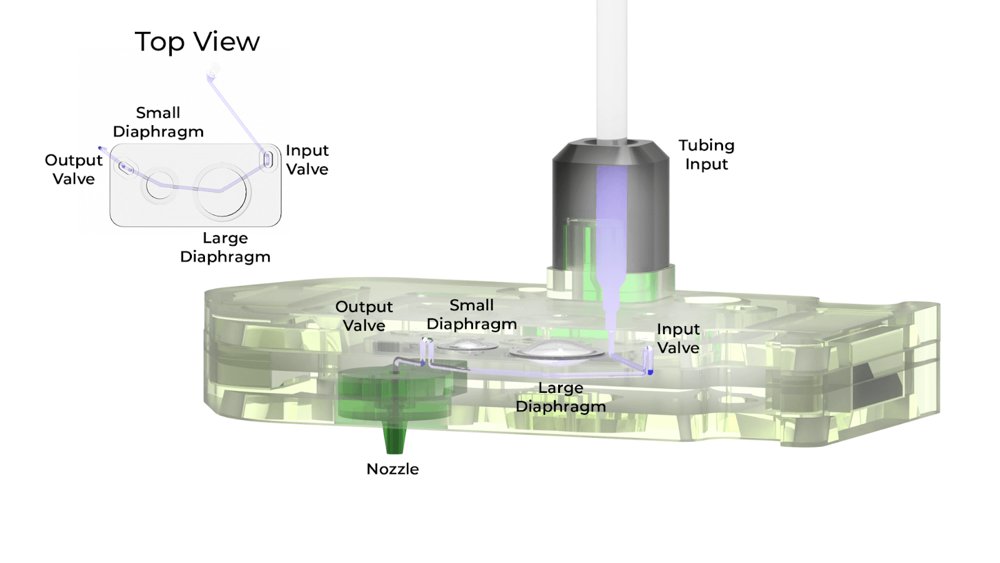
At the heart of these instruments are microfluidic chips - the functional units that deliver exceptional precision, speed, and sustainability from nanoliters to milliliters. Mantis Microfluidic Chip These microfluidic chips use patented microdiaphragms and valves that are pneumatically controlled to deliver metered droplets, enabling precise, non-contact dispensing. The dispensing cycle begins when vacuum is applied to the input valve, drawing a fixed volume of liquid into the microdiaphragm. Pressure then closes the input valve to isolate the measured volume; after which, the output valve opens, and pressure is applied to the diaphragm, which expels the droplet through the nozzle. This innovative design enables the dispensing of fixed discrete volumes, even for challenging liquids such as volatile and viscous solutions. Sustainable, Tipless Dispensing: High-throughput assays consume enormous amounts of plastic tips, incurring both financial and environmental costs. Our microfluidic chips make tipless dispensing the new standard for modern laboratories. Their reusable design cuts consumable cost, while built-in RFID tracking monitors chip usage to ensure consistent performance. Each chip is optimized for reliability and longevity, turning sustainability into a core design principle rather than an afterthought. No Cross-Contamination: In high-value assays, cross-contamination is a critical failure point, causing batch loss, increased costs, and compromised results. Formulatrix microfluidic chips are built to eliminate cross-contamination. Each reagent travels through an isolated fluid path and is dispensed non-contact, preventing reagent carryover between dispenses. The chip is designed for reuse—simply wash it to clear the fluid path of any residual material. Together, these features protect even the most sensitive assays, ensuring the accuracy and reliability of every result. Miniaturization with Precision and Efficiency: As modern workflows move toward smaller reaction volumes, every drop counts. Traditional systems struggle, wasting reagents through dead volume and losing accuracy at sub-microliter scales. Formulatrix microfluidic chips solve these challenges by dispensing volumes down to 100 nL with < 2% CV, even into 384- and 1536-well plates with the dead volume as low as 6 µL . This minimizes waste and maximizes the value of every reagent and enzyme, enabling true assay miniaturization without sacrificing accuracy.
CATEGORY
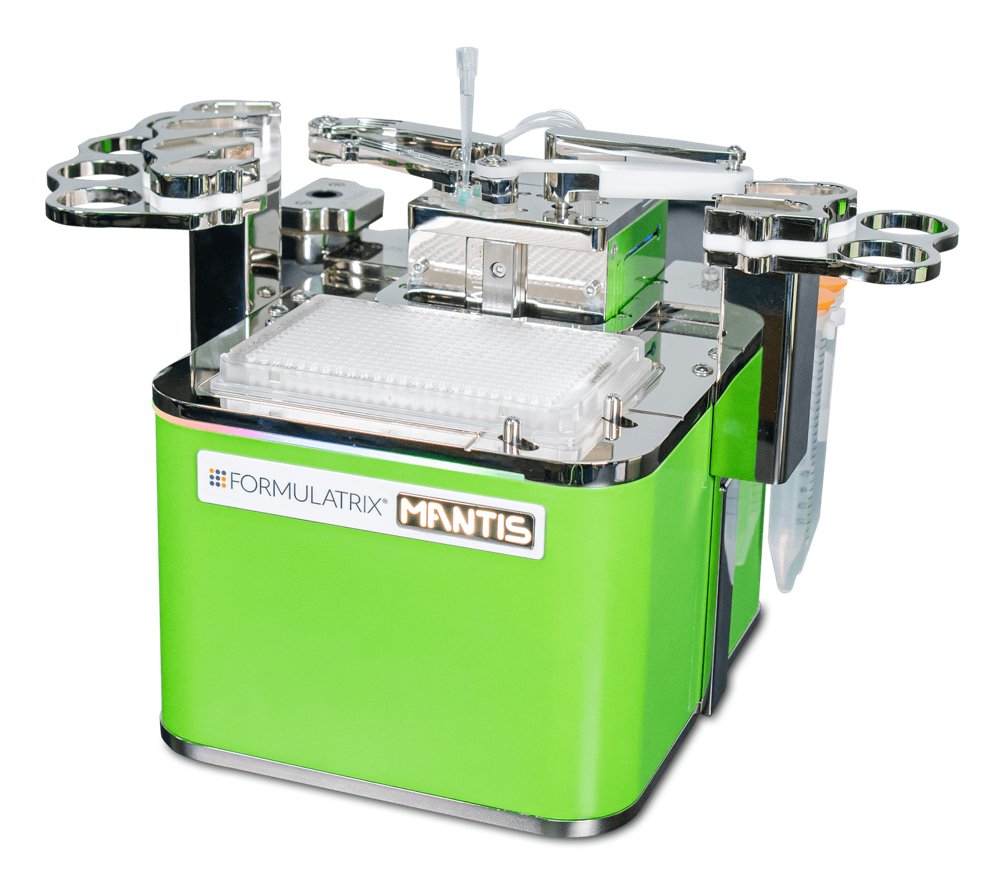
A compact, programmable dispenser built for workflows where every nanoliter counts from master mix preparation to sensitive cell and bead dispensing. Volume Range Min: 0.1 µL Max: ∞ Technology Micro-Diaphragm Pumps + Continuous Flow Precision CV <2% @ 0.1 µL More Than a Reagent Dispenser While traditional handheld pipettes or larger automated liquid dispensers greatly deteriorate in accuracy and precision below 2 µL volumes, the Mantis automated liquid dispenser excels at low-volume dispensing in a wide variety of scientific workflows. The system is an easy and affordable solution to quickly increase the reproducibility and quality of your research as well as the throughput and efficiency of your laboratory. The diaphragm-based chip design is liquid class compatible, easily dispensing aqueous and organic solutions. Additionally, the Mantis will dispense in any SBS template from 6 to 1536 well plates and can be easily programmed to dispense to custom designs as needed. Reduce Costs - Save on Reagents and Consumables - Miniaturize reactions with tipless dispensing Reproducible and Accurate - Enhanced Precision & Accuracy - Dispense volumes down to 100 nL at CV < 2% Versatile and Flexible - Dispense and Normalize with Ease - Reagent dispensing for a broad range of applications Benefits High Precision and Reproducibility: Dispense volumes as low as 100 nL with exceptional consistency (CV < 2%), enabled by the new High-Fidelity Chips that ensure even tighter control over dispense accuracy and precision Efficient: Miniaturize reactions, scale up throughput, save on reagents, and remove pipette tip cost, saving time and resources across the board Tackle High-Viscosity and Diverse Reagents: The continuous flow chips enable accurate dispensing of thick fluids like 70% glycerol, DMSO, beads, and mastermix—ensuring broad reagent compatibility for various workflows Reliability and Traceability with Every Dispense: The Mantis ensures reliable dispensing with droplet verification, real-time LED status, automated breach detection, and RFID tracking for accurate, traceable results and enhanced uptime across your workflows Fast, Error-Free Setup with CSV Templates: Seamlessly import CSV templates for quick and error-free experiment setup, streamlining workflows and reagent normalization Fast Labware Setup with Intuitive Control: Define labware in seconds with the Interactive Labware Teaching module, and enjoy a streamlined setup process through an intuitive user interface Compatible with a Broader Range of Plates: The Adaptable Plate Clamp is gentle enough to accommodate even thin-bottomed plates Biosafety Cabinet Compatible: With its compact dimensions (350 mm x 232 mm x 212 mm), the Mantis can be used in various biosafety cabinets to accommodate workflows that require this level of safety Automation Friendly: Integrate effortlessly with external systems, fostering connectivity and dat a synchronization Seamless Operation in Regulatory Environments: The system features optional 21 CFR Part 11 Capable Software Small Footprint: All these new features are packed within the same small footprint Broad Range of Applications - Assay Development and Design of Experiment (DoE) - Next Generation Sequencing (NGS) - Library Preparation - Polymerase Chain-reaction (PCR) Workflows Real-time and Digital - Enzyme-Linked Immunosorbent Assays (ELISA) - Cell Culture and Bead-Based Assays - Scaling Up Organoid Cultures - 3D Cell Culture Automated Washing Built-in dual wash stations for easy fluid pathway cleaning following dispenses. QC Droplet Detection Station Verify your dispenses with the new Quality Control Droplet Detection Station Waste Collection Waste Station Sample Numbers and Accessories Automatic Chip Changer (ACC) - Dispense up to 6 reagents to create complex plates and assay development protocols Large Capacity Chip Changer (LC³) - Up to 24 reagents can automatically be dispensed Flexible Reagent Formats Use Any of these Reagent Formats - Pipette Tips - Microfuge Tubes - 15 mL and 50 mL Tubes - Bottles Plate and Sample Types (SBS, Tubes and More) Dispense into 6-, 24-, 48-, 96-, 384-, and 1536-well formats. Able to create custom, non-standard plate templates quickly and easily Accuracy of 'Chips' State-of-the-art Dispensing Technology Accurately and rapidly dispense discrete, or continuous volumes of liquid, - 0.1 μL – 5 μL - CV's < 3% - Continuous flow (600 μL /sec.) Radio-Frequency Identification (RFID) Automatically track all your chip usage data including, diaphragm cycles and dispense history. The RFID chip will also notify you if any reagent is not in the correct position on the system. Compatability Chemical: Dispense DMSO and other harsh solvents using optional perfluoroelastomer chips Hardware: Expands the number of reagents that can be dispensed by adding a modular carousel for up to 24 chips, or 48 different reagents
CATEGORY
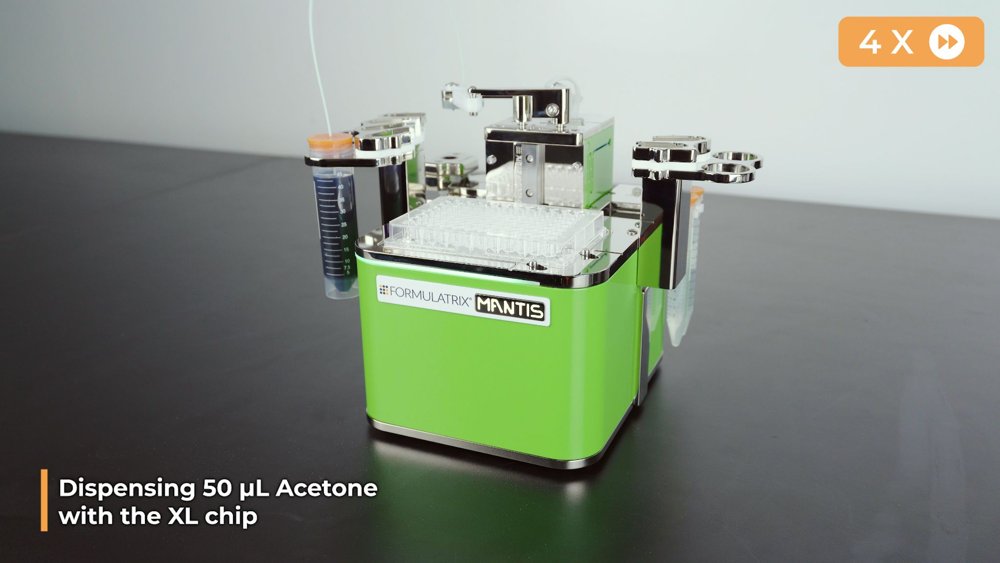
Precision meets power with the all-new XL Chip, engineered to deliver metered dispensing of 50 µL, making it the largest-volume diaphragm chip in our Mantis chip catalog. Designed for applications that require higher robustness, scalability, and chemical compatibility, the XL chip represent the next evolution in automated liquid dispensing. Modern chemistry workflows, from reaction setup and compound screening to formulation and sample prep, routinely rely on the dispensing of aggressive solvents and corrosive reagents. Our LV and HV PFE chips have long supported miniaturized, high-precision workflows for harsh reagents. But for workflows that operate at higher volumes and with harsher reagents, a new level of performance was needed. Designed for Chemistry - Built to Scale The XL Chip have been developed specifically to bridge this gap. With a 50 µL metered volume, it enables the accurate dispensing of larger volumes in a single shot, reducing the need for repeated cycles and minimizing wear on the system. Its advanced chemical-resistant fluorinated ethylene propylene (FEP) body and perfluoroelastomer (PFE)diaphragm ensure reliable performance with even the most challenging solvents, for example, DMSO, THF, Toluene, Chloroform, as well as strong acids and bases. Key Benefits - High-volume metered dispensing: (50 µL) in a single actuation- filling 96 well-plate in less than a minute - Exceptional chemical compatibility:Compatible with a vast range of aggressive chemicals - No calibration required: The system is ready to use out of the box for consistent performance - Exceptional precision:CV < 2% at 50 µL for high reproducibility across dispenses - Save on Reagents:Dead Volume as low as 70 µL Whether you're scaling up reaction volumes, formulating compound libraries, or preparing complex mixtures, the XL chip bring a new level of versatility and durability to your chemistry workflows. Revolutionize Your Workflows With the XL Chip, you can now automate higher-volume dispensing with the same accuracy, reliability, and cleanliness that define our PFE chip portfolio. It's not just a bigger chip, it's a more powerful solution for demanding chemical environments.
CATEGORY
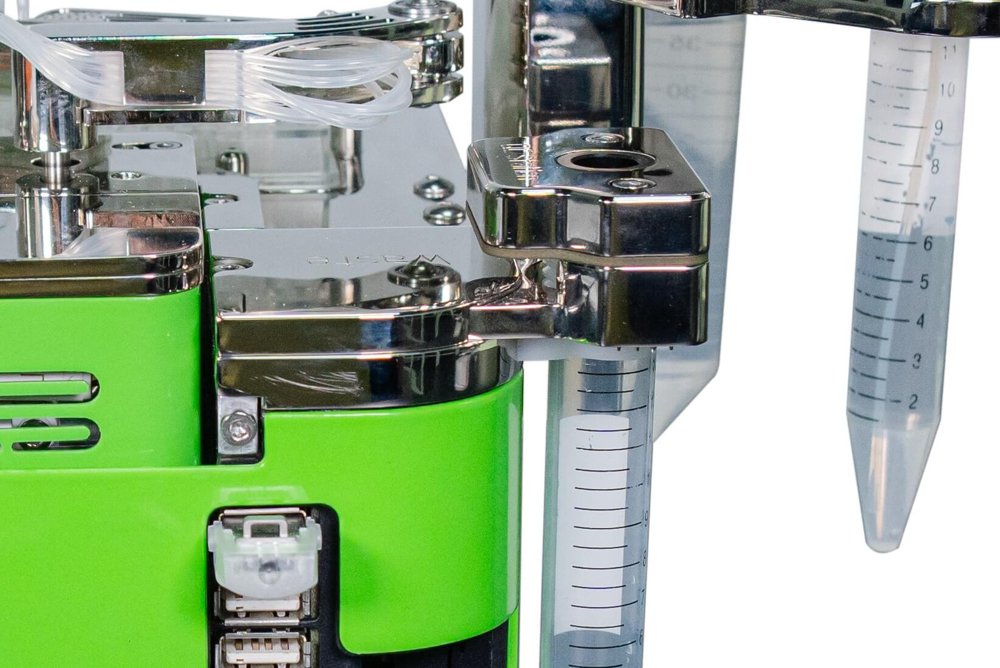
Verify your dispenses with the new Quality Control Droplet Detection Station. Enjoy Peace of Mind that Your Dispenses were Precise and Accurate. Optimize your workflow and ensure reliable results with the new Quality Control (QC) Droplet Detection Station. The QC station uses LEDs and optical sensors to confirm proper chip function by detecting the presence of dispensed drops. This technology allows the Mantis to automatically verify if drops are dispensed at the beginning and end of each run, providing both further confidence in dispense quality and traceability. This feature also eliminates the need for manual priming, saving you time and minimizing the risk of errors. With the QC station, you can have complete confidence that your Mantis chips are functioning properly throughout the dispensing process, delivering trustworthy results.
CATEGORY
