By NenoVision
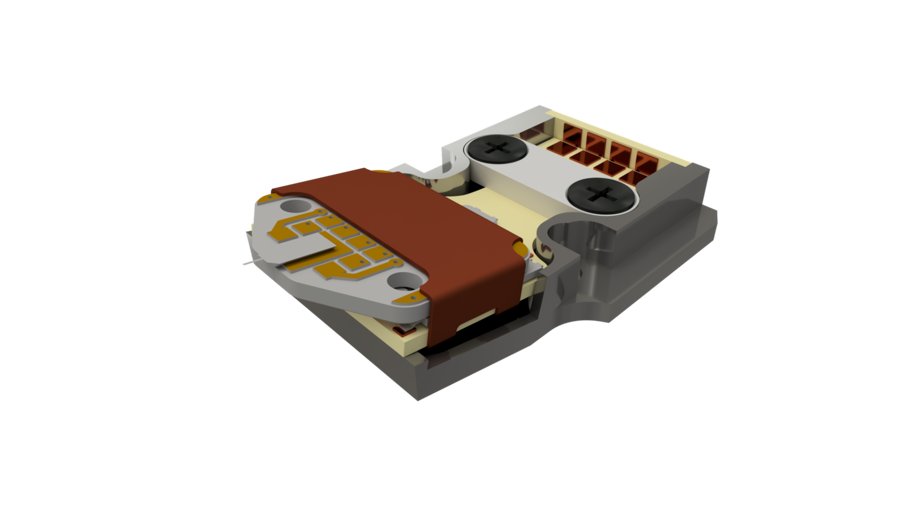
CPEM Correlative Probe and Electron Microscopy™ Correlative microscopy enables a new insight into imaging of the nanoworld. AFM LiteScope™ brings a revolutionary approach into this subject. With LiteScope™, Scanning Probe Microscopy (AFM) and Scanning Electron Microscopy (SEM) can be correlated without limiting the imaging options of either system. Instead, advantage is taken of both sets of information. Correlative Probe and Electron Microscopy™ (CPEM) combines both AFM and SEM techniques. CPEM makes it possible to acquire both AFM and SEM images of the same area at the same time and in the same coordination system. Combining AFM and SEM imaging methods results in a wider information spectrum of the analyzed area, revealing possible equalities and inconsistencies in both images. Working Principle: A sample is attached to a piezoelectric scanner. Both the electron beam focal point and the AFM probe are still during the CPEM image acquisition. The area of interest is scanned point by point by the piezoelectric scanner and signals from an SEM detector and the AFM probe are sampled simultaneously so that measurement takes place in the same coordination system. There is a constant tip/spot offset between the AFM tip and the focused electron beam in the range of hundreds of nanometers. If such a tip/spot offset is subtracted, SEM and AFM images with a perfect match and a superior correlation – a CPEM image – can be acquired. Advantages of the CPEM technique: - CPEM provides multidimensional correlation imaging – images from a Scanning Electron Microscope are extended into 3D. - Using CPEM, it is possible to quickly and accurately distinguish the topographic and the material contrast in SEM images. - CPEM correlates, in an appropriate fashion, two or more SEM signals with the measured topography such as SE, BSE, EBIC, etc. - CPEM makes it possible to measure AFM and SEM simultaneously under the same specimen conditions, at the same measurement speed, etc. - The combined AFM and SEM scanning system enables an accurate image correlation, elimination of drift and other inaccuracies.
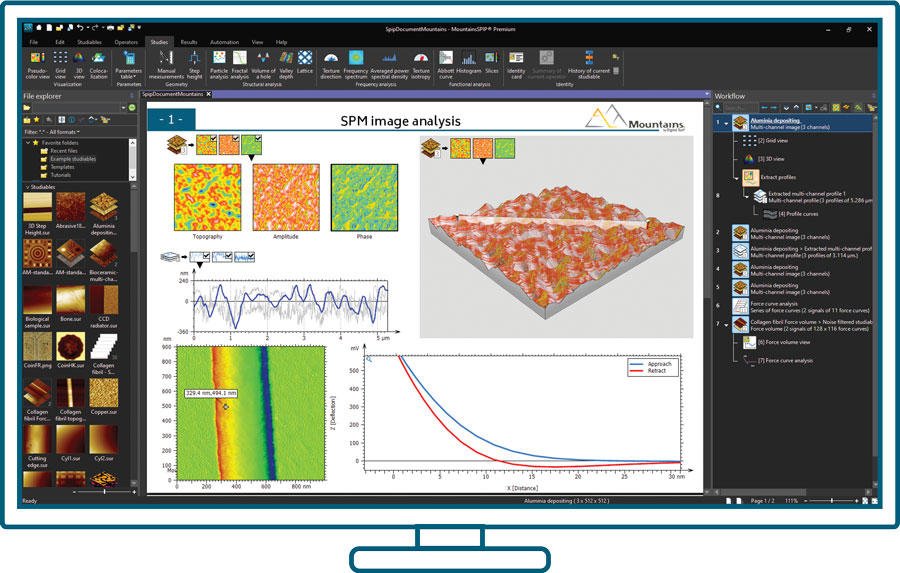
Key features of MountainsSPIP® software: - Interactive particle analysis: detect, quantify, and classify structures of any shape and size. - Force curve and force volume image analysis: analyze force curves and force volume images with precision and ease. - Correlative analysis: seamlessly combine your AFM data with data from your SEM. - Multi-channel file analysis: easily handle and analyze multi-channel files, simplifying complex data processing. - Data enhancement: correct, normalize, and denoise your measured data to extract meaningful insights. - Accurate XY calibration: ensure precise XY calibration for precise measurements and analysis. - Tip effect correction: correct for tip effects to enhance the accuracy of your results. - Surface texture characterization: investigate surface texture in compliance with ISO standards.
CATEGORY
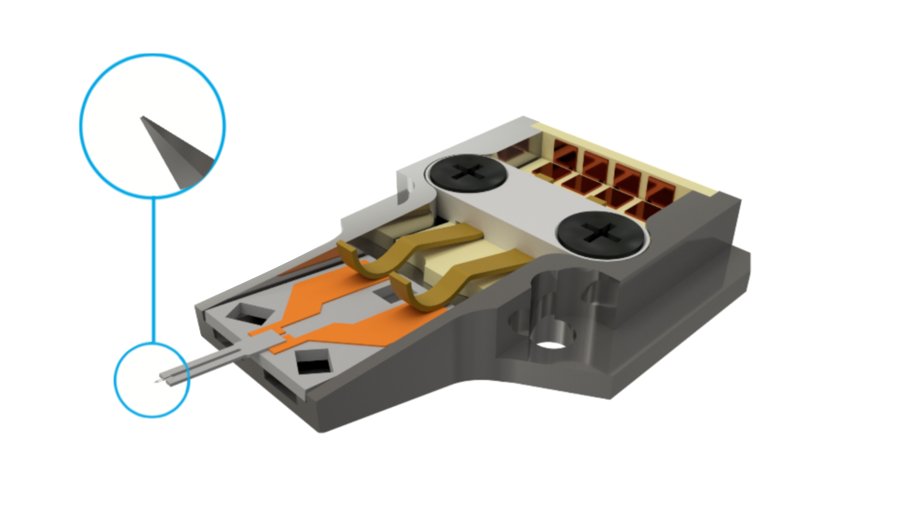
The go-to probe for CPEM measurements thanks to its visible tip. Capable of measuring AFM topography and energy dissipation signal at the same time. Measurement modes: Topography, Energy dissipation
CATEGORY
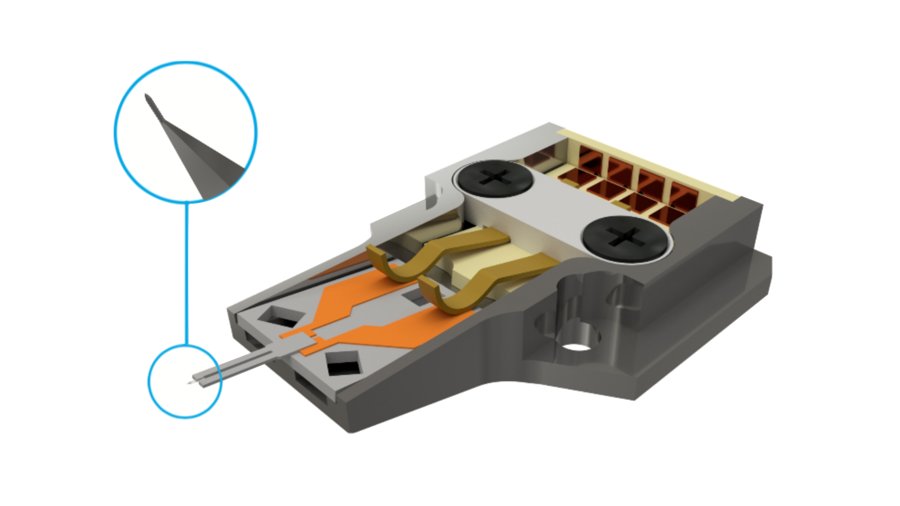
Magnetic-sensitive probe based on the Akiyama sensor, that can be used in SEM thanks to its visible tip. It uses the same probe holder as regular Akiyama. Measurement modes: Topography, MFM
CATEGORY