By Innofocus Photonics Technology Pty Ltd
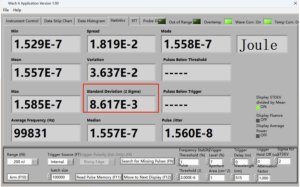
High Power Stability and Precise Power Control The nanoFACTORY r-FBG system precisely controls the laser exposure time down to 0.001 ms, ensuring consistency in every grating fabrication. Precise laser power control is critical for maintaining uniform refractive-index modulation. Any fluctuation in laser power can lead to uneven index changes within the fibre core, resulting in reduced FBG quality and performance. To achieve consistent fabrication performance, Innofocus uses a high-stability femtosecond laser equipped with a real-time pulse power monitoring system, to maintain pulse power stability during continuous long-term operation (>100 hours) and single-pulse power fluctuations at ±1%. Therefore, laser pulse energy at each processing point (also the range of refractive index change) is controlled at the same level, ensuring stable and continuous fabrication, and establishing a solid foundation for manufacturing high performance FBG devices. nanoFACTORY r-FBG also integrates PowerFlex, a precise power control module developed by Innofocus. PowerFlex is a fully automated laser power control technology that enables precise control of laser power at a step of 1μW. Higher power processing produces larger grating points (Figure A), while lower power processing produces smaller grating points (Figure B). Simply adjust the system parameters tailored to your needs. Precise Control of Consistent Periodic Structure of FBGs Along with the strong R&D capabilities and the collaborative research on hardware, software and algorithms, Innofocus have developed the PTST (Position-Time Synchronized Trigger) module and integrated in nanoFACTORY r-FBG system for highly intelligent laser exposure control. Compared to conventional method of controlling the exposure intervals to make it constant, PTST enables accurate trigger of laser exposure at the desired positions, by precisely synchronizing the position detection and laser trigger. PTST is an effective way to ensure the intervals between each fabrication point remain consistent. As shown in the images below, PTST guarantees nanoFACTORY manufactures uniform periodic structure in every fabrication, promising device performance and yield. Intelligent Fibre Core Recognition and Fiber Position Correction To fully automate FBG manufacturing process, Innofocus has developed AI-assisted fiber core recognition function (patented) based on machine-vision technology. The system conducts a fully automated FBG fabrication process by identifying the position of fiber core, scanning for initial point and end point, then calculating fabrication path. Fully Automated Roll-to-Roll Fiber Delivery and Collection up to Kilometer-length nanoFACTORY r-FBG system integrates rollers specialized for fiber delivery and fiber collection, enabling fully automated FBG manufacturing without operator intervention, further eliminating the uncertainties in fabrication process. This function significantly enhances FBG fabrication consistency and guarantees continuous FBG manufacturing up to kilometer-length, reaching over 95% yield. The nanoFACTORY r-FBG is equipped with a specialized precision fixture designed to ensure stable fibre positioning throughout the delivery, fabrication, and collection stages. The fixture features an integrated strain-detection and control system capable of measuring forces from 0 to 30 N with an accuracy of 0.03 N. By precisely managing the external strain applied during the writing process, the system further enhances the consistency and accuracy of FBG fabrication. With its long-distanced single processing range of upto 5 km (positioning accuracy within 1 mm) and high intelligent, fully automated operation, nanoFACTORY r-FBG delivers outstanding results in precision, efficiency, and yield. Standing out among other FBG manufacturing equipments in the market, it is designed for meeting the industry demand for high performance, high efficiency FBG manufacturing. Support Multiple Fiber Types and Grating Structures The nanoFACTORY r-FBG can fabricate various types of fibers including fibers with acrylate coating and polyimide coating, multimode fibers, and multi-core fibers. It is also capable of manufacturing multiple FBG structures, such as point-by-point writing and line-by-line writing, enabling applications in a wide range of scenarios.
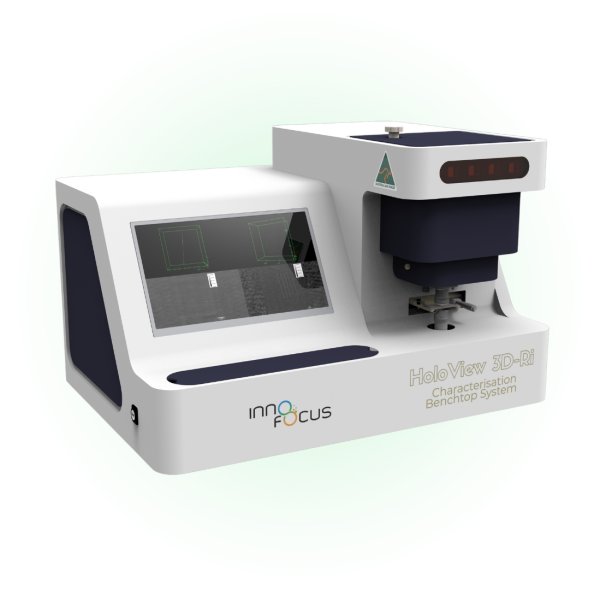
World only HoloView 3D-Ri Characterisation Benchtop System that provides unique performance, simple operation, fast characterisation speed at about 1 minute World-only Benchtop 3D Refractive Index Characterization System provides high index accuracy (10-4), simple operation, fast characterization speed at about 0.5 fps, allowing quantitative measurement and rapid optimization of photonic nanomanufacturing parameters and processes. - In-situ characterization of refractive index of optimal design and fabrication parameters - Fast Characterization Speed (0.5 Fps) - Characterize available for various devices (eg. FIFO, WDM, FBGs) - Characterize available for a wide range of materials including polymers, glasses (incl. chalcogenide glass), crystals (eg. LiNbO3), sapphires, transparent ceramics, quartzes, fibers and etc. - Convenient one-click operation design, with minimal time consumption and manual operation interference, ensuring high efficiency in processing - Suitable for a wide range of applications to test surface and internal refractive index distributions under harsh environment conditions - Provide a quantitative reference index system for 3D refractive index measurements, which is continuously being enriched - Obtain unique data for 3D refractive index distribution to assist cutting-edge scientific research The rapid advancement of information technologies in the 21st century has indicated the approaching post-Moore’s law era. Moore’s law, which dictates the doubling of transistors on microchips every two years, has driven traditional computing technology for many years. The demand for higher speed, larger bandwidth, lower energy consumption, and improved security and stability in information technologies continues to grow. However, as we near the physical limits of miniaturisation, new approaches are needed to continue advancing computation. Integrated Photonic Chips (iPC) have emerged as a promising successor to silicon chips. With the continuous development, iPCs which offer the desired features including high speed and low power consumption, has become the best solution for high-throughput communication technology. However, as 3D photonic chips move towards commercialisation and industrialisation, existing fabrication capabilities face significant challenges concerning precision, reproducibility, and scalability to fulfil the needs for R&D and manufacturing. There is currently no effective measure to accurately characterise the three-dimensional structural changes formed inside an optical crystal by femtosecond laser, as well as the resulting refractive index distribution and morphology. To fabricate 3D optical structures in optical crystals, the difference in refractive index introduced by laser processing is particularly important, which determines the design of the component and its loss. Therefore, to effectively characterise the fabricated nanostructure/nanopatterns and provide timely feedback to the fabrication process has become one of the key challenges in quality control for processing 3D photonics chips. HoloView 3DRI, the 3D in-situ refractive index characterisation system designed by Innofocus, has proved to enable characterise the 3D spatial refractive index distribution with our newly-developed optical imaging technology and image reconstruction algorithm. The system can precisely measure the refractive index distribution in material and effectively reconstruct the refractive index distribution, and form image of the 3D structure with an accuracy of 10-4. It is non-destructive and non-invasive, and it allows real-time monitoring the fabrication process, making it valuable for the applications in the disciplines of all-optical communications, sensors, biophotonic and micro/nano optical and photonic devices. The key properties of an optical component are its refractive index distribution and surface morphology. High-performance optical components can only be fabricated when meeting requirements for both of the properties. Otherwise, distortion in electric field pattern, transmission loss and imperfection will occur, degrading the performance of the components. Meanwhile, by understanding the refractive index variation and distribution, properties of the optical material and components are quantified, which can be used to indicate whether the material or component is damaged. For those optical components that are sensitive to variation of refractive index, e.g. optical waveguide and optical fibre gratings, there is no standard quantitative method to characterise their 3D refractive index distribution. This issue has become a bottleneck for accurately designing and fabricating optical components like 3D photonic chips. To solve, Innofocus has developed world-unique technology of 3D spatial characterisation of refractive index to measure the refractive index difference between the structure designed and the substrate material, with an accuracy of 10-4. The system can not only precisely measure the distribution of refractive index differences, but also reconstruct the 3D surface morphology of the fabricated structure. The main functions of the Innofocus HoloView 3DRI include: In-situ inspection of the refractive index difference, along with the 3D spatial distribution of the refractive index and surface smoothness of femto-laser-processed optical components and structures. All of these can then contribute to optimising laser processing parameters. Quantitative measurement of both the surface and internal refractive index distributions of the components, followed by a comparison with the original design input. This helps to ensure whether the fabrication outcome is optimal in terms of the desired quality requirements (e.g. self-inspection for defects and alignment with the design), allowing on-site correction of fabrication conditions of the optical components. Imaging functionality which visualises the quantitative measurement of the refractive index distribution. HoloView 3DRI provides three-dimensional refractive index imaging display functionality which can visualise the observed refractive index distribution outcome. Based on the observed distribution, novel physical mechanisms of laser-material interactions can be discovered, displayed in a trustworthy and aesthetically pleasing manner through three-dimensional imaging. Refractive index characterisation X-Y image Refractive index characterisation X-Z image In-situ 3D Refractive Index Characterisation HoloView 3DRI Benchtop
CATEGORY
Innofocus's NanoPrint 3D Intelligent Laser Nano-fabrication System. Innofocus Photonics has developed the world's first and only intelligent laser nanofabrication system with in-situ refractive index imaging characterization capability, which is a ground-breaking invention. Based on this patented invention, they have achieved the first in-situ characterization of three-dimensional refractive index difference distribution, which is a fundamental breakthrough in the field of laser processing. Innofocus's commercialized nanofabrication equipment based on multiple patented technologies is the world first system to ever achieve in-situ laser nanofabrication characterization of three-dimensional refractive index distribution, which is a fundamental breakthrough in the field of laser processing. Innofocus provides laser of multiple wavelength options including 450nm, 488nm, 532nm, 633nm etc., and can customize laser wavelength to be used according to customer requirement. Innofocus's nanofabrication system have unique technical advantages in terms of light field modulation. For example, our software system can generate phase maps for aberration correction in real time, based on the processing depth calculated after locating the material surface, and quickly update them on the spatial light modulator to achieve optimal compensation for each processing depth. Furthermore, since the laser focal spot runs along a specific designed trajectory in 3D space during the processing, it may move continuously at different depths. We designed AI-assisted software system to realize real-time compensation according to the depth where the focal spot is located during the continuous processing, to ensure quality and consistency. With the support of Innofocus's unique beam shaping function, we can adjust the beam focus and extend one of the focus dimensions (perpendicular to the fiber core direction) to inscribe in a pancake-shape focus. This method inscribes in a circular interface. Furthermore, this method can directly adjust the focus to match the specific parameters of the fiber core. The advantage of using this method is that it enables high-speed processing of FBGs with point-by-point writing. Innofocus's system has excellent performance in this area and completely automated the process for users, allowing automatic continuous image acquisition and computational reconstruction without multiple background acquisitions. The speed of the completed process depends on the configuration of the computer. A real-time reconstruction speed of 0.5 Hz can be achieved with the standard configuration of a small workstation. Speed can be increased with more advance-configured workstations. For example, Innofocus' standard SLM achieves a maximum power of 800 mW/cm2. Thus, depending on the SLM irradiated area, the maximum power is 1.06 W. If set higher customised SLMs, 2 W/cm2 can be achieved with a maximum power reaching 2.654 W. The surface tracing function of Innofocus's nanofabrication system is a valuable invention that ensures accurate processing position throughout the whole processing area, enabling large-area processing of micro and nano optical components. Innofocus's unique multi-focus parallel fabrication function, which divides the laser energy into hundreds or thousands of focal points for parallel processing, in accordance with the desired processing target, increases the productivity of 3D laser nanofabrication technology by hundreds or thousands of times and achieves a breakthrough in large-area processing from the principle.
CATEGORY
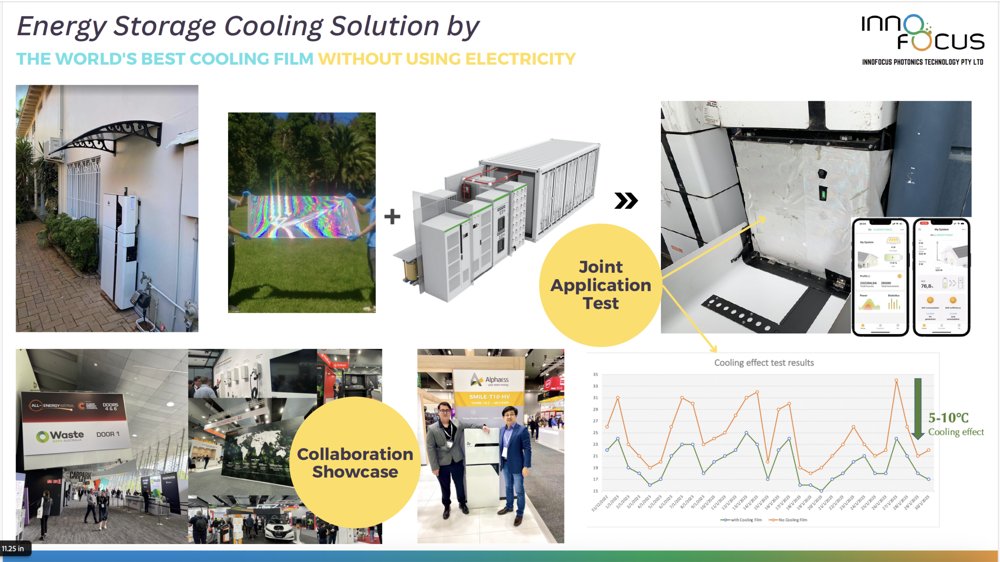
World best cooling film without zero energy The world's best cooling film without using electricity. - Cooling down objects with zero electricity consumption - Proven superior cooling performance - Ultra-thin, easy and flexible for integration - Wide applications in various industries - Cost-effective and mass-production ready Innofocus designed and manufactured in Australia a novel nanostructured thin film that can cool down any objects without using electricity. It is based on innovative nanostructures precisely manufactured by our intelligent nanoprinting system, which can manipulate solar spectrum at will for the first time. This technology can revolutionise sectors, which need to maintain products at low temperature. Radiative cooling cools an object on the earth by emitting thermal infrared radiation to the cold universe through the atmospheric window (8–13 µm). It consumes no electricity and has great potential to be explored for cooling buildings, vehicles, solar cells, and even thermal power plants. Radiative cooling has been explored in the past few decades but is limited to night-time use only. Very recently, owing to the progress in nanophotonics and metamaterials, daytime radiative cooling to achieve subambient temperatures under direct sunlight has been achieved. As the energy situation and environmental issues become more and more severe in the 21st century, radiative cooling can be explored for energy saving in buildings and vehicles, mitigating the urban heat island effect, resolving water and environmental issues, achieving more efficient power generation, and even fighting against the global warming problem. Our patented power-free film employs radiative cooling technology which enables it to cool any covered objects by emitting the thermal radiation into the universe. The film can block sunlight from heating it up and simultaneously emit the heat to the cold universe thus cooling the objects attached to it by 5-10°C without using any electricity. Such a film can be made in a large scale. It can be either flexible or rigid. It can attach to any outdoor surfaces requiring cooling. It performs better at high temperature. It operates 7/24 and provides continuous cooling without energy consumption. The high performance cooling film developed by Innofocus can cool down any covered objects without consuming electricity. The patented film with nanostructure on its surface can allow objects to radiate heat completely into outer space (emissivity close to 100%) while completely avoid solar heat absorption in the visible and infrared, achieve the highest efficiency of radiative cooling. The cooling process by the film consumes absolutely zero power and has the capability to revolutionise industries like food and agriculture, transportations, energy storage, data centres, etc. Applications of the film will result in billions of dollars in savings while significantly reducing carbon footprints. The product is proven effective, with its unique performance that can revolutionise industries like food and agriculture, transportations, energy storage, data centres, etc.
CATEGORY
Zero energy consumed A nanostructured thin film with the world-record cooling performance and mass-production efficiency that can cool down any objects without using electricity. It has been adopted in food preservation and glasshouse farming, and it can be widely used for many more industries towards net-zero emissions. - Record cooling power - Proven performance - Cost-effective - Ultra-thin & flexible - Trusted durability - UV completely blocked - Mass-production ready World best cooling film without electricity Power-Free Radiative Cooling Mechanism Innofocus designed and manufactured in Australia a novel nanostructured thin film that can cool down any objects without using electricity. It is based on innovative nanostructures precisely manufactured by our intelligent nanoprinting system, which can manipulate solar spectrum at will for the first time. This technology can revolutionise sectors, which need to maintain products at low temperature. Radiative cooling cools an object on the earth by emitting thermal infrared radiation to the cold universe through the atmospheric window (8–13 µm). It consumes no electricity and has great potential to be explored for cooling buildings, vehicles, solar cells, and even thermal power plants. Radiative cooling has been explored in the past few decades but is limited to night-time use only. Very recently, owing to the progress in nanophotonics and metamaterials, daytime radiative cooling to achieve subambient temperatures under direct sunlight has been achieved. As the energy situation and environmental issues become more and more severe in the 21st century, radiative cooling can be explored for energy saving in buildings and vehicles, mitigating the urban heat island effect, resolving water and environmental issues, achieving more efficient power generation, and even fighting against the global warming problem. Our patented power-free film employs radiative cooling technology which enables it to cool any covered objects by emitting the thermal radiation into the universe. The film can block sunlight from heating it up and simultaneously emit the heat to the cold universe thus cooling the objects attached to it by 5-10°C without using any electricity. Such a film can be made in a large scale. It can be either flexible or rigid. It can attach to any outdoor surfaces requiring cooling. It performs better at high temperature. It operates 7/24 and provides continuous cooling without energy consumption. Disruptive Solutions that Revolutionises Industries The high performance cooling film developed by Innofocus can cool down any covered objects without consuming electricity. The patented film with nanostructure on its surface can allow objects to radiate heat completely into outer space (emissivity close to 100%) while completely avoid solar heat absorption in the visible and infrared, achieve the highest efficiency of radiative cooling. The cooling process by the film consumes absolutely zero power and has the capability to revolutionise industries like food and agriculture, transportations, energy storage, data centres, etc. Applications of the film will result in billions of dollars in savings while significantly reducing carbon footprints. The product is proven effective, with its unique performance that can revolutionise industries like food and agriculture, transportations, energy storage, data centres, etc. Currently, Innofocus has partnered with several businesses in Australia and U.S. and deployed industrial applications, e.g. applying the film to seafood packaging to provide superior freshness; to outdoor energy storage systems to avoid overheating and extend battery life; to solar panels to enhance photovoltaic conversion efficiency, and to pill boxes to facilitate the distribution of temperature-sensitive pharmaceuticals in tropical regions like Africa.
CATEGORY
