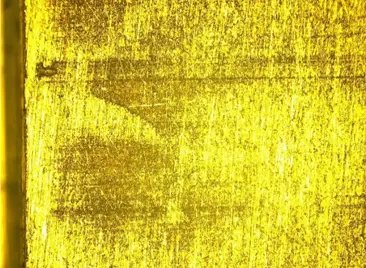
Our innovative high viscosity paste fills an unmet need The Navy needed a safer and more efficient alternative to the hazardous process used in traditional non-destructive inspection (NDI) processes to test aircraft components for cracks and corrosion. ANI’s solution, which has been successfully tested on Naval aircraft materials, has the high viscosity of toothpaste, comes in single-use packets, has a long shelf life, and gets the job done more effectively and safely. Safer More efficient Single use, Easy storage Our three-packet kit: safe, convenient, effective The traditional method involves dipping aluminum alloys in large baths of corrosive etchant materials which are difficult to contain, may damage other components, and could expose users to chemical burn. Our high-viscosity materials are contained in a three-packet kit (etchant, neutralizer and de-smut) for single-use application, and can be used as-is with no mixing. More revealing than traditional processes Far from compromising performance, the increased viscosity ANI solution has demonstrated improved etch-rate. It achieves 0.5 micros/min etch rate at <30° C and uncovers cracks more visibly than with traditional methods. An added advantage is the shelf-life of <12 months. Packets maintain their integrity under weights of 25lb. Quench-cracked aluminum after sanding with 600 grit. Metal is smeared and cracks are hidden. Quench-cracked aluminum after sanding and after ANI etch. Cracks are uncovered by etch! UV penetrant test on quench-cracked sample after etch with ANI materials. A Navy-tested product with broad applications Penetrant NDI is important for early detection of corrosion and structural damage before component failure. The ANI solution has been successfully tested for use on Navy aircraft, but similar NDI needs are found on commercial aircraft, oil and gas exploration, refineries and pipeline transportation, ocean cargo vessels, railways, and aluminum industries in general.
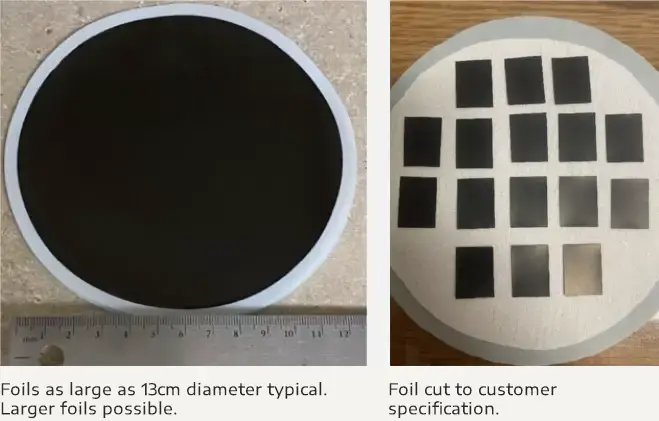
Our water-based graphene foils offer big advantages in a small scale Our unique stripper foils (aka extraction foils) apply ANI’s innovations in nanotech-based inks, graphene, and water-based processes to offer many advantages over conventional foils. Our foils are less expensive, longer-lasting, and don’t require vacuum-based equipment. Our sustainable green manufacturing process scales quickly for timely delivery of large orders. More durable More economical Sustainable It all begins inside a cyclotron, which accelerates negative hydrogen ions to speeds of 18 MeV to pass through our stripper foils, which strip away electrons to create positively charged protons used to synthesize isotopes for medical imaging. ANI is the primary vendor of carbon stripper foils to larger corporate manufacturers and operators of cyclotron accelerators that are paving the way to the future of nuclear medicine. Our foils play a key role in the synthesis of isotopes such as F18/FDG in PET scans to track down cancer cells, identify where to focus treatment, and evaluate therapeutic efficacy. We customize stripper foils to your specifications We offer thin targets for a variety of isotopes, elements & compounds. ANI carbon stripper foils (extraction foils) are made with graphene, water and our ink technology. Thicker foils incorporate carbon nanotubes (CNT). Large order discount rates are available. Features: Long Lifetime: Lifetimes exceeding 7,500 μA-hrs have been routinely documented on some PETtrace cyclotrons (depending on operating parameters) Density: Approximately 1.5 – 2.0 gm/cc Thermal conductivity: 1480 W/mK Made in USA under ISO-9001:2015 quality standards Customers: We make foils for GE, IBA, Siemens, ACSI, Sumitomo cyclotrons. Size and density options Foils are cut, packaged, and delivered to customer specifications. ANI offers graphene films with diameters up to 13 cm (up to 26 cm diameter available on request). Area densities of 0.1 to 1.0 mg/cm2 are standard. Higher mass density foils are available. Thicker foils are made with mixture of graphene and carbon nanotubes. Mounting options Stripper foils can be delivered as bare foils, cut to size, or mounted on carbon or aluminum frames to customer specifications. Photo at left shows foils mounted on carbon frames. On right: a bare foil in an individual package; the package measures approximately 7cm.
CATEGORY
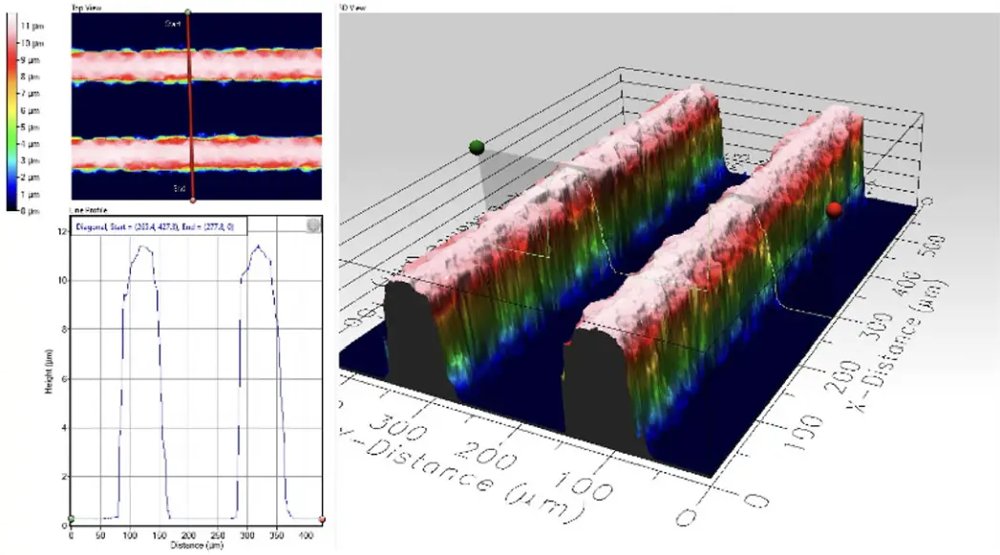
SUPERCONDUCTING INDIUM AND InSn INKS AND PASTES Meeting next-gen demands: higher density electronics packaging and superconducting interconnects Traditional photo etching becomes cost-prohibitive if you want to achieve the higher densities required by next generation electronics. So don’t etch your circuits, print them with our superconducting Indium inks. Our inks and solders are not only more economical. You gain process efficiency, sustainability, and new levels of performance including temperature resistance. HIGH DENSITY | BETTER ECONOMICS | PROCESS EFFICIENCY | SUSTAINABILITY | WASTE REDUCTION | HANDLE EXTREME TEMP AND VIBRATION Indium lines – Thickness 50um, height 5 um, pitch 200um Why indium inks and pastes: applied advantages - Smaller particle size enables higher density in less space - Malleable in a wide range of temperatures, resulting in much less mechanical stress. Can handle extreme cold for superconducting applications, or extreme high temperatures where typical materials would melt - High thermal conductivity makes them excellent for thermal management in electronic devices - Reduced reflow temperature leads to improvements in thermal fatigue and wetting - Indium is suitable for components that need low reflow temperatures (180-210°C). - Indium is a type-I superconductor with superconducting transition temperature at 3.4K; Tc for In/Sn 7.5K
CATEGORY
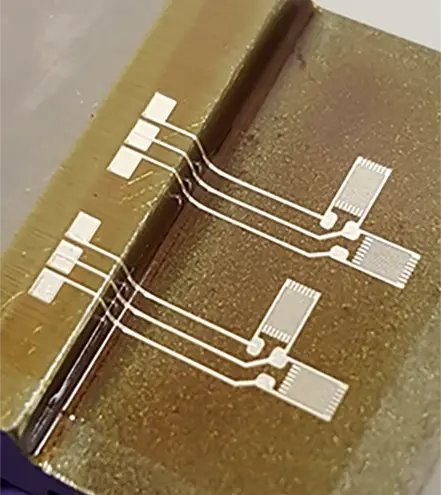
Electronics packaging: Higher density, flexibility, and durability. Whether for NASA missions or hybrid flexible electronics, our nano-materials and methods enable new levels of performance for electronics packaging. Our ink alloys make it possible to print circuits to increasingly smaller dimensions, sustainably, at lower cost. Examples? Detectors and shielding that withstand high heat, low cryogenic temperatures and extreme vibration; and flexible sensors for products of the future, from smart clothing to smart automobiles.
CATEGORY
Bring in the tin! InSn advantages Our printed solders made of indium/tin alloys (InSn) make the solder bump smaller, enabling more interconnects in a smaller space. Plus, Indium is more expensive than tin, so introducing tin into the mix where appropriate can mean an end product that is 4X less costly. Profile of laser sintered InSn line
CATEGORY
