By EKSPLA
Benefits: - Any desired intra-burst PRR can be achieved independently from the initial PRR of the master oscillator - Identical pulse separation inside the GHz bursts is maintained - Short- and long-burst formation modes can be provided. – A short burst is up to about 10 ns burst width (from 2 to tens of pulses in the GHz burst). – A long burst is from ~20 ns up to a few hundred ns in burst width (from tens to thousands of pulses in the GHz burst) - MHz+GHz burst mode - An adjustable amplitude envelope of the GHz bursts is provided - No pre/post pulses in GHz burst. Pure GHz bursts - Ultrashort pulse duration is maintained inside the bursts Patented Method: The Femtolux laser can operate in single-pulse mode, MHz burst mode, GHz burst mode, and MHz + GHz burst mode. A versatile patented method for generating ultra-high-repetition-rate bursts of ultrashort laser pulses is based on an all-in-fiber Active Fiber Loop (AFL) technology. It overcomes many limitations encountered by other fiber- and/or solid-state-based techniques. Technology is protected by international patents and patent applications: WO2021059003, US12438325B2, CN114830462B, KR102707843B1, EP4035234A1. Specifications: Main specifications: Laser Pulse Repetition Rate (PRR) up to 500 kHz; Intra-burst pulse repetition rate 2 ±0.25 GHz; GHz burst mode short: GHz burst length 0.5– 10 ns, number of pulses 2– 20, shape square, rising, falling; GHz burst mode long: GHz burst length 20– 500 ns, number of pulses 40– 1000, shape falling, pre-shaped; MHz + GHz Burst Mode: Number of pulses in MHz burst 2– 10, Number of pulses in GHz burst 2– 20. Due to continuous improvement, all specifications are subject to change without notice. Parameters marked typical are not specifications. They are indications of typical performance and will vary with each unit we manufacture. All parameters are specified for a shortest pulse duration. Custom intra-pulse PRR is available upon a request. Depends on the intra-pulse PRR. For more information, please inquire sales@ekspla.com.
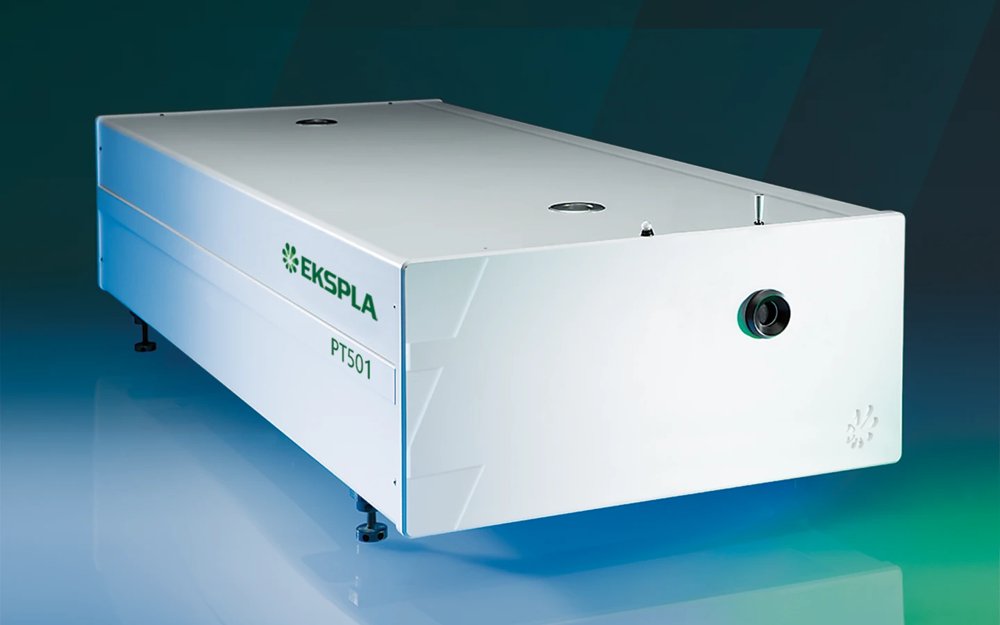
PT501 series Mid-Infrared Single Housing Tunable Picosecond Laser System PT501 covers 2300 to 16000 nm at 100 Hz repetition rate, with linewidth under 3 cm⁻¹ across the entire tuning range. The pump laser and OPO share a single compact housing. Mounting the components on the same frame provides a robust solution. It makes laser installation shorter, improves long-term stability, and reduces maintenance costs. Features - Tuning range 2300– 16000 nm (4345– 625 cm‑1) - Hands-free tuning: motorized for the entire tuning range - Linewidth <3 cm‑1 in the entire tuning range - Repetition rate 100 Hz - Air cooled – external water supply is not required - Beam direction stability in the entire tuning range - Single housing: integrates a pump laser and OPO in a single housing - PC control via USB (virtual COM port), RS232, LAN using REST API commands - Fast wavelength scan (sweep) Applications - Infrared spectroscopy - SFG (sum frequency generation spectroscopy) Description PT501 integrates the pump laser and OPO in one housing, covering 2300 to 16000 nm at 100 Hz. A shared frame removes the inter-unit alignment interface that separate-box MIR systems require. That interface is the main origin of long-term pointing drift. The system is air-cooled; no external water supply is needed. Wavelength tuning is fully automatic. Closed-loop micro-stepping motors drive the tuning elements, and thermo-controllers maintain the nonlinear crystal temperatures. The sweep from 2300 to 16000 nm runs without manual adjustment, including the transition between OPO and DFG output stages. For customer convenience, the laser can be operated from a master device or a personal computer using various interfaces. Depending on the system configuration, control is available via the USB interface (REST API over RNDIS or VCP with ASCII commands), the RS-232 interface (ASCII commands), the LAN interface (REST API), or from the remote control pad with a backlit display that remains easy to read even while wearing laser safety glasses. Communication interface - USB : REST API over RNDIS - RS232: ASCII commands - LAN: REST API - Remote control pad: With a backlit display Default. Other option– ASCII commands over virtual serial port. Available models - PT501: Provides a narrowband radiation with a linewidth <3 cm‑1 in the entire tuning range: 2300– 16000 nm (4345– 625 cm‑1). Repetition rate 100 Hz. Specifications - Model: PT501 Main Specifications 1) - Tuning range: 2300 – 16000 nm Output pulse energy - at 3500 nm: 200 µJ - at 10000 nm: 50 µJ - Bandwidth: <3 cm‑1 - Pulse repetition rate: 100 Hz - Tuning resolution: <0.5 cm‑1 - Typical beam size 2): ~4 mm - Beam divergence 3): <3 mrad - Beam pointing stability: ≤100 μrad rms - Beam polarization: horizontal, 100:1 - Wavelength sweep: available Optical pulse jitter - Internal triggering regime 4): <50 ps (StdDev.) in respect to TRIG1 OUT pulse - External triggering regime 5): ~3 ns (StdDev.) in respect to SYNC IN pulse - TRIG1 OUT pulse delay: Positive pulse with controllable delay. Pulse width ~100 ns. Default delay ~250 μs before optical pulse up to 10 ms. Physical characteristics - Laser unit size (W × L × H): ~508 × 1030 × 244 mm - Power supply unit size (L×W×H): 450 × 450 × 140 mm Operating Requirements - Mains requirements: 100 – 240 V AC single phase, 47 – 63 Hz - Power consumption: <0.5 kW - Operating ambient temperature: 22 ±2 °C - Relative humidity: 20 – 80 % (non-condensing) - Cooling: air cooled - Cleanness of the room: not worse than ISO Class 9 1. Due to continuous improvement, all specifications are subject to change without notice. Parameters marked typical are not specifications. They are indications of typical performance and will vary with each unit we manufacture. Unless stated otherwise, all specifications are measured at 3500 nm for PT501 units for basic system without options. 2. Beam diameter is measured at the 1/e 2 level. 3. At 3000 nm, Full angle measured at the FWHM point 4. With respect to TRIG1 OUT pulse. <10 ps jitter is provided with PRETRIG option. 5. With respect to SYNC IN pulse. Performance Typical PT501 tuning curve. Drawings & Images Typical PT501 outline drawing.
CATEGORY
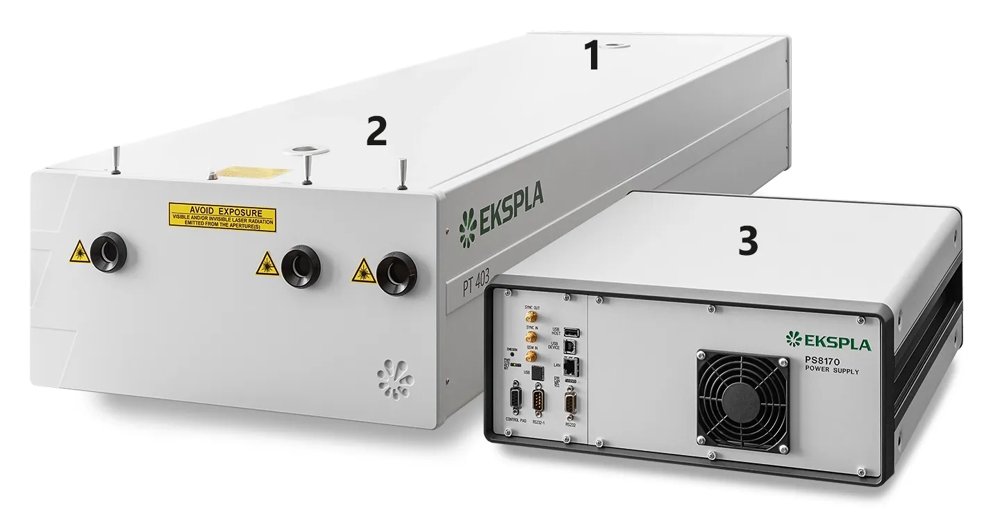
Energy increasing in 300– 409 nm range by sum-frequency generation. 20 µJ at 340 nm. Pulse energies are ~10 % lower in comparison to the system without -SF option. See table below for pulse energy specifications: Model 1) PT403 / PT403-SH Output pulse energy: SH 2) – / 13 µJ; Signal 3) 70 µJ / 70 µJ; Idler 4) 22 µJ / 22 µJ 1. Due to continuous improvement, all specifications are subject to change without notice. Parameters marked typical are not specifications. They are indications of typical performance and will vary with each unit we manufacture. 2. Measured at 260 nm. 3. Measured at 450 nm. 4. Measured at 1000 nm.
CATEGORY
1064 nm or 532 nm, or 355 nm outputs. All energy is directed to this output port. 1) 2) - H output energy 0.7 mJ; - 2H output energy 0.3 mJ; - 3H output energy 0.3 mJ. 1. Outputs are not simultaneous. 2. Inquire for outputs simultaneously with PG.
CATEGORY
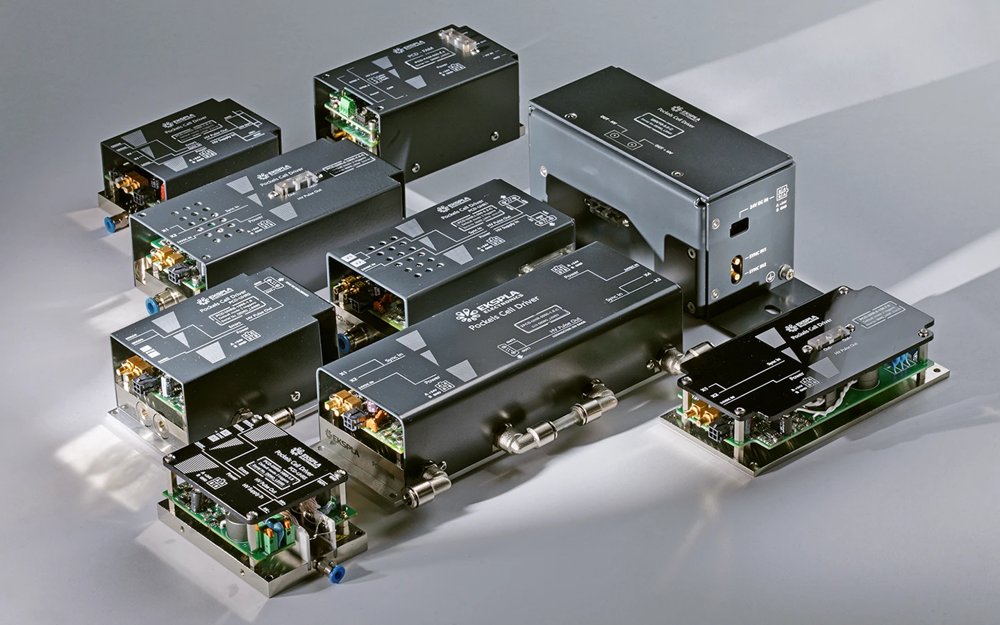
High repetition rate and high voltage Pockels cell drivers with energy-efficient power supplies - Designed for BBO, RTP, KDP, KTP, LiNbO 3, CdTe Pockels cells - HV repetition rates up to 6 MHz - HV output pulse amplitude up to 9.8 kV - Electrical HV rise / fall times typically as low as 5.5 ns at 6pF load - HV pulse durations from 0 ns to infinity
CATEGORY
