Aplo Flow Preparation Protocol This protocol is designed to support the automated use of the ONI Application Kit™: LNP Profiler, for the staining of lipid nanoparticles (LNPs) with Single-Molecule Localization Microscopy (SMLM) and diffraction-limited imaging using the Aplo Flow system. This protocol is meant for use with CODI System App 1.2.9 and later. This user guide is written to cover steps 1-4 when using ONI’s LNP Profiling workflow in an automated format (also known as Lipid Nanoparticle Profiler Kit, PREP or LNP PREP) on the Aplo Flow system: Step 1: Define experiment and sample details Step 2: Load reagents system deck Step 3: Begin LNP Sample Preparation Step 4: Automated Cargo Addition Step 5: (Not covered in this guide) AutoLNP data acquisition and analysis General Precautions - The LNP PREP kit was optimized for a room temperature of 18˚C – 30˚C and humidity >25%. Contact ONI’s technical support if the working conditions do not meet the criteria. - We recommend performing a dilution series across the RNA concentration range using a full Assay Chip (four lanes), running a full LNP Profiler Assay, and select the concentration that gives around 1000-2000 LNP counts/field of view on a Nanoimager or 3000-6000 LNP counts/field of view on an Aplo Scope. - Final RNA concentration of diluted LNPs should be 40-100 ng/mL, assuming an encapsulation efficiency of over 50%. Lipid Nanoparticle Profiler Kit, PREP components LNP Assay Kit ✝ | N/A | 4 | N/A | N/A | T Wash Buffer | N/A | 1 | 12 mL | N/A | RT* 15mL bottle | N/A | 1 | N/A | N/A | RT 0.2mL tubes | N/A | 16 | N/A | N/A | RT Chip-Strip ✝ | 4 | N/A | T PER STRIP: Surface Block | 50 µL | N/A Surface Reagent | 50 µL | N/A Anti-PEG Capture | 50 µL | N/A Ligand Detection | 5 µL | N/A Pan-LNP Detection | 5 µL | N/A Cargo Detection | 5 µL | Hazard T Store at -20°C † Single use * Wash buffer can be stored at -20°C with all kit components, but storage at RT or 4°C is recommended for ease of use Entire kit is shipped on dry ice. Pipette Tips Needed Per Assay LNP PREP utilizes a variable amount of pipette tips per run depending on the assay configuration.
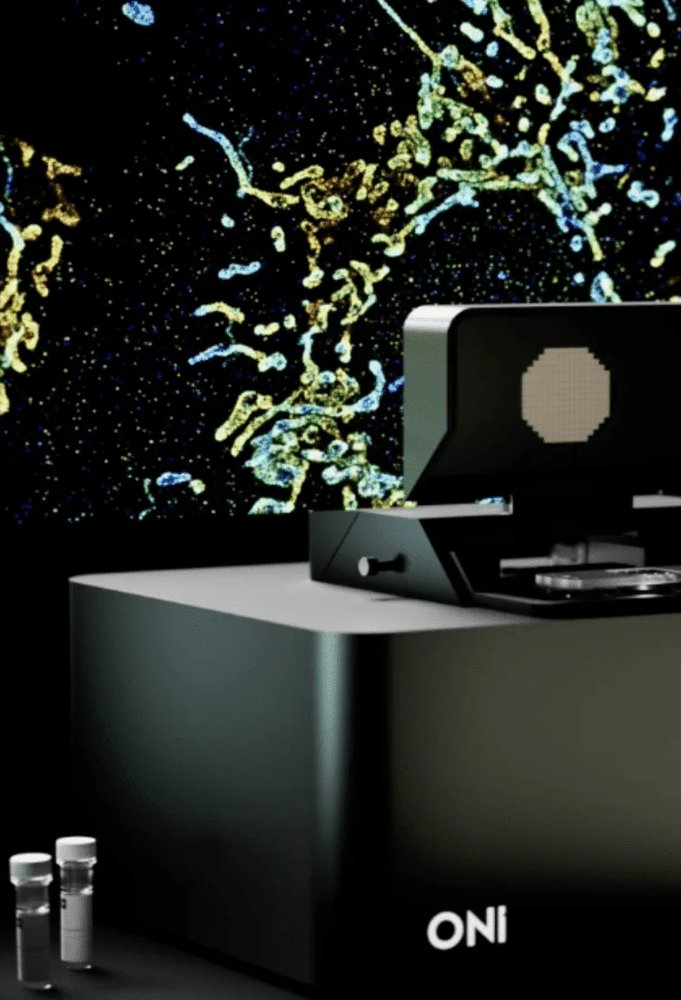
Acquisition, analysis and reporting in one place Flexible software for every environment Sample to answer CODI is a comprehensive software solution with automated image acquisition, analysis and reports anyone can use Flexible data access CODI runs in the cloud to allow analysis from everywhere, or offline to support local data and instrument control Analysis & reporting simplified Analysis app workflows can be customized to analyze hundreds of datasets and generate reports with ease Sharing and collaboration CODI cloud makes it easy to organize datasets and analyses into collaborations and instantly share them with collaborators. One platform, two ways to work CODI cloud CODI offline Analyze your data, your way Use CODI in the cloud or offline to acquire, analyze, organize, and report your data. Save analysis settings for specific experiments and apply them to newly acquired datasets to support reproducibility. Easily organize, analyze, and export images and reports. CODI cloud enables streamlined analysis, collaboration, and access from anywhere, while CODI offline runs locally in restricted-connectivity or air-gapped environments. What’s in CODI CODI space Datasets & collaborations Analysis workflows Share & export results With CODI you are able to Understand the morphology of my structure Understand how my molecules of interest organize Clean up my data to improve signal-to-noise ratio Identify EV subpopulations based on size or biomarker content Understand the morphology of my structure Single-molecule localization microscopy techniques, such as dSTORM, PAINT or PALM, pinpoint the position of individual molecules, providing morphological information of structures and the organization of proteins. To assess the distribution of a specific protein within a structure, a simple density profile measurement can be performed. 3D imaging and visualization further enhances the nanoscale information of structure morphology and protein organization. Understand how my molecules of interest organize One of the most powerful applications of SMLM is investigating spatial distributions down to the nanometer scale. The raw point cloud of localizations serves as the basis of nanoscale morphological analysis. CODI offers different clustering analyses including DBSCAN and our in-house extension of HDBSCAN called Constrained Clustering. Clustering on localization data allows researchers to find biological structures and quantify their morphological properties (size and shape), as well as determine presence or absence of specific markers of interest. Clean up my data to improve signal-to-noise ratio A critical part of SMLM imaging is removing noise to obtain accurate information and sensitivity for the analysis. To this end, the CODI analysis workflow includes a single-molecule filtering step that enables real-time visualization as users tune the filtering parameters, as well as default filters that serve as a great starting point for keeping only the most accurate data. Identify EV subpopulations based on size or biomarker content The EV Profiling App on CODI is the perfect analysis workflow for EV samples with various subpopulations, allowing you to quantify size and biomarker distributions from a collection of single EVs. The App includes a range of tools from drift correction, single-molecule filtering, clustering, cluster filtering, and counting of biomarker distribution. In addition, the batch analysis tool allows analysis automation by applying the same analysis settings to multiple datasets. CODI Apps CODI contains several app workflows to streamline and simplify single molecule data analysis. Each workflow is a unique combination of tools for a specific kind of dataset, all starting with the basics of spatial drift correction and single-molecule localization filtering.
CATEGORY
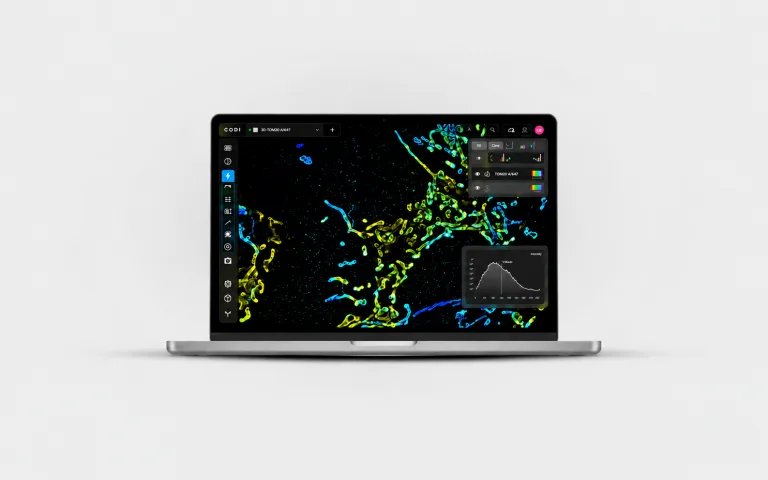
Powerful analysis, entirely within your environment CODI Offline brings the CODI experience directly to the Aplo Scope PC for laboratories with restricted connectivity, strict IT policies, or air-gapped environments. Control the instrument, acquire data, run supported workflows, analyze results, and generate reports without requiring an internet connection. Raw and processed data remain stored locally. - Operate without an internet connection - Keep raw and processed data stored locally - Support air-gapped and restricted-connectivity environments - Use a familiar interface consistent with CODI Cloud
CATEGORY
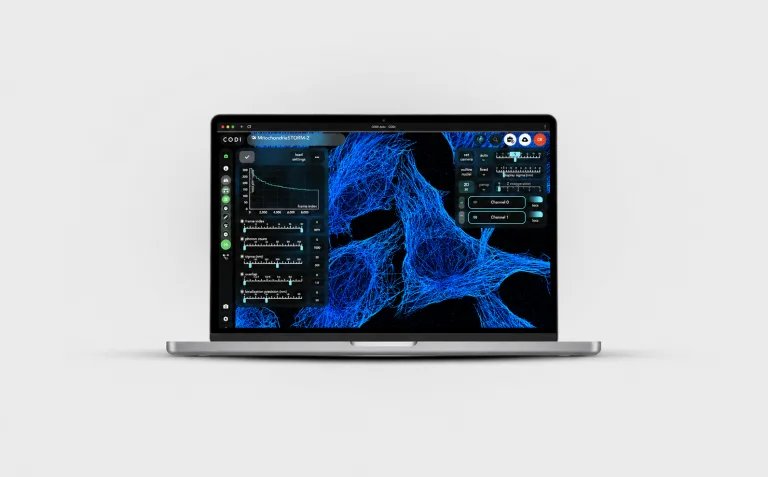
Connected analysis, built for collaboration CODI Cloud provides a streamlined environment for visualizing, analyzing, and managing your super-resolution data. Access datasets through the cloud, run supported analysis workflows, and move from acquisition to quantitative results in one connected experience. - Access and analyze your data through the cloud - Run supported visualization and analysis workflows - Easily manage and revisit datasets and results - Ideal for connected labs and collaborative workflows
CATEGORY