Pro-Optix™ is also a powerful data analysis package and is the only software required for determining n, k and d from the measured T and R spectra. Pro-Optix™ uses a variety of analytical models to represent the complex refractive indices of each material in the sample. These models have been carefully designed to make the data analysis fast and robust. Starting with initial values from the system's built-in database of known optical properties, the analysis algorithms use intelligent procedures to match the measured spectra with a theoretical model by varying the thicknesses of the layers in the model and the parameters which define their optical properties. n, k and d are determined quickly and simply. If a particular material is not already present in the extensive database, the advanced analysis mode provides a range of tools to construct and refine a new dispersion model. Models for new materials can then be stored in the database for future use. Transparent and metallic samples are catered for in the analysis with the use of coherence factors and metal algorithms. Facilities for solar and colour co-ordinate calculations are also provided. s- and p- polarisation spectra can also be combined for accurate profile matching. Acquistion Wizard 1. The wizard begins by requesting information about the sample and analysis set-up. The number of layers, the nature of the sample, the selected incident angle and polarisation state. 3. Most common thin film materials are already in the Pro-Optix database, so entering the specifications of a new sample to analyse is straightforward. 2. The acquisition wizard walks the user through the steps necessary to collect high-precision transmittance and reflectance spectra. The scanning range and step are selected and the sample position entered if an X Y mapping platform is fitted. 4. Data collection typically takes from two to eight minutes including the self-calibration step which the instrument performs before every measurement. Without further operator intervention, Pro-Optix displays the measured spectra. 1. Analysis of the measured spectra is performed automatically with one click using default mode. 2. n and k is determined and plotted automatically with no further user input. 3. Advanced analysis mode provides facility for defining new dispersion models.
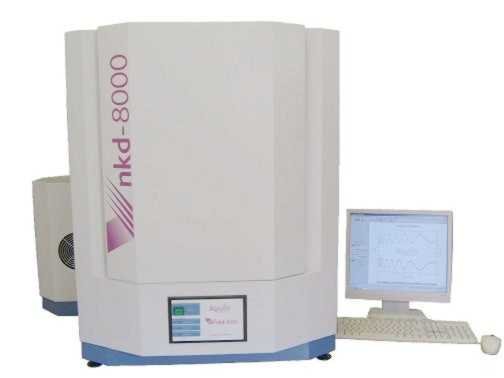
Flexible thin film measurement instrument. The nkd-8000, is the most advanced design in our innovative range of desktop thin film measurement systems, purpose built for enhanced functionality and flexibility, to meet all your thin film analysis requirements – from research to production and quality control. Non-destructive determination of refractive index, extinction coefficient and film thickness measurement, of single or multi-layer thin films and substrates is achieved using the simultaneous measurement of Transmittance and Reflectance spectra. This capability is unique to the nkd range and guarantees photometric precision, unattainable with conventional spectrophotometers. Key features of the nkd thin film analysis systems, are the ability to capture spectra using polarised (s- and p-) or unpolarised light and at continuously varying angles of incidence, enabling thin, multilayer and complex films to be analysed with ease. The X Y mapping platform enables film thickness and refractive index profiling of entire substrates and scanning can be performed over a wide spectral range. Full data capture and thin film analysis takes only 15 minutes and the powerful Pro-Optix™ software makes the whole process of obtaining film thickness and dispersion for your coatings fast and simple. In fact, for a single layer of unknown poperties, the nkd can obtain the film thickness, refractive indices (dispersion) and absorption coefficient – from just one measurement! Transparent samples are handled with ease and are infact an advantage as they allow for the determination of absolute absorption (1-(T+R)). Transparent substrates require no roughening or blackening of the back surface - they are simply placed as manufactured on the sample stage. Metallic films are also catered for in the analysis with metal algorithms. A wide selection of accessories are available, making this the most flexible thin film analysis system available.
CATEGORY
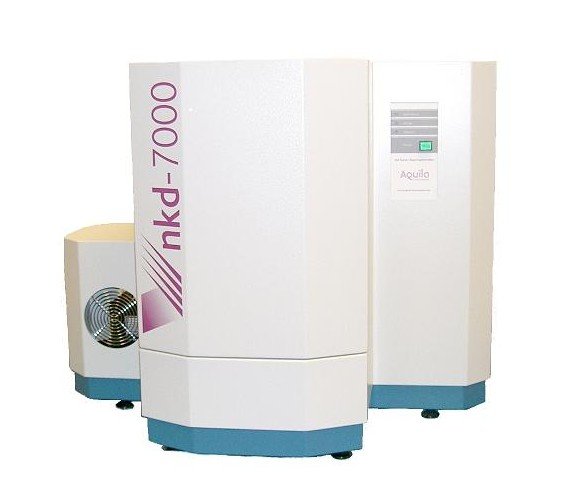
Thin Film measurement on your desk top. The nkd-7000 provides a unique, integrated desk top solution for all your thin film measurement needs. Non-destructive determination of refractive index (n), extinction coefficient (k) and film thickness measurement (d), of single and multi-layer thin films and substrates is achieved using the combined measurement of Transmittance and Reflectance - simultaneously. No sample preparation is required and samples are mounted on a horizontal x y platform for ease of handling and access. A range of sample platform options are available for use with thin, flexible substrates or thick, heavy slabs of material. We even have temperature-controlled and XY-stepping stages for automatic film thickness and index mapping of sample surfaces. Spectra for thin film analysis, may be measured using polarised (s- and p-) or unpolarised light, at one or three fixed angles of incidence and over a wide spectral range. These can be standard or user defined angles, (see the nkd-8000 for continuously variable angles of incidence). Full data capture and film analysis takes only 15 minutes and the powerful Pro-Optix™ control software makes the whole process of measuring film thickness and derermining optical properties fast and simple A wide selection of accessories are available, ensuring that there is no compromise in the collected spectra.
CATEGORY
Thin Film measurement on your desk top. The nkd-7000 provides a unique, integrated desk top solution for all your thin film measurement needs. Non-destructive determination of refractive index (n), extinction coefficient (k) and film thickness measurement (d), of single and multi-layer thin films and substrates is achieved using the combined measurement of Transmittance and Reflectance - simultaneously. No sample preparation is required and samples are mounted on a horizontal x y platform for ease of handling and access. A range of sample platform options are available for use with thin, flexible substrates or thick, heavy slabs of material. We even have temperature-controlled and XY-stepping stages for automatic film thickness and index mapping of sample surfaces. Spectra for thin film analysis, may be measured using polarised (s- and p-) or unpolarised light, at one or three fixed angles of incidence and over a wide spectral range. These can be standard or user defined angles. Full data capture and film analysis takes only 15 minutes and the powerful Pro-Optix™ control software makes the whole process of measuring film thickness and derermining optical properties fast and simple. A wide selection of accessories are available, ensuring that there is no compromise in the collected spectra.
CATEGORY
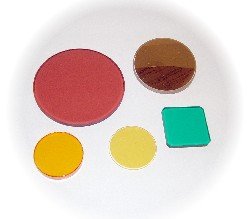
Flexible measurement platforms for research. When you are developing new coatings and substrates – you need the nkd to provide you with the most spectrocopic information available from a thin film analysis system. When you have more than one type of thin film measurement to make, multiple applications and analysis of complex structures, new and absorbing films, then you need the nkd - specifically designed for the most demanding applications. It provides: – Space for larger samples – – Variable angle measurements – – Flexibility of measurement type – Measure T & R simultaneously. Determine layer thickness for single and multilayers with ease. Determine optical properties and absorption for all types of materials - transparent, absorbing, dielectric, polymers, semiconductors, organic semiconductors and polymers etc. Take advantage of advanced features such as a the heated stage, sample mapping and small spot sizes. The extensive application capabilities of the nkd include: • Transparent substrates • Thick and thin layers • High and low index (n) layers • Plastics & polymers • Optical coatings • Display technology • Organic and Inorganic semiconductors • Metal films • Dielectric films • DBR structures
CATEGORY
