Owlstone chemical detectors are based on a proprietary, micron-scale ion-filtering technology. The ion filters are rapidly and precisely tunable, enabling a new level of detection and identification performance for hand-held, portable, and fixed-site systems. Advanced control software and data processing algorithms provide re-configurable alarm capability, allowing systems to keep pace with changing chemical threats without hardware modification. At the heart of our technology is a revolutionary micron-scale ion spectrometer, which responds to the whole range of chemical threats faced by today's soldier and first responder. Owlstone chemical detection systems provide complete coverage across the board for military and civilian chemical threat protection. The technology detects and identifies nerve agents, blister agents, blood agents, and toxic industrial chemicals. Owlstone develops products in collaboration with some of the most respected names in chemical detection and analysis; from Fortune 500 companies to government agencies and independent test laboratories. Our technology delivers an unprecedented combination of sensitivity selectivity and rapid response time – putting the most accurate threat information in the hands of the user.
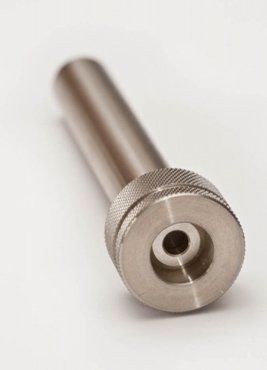
A diffusion tube is a container with an opening at the top (which may be covered with a permeable membrane). Gas evaporates from a reservoir of sample at the bottom of the tube, and diffuses upwards at a rate governed by temperature, pressure and tube geometry. Performance Comparison: - Can be used with the V-OVG - Any substance with a sufficiently high vapor pressure can be used - Can produce higher concentrations
CATEGORY
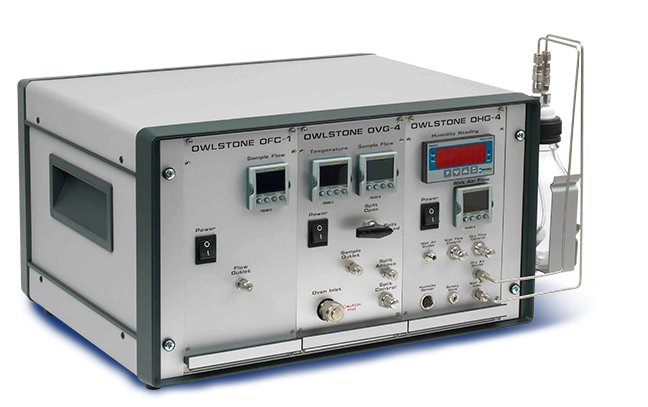
The GEN-SYS is a modified 19” rack unit especially design to houses a series of instruments that provide the functionality and adaptability needed to create a wide range of vapour standards. As the system is based on a modular design the user has a choice of when and what modules they wish to employ, the choices of modules are the OVG-4, OVG-4C, OFC-1 and OHG-4. GEN-SYS is designed to create chemical vapours, therefore to limit the user’s exposure to these chemical vapours it is strongly recommended that the GEN-SYS be operated in a fume hood, or ideally in a well-ventilated space. Do not place in the following environments - Space that is poorly ventilated or confined. Allow at least 50cm clearance from walls and free flow of air around the system - Locations with an ambient temperature above 30 oC- Locations where the altitude is greater than 10,000 feet. - Do not place the unit on fabric or any other soft surface - Do not cover the unit with a cloth or any other item - Do not place near flammable materials - Where maximum relative humidity exceeds 80 % GEN-SYS is supplied with a power supply that is automatically compatible with all conventional mains power supplies: 100-240V, 50-60Hz, max 2.5A. It is not necessary to manually select or switch voltages. The maximum power consumption of GEN-SYS is 170 W. The Power supply comes with a 5A IEC mains lead for the UK, or a European / USA equivalent. Warning if power is interrupted to unit this will result in an increase in concentration of vapour levels. If unit found in a powered down state it is suggested to purge the permeation oven by opening the split flow fully for 2 hours. GEN-SYS requires a pressure regulated supply of air / nitrogen at 40 psi. As the GEN-SYS is primarily used to validate instrument detection capabilities it is recommend that the gas supply has a dew point lower then -35 0C, is free from impurities (Hydrocarbon less than 0.1ppm methane) and particulates (less then 30 μm). It is also recommended that all gas lines be constructed of refrigeration grade copper or stainless steel tubing connected using Swagelok fittings. Please note that if the gas supply is interrupted whilst a permeation source is being incubated within the OVG, the concentration of the chemical will increase until it has reached a saturated level. For this reason any interruptions in the gas supply will result in a flow controller alarm where the permeation oven will be turned off. If found in this state please purge the oven through the exhaust with the sample outlet closed. A separate exhaust line off ¼” OD and 2 meters in length should be made ready to connect to the exhaust outlet of the GEN-SYS. This line should be checked for chemical compatibility and it is recommended that it is exhausted to a fume hood. Check the exhaust line at regular intervals for blockages and leaks. • Check chemical compatibility: Materials in the flow path include PTFE, copper, stainless steel, and Viton®. Ensure permeation devices are neither corrosive nor reactive with materials in the flow path. • Always refer to the Material Safety Data Sheets relevant to the vapour(s) you are handling and ensure adequate risk controls and COSHH are in place before using potentially hazardous vapours / gases with the GEN-SYS. • The GEN-SYS racking unit gets warm during operation, especially the oven inlets. • Do not place liquids on or near the GEN-SYS. Liquid spill may cause instrument failure. • Ensure cabling is routed behind the system, at bench level, posing no risk of tripping. Ensure that all cables are detached from GEN-SYS before attempting to move the unit. • GEN-SYS has not been designed for drop tests; any such test or accidental drop will cause damage to the system. • The GEN-SYS rack unit can weigh up to 25kg please take care in handling to avoid injury. Owlstone Ltd declares under its responsibility that the electronic product GEN-SYS is in conformity with the following standards: • EMC Directive The GEN-SYS complies with the following standards CR47: 2006 Class A Code of Federal Regulations: pt 15 Subpart B – Radio Frequency Devices – unintentional radiators EN61326-1:1997 Electrical equipment for measurement, control and laboratory use – EMC requirements, Group 1, Class B equipment (emission section only) EN1326-1:1997 Electrical equipment for measurement, control and laboratory use – EMC requirements, Industrial Location Immunity (immunity section only) EN61000-3-2:2000 Electromagnetic compatibility (EMC) – part 3-2: Limits – Limits for harmonic current emissions (equipment input current up to and including 16A per phase) EN61000-3-3:1995 (+A1/A2) Electromagnetic compatibility (EMC) – Part 3-2: Limits –Limitation of voltage changes, voltage fluctuations and flicker in public low voltage supply systems for equipment with rated current <= 16A per phase and not subject to conditional connection • Low Voltage Safety Compliance This device complies with Low Voltage Directive EN 61010-1:2001. Changes that you make to your system may void compliance with one or more of these EMC and safety standards. Changes to your system include replacing a part or adding components, options, or peripherals not specifically authorized and qualified by Owlstone Ltd. To ensure continued compliance with EMC and safety standards, replacement parts and additional components, options, and peripherals must be ordered from Owlstone Ltd or one of its authorized representatives. • FCC Compliance Statement This equipment has been tested and found to comply with the limits for a Class A digital device, pursuant to Part 15 of the FCC rules. These limits are designed to provide reasonable protection against harmful interference when the equipment is operated in a commercial environment. This equipment generates, uses and can radiate radio frequency energy and, if not installed and used in accordance with the instruction manual, may cause harmful interference to radio communications. Operation of this equipment in a residential area is likely to cause harmful interference, in which case the user will be required to correct the interference at his or her own expense.
CATEGORY
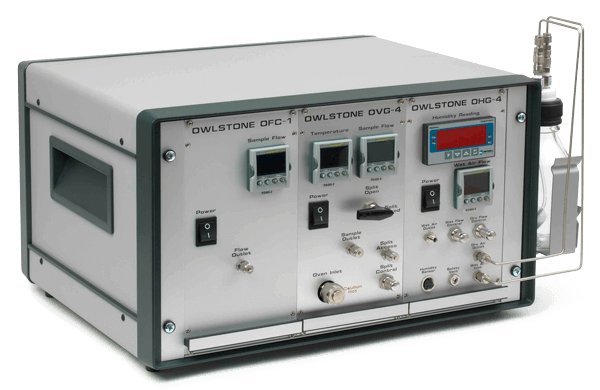
The Vertical Owlstone Vapor Generator (V-OVG) is designed to be compatible with both permeation tubes and diffusion tubes.
CATEGORY
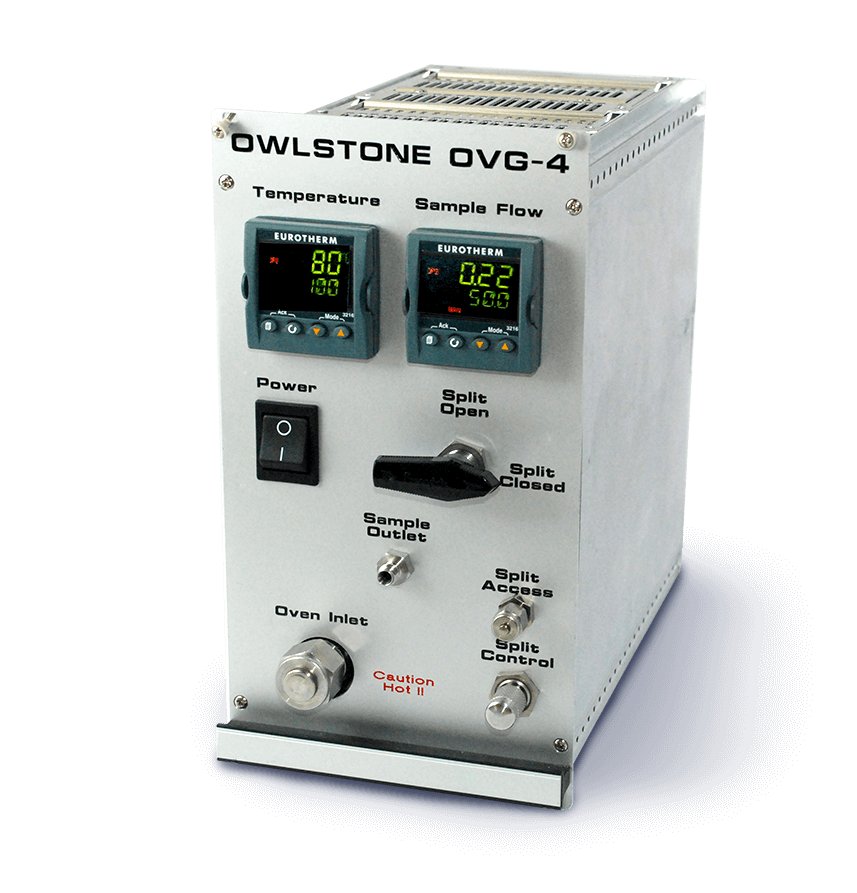
The Owlstone V-OVG is a system for generating precise, repeatable trace concentrations of gases. By using permeation and diffusion tube technology, a range of concentrations from low parts per billion to high parts per million levels can be achieved. The large permeation oven allows the use of up to 6 permeation tubes to create multiple-component mixtures, or a diffusion tube to generate high ppm concentrations.
CATEGORY
