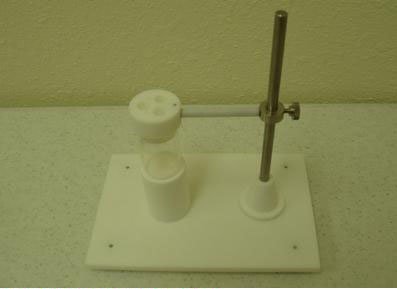
The quartz crystal microbalance (QCM) is a variant of acoustic wave microsensors that are capable of ultrasensitive mass measurements. Under favorable conditions, a typical QCM can measure a mass change of 0.1-1 ng/cm 2. QCM oscillates in a mechanically resonant shear mode under the influence of a high frequency AC electric field which is applied across the thickness of the crystal. Figure 1b below shows an edge view of a QCM crystal undergoing oscillatory shear distortion. The central portions of the top and bottom of the crystal are coated with a typically disk-shaped thin metal film (e.g., gold). The mass sensitivity of the QCM originates from the dependence of the oscillation frequency on the total mass of the metal-coated crystal, including any adlayers of deposited materials, as given by the Sauerbrey equation: ∆f = -2f 02 ∆m / [A sqrt( μρ )] where f 0 is the resonant frequency of the fundamental mode of the crystal, A is the area of the gold disk coated onto the crystal, ρ is the density of the crystal (= 2.684 g/cm 3), and μ is the shear modulus of quartz (= 2.947 x 10 11 g/cm.s2). For example, using our crystal, which has a 7.995-MHz fundamental frequency, a net change of 1 Hz corresponds to 1.34 ng of mass adsorbed or desorbed onto the crystal surface of an area of 0.196 cm 2.QCM in conjunction with electrochemistry (EQCM) has been widely employed for the determination of metals deposited onto the crystal, studies of ion-transport processes in polymer films, biosensor development, and investigations of the kinetics of adsorption/desorption of adsorbate molecules. In EQCM experiments, measurements of various electrochemical parameters, such as potential, current, and charge at the working electrode, are conducted simultaneously with the acquisition of the corresponding frequency and resistance changes, using the experimental setup shown in Figure 1a. For any model in the 400C series, application of a specific potential waveform (e.g., triangular potential waveform for cyclic voltammetric experiments), current measurement, and frequency counting are carried out with a potentiostat/frequency counter, which is in turn controlled by a computer. The 400C series contains a quartz crystal oscillator, a frequency counter, a fast digital function generator, high-resolution and high-speed data acquisition circuitry, a potentiostat, and a galvanostat (Model 440C only). The QCM is integrated with potentiostat and galvanostat, to facilitate simple and convenient EQCM studies. Instead of measuring the frequency directly, the 400C series uses a time-resolved mode as follows. The observed frequency of the QCM is subtracted from a standard reference frequency, and the resulting difference is measured by a reciprocal technique, greatly reducing the required sampling time and yielding much better time resolution for the QCM signal. With direct counting, a QCM resolution of 1 Hz requires 1 second of sampling time, 0.1 Hz resolution requires 10 seconds, etc. In contrast, our time-resolved mode allows the QCM signal to be measured in milliseconds with much better resolution. The potential control range of the instrument is ±10 V and the current range is ±250 mA. In addition to QCM and EQCM measurements, the instrument is capable of a wide range of techniques, and is suitable for general-purpose electrochemical applications. The instrument is very sensitive and very fast, capable of measuring current down to the picoampere level. The scan rate in cyclic voltammetry can be up to 500 V/s with a 0.1 mV potential increment or 5000 V/s with a 1 mV potential increment. The model 400C series is the upgrade to the model 400/400A/400B series. The new design provides more stable and accurate potential control (1 mV, 0.02%), and it also allows the resistance change and frequency change to be measured simultaneously. The 400C series uses a USB port for data communication with the PC. 16-bit highly stable bias circuitry is added for current or potential bias. This allows wider dynamic range in AC measurements. It can also be used to re-zero the DC current output. The EQCM cell consists of three round Teflon pieces (Figure 1a). The total height is 37 mm with a diameter of 35 mm. The top piece is the cell top, which holds the reference and counter electrodes. There are also two 2 mm holes for manual purging. The center piece is the solution cell, and the bottom piece is for mounting purposes. Four screws are used to tighten an O-ring seal between the bottom and center pieces, with the quartz crystal sandwiched between them. The diameter of the quartz crystal is 13.7 mm. The gold electrode diameter is 5.1 mm. Specifications Potentiostat Galvanostat (Model 440C) 2, 3, or 4-electrode configuration Potential range: -10 to 10V Applied potential accuracy: ±1 mV, ±0.02% of scale Potentiostat rise time: < 2 μsCompliance voltage: ±12 V Maximum current: ±250 mA continuous, ±350 mA peak Reference electrode input impedance: 1 ×10 12 ohm Sensitivity scale: 1 ×10 -12 - 0.1 A/V in 12 ranges Input bias current: < 50 pA Current resolution: 0.0015% of current range, minimum 0.3 fA Minimum potential increment in CV: 100 μVFast waveform update: 5 MHz @ 16-bit Data acquisition: 16 bit @ 1 MHz External signal recording channel QCM Frequency resolution: < 0.1 Hz QCM maximum sampling rate: 1 kHz Automatic and manual iR compensation CV and LSV scan rate: 0.000001 to 5000 V/s Potential increment during scan: 0.1 mV @ 500 V/s CA and CC pulse width: 0.0001 to 1000 sec CA and CC minimum sample interval: 1 μsCA and CC Steps: 320 DPV and NPV pulse width: 0.001 to 10 sec SWV frequency: 1 to 100 kHz i-t sample interval: minimum 1 μsACV frequency: 0.1 to 10 kHz SHACV frequency: 0.1 to 5 kHz Low-pass signal filters, automatic and manual setting Potential and current analog output RDE rotation control output: 0 - 10 V (430C and up) CV simulation and fitting program Cell control: purge, stir, knock Data length: 128K – 16384K selectable Dimension: 14.25”(W) × 9.25”(D) × 4.75”(H) Oscillator Box (external): 4.75"(L) × 2.6" (W) × 1.55" (H) Weight: 12 Lb. Differences of 400C Series Models Functions 400C 410C 420C 430C 440C Cyclic Voltammetry (CV) Linear Sweep Voltammetry (LSV) & Staircase Voltammetry (SCV) #,& Tafel Plot (TAFEL) Chronoamperometry (CA) Chronocoulometry (CC) Differential Pulse Voltammetry (DPV) #,& Normal Pulse Voltammetry (NPV) #,& Differential Normal Pulse Voltammetry (DNPV) #,& Square Wave Voltammetry (SWV) & AC Voltammetry (ACV) #,&,$ 2nd Harmonic AC Voltammetry (SHACV) #,&,$ Amperometric I-t Curve (I-t) Differential Pulse Amperometry (DPA) Double Differential Pulse Amperometry (DDPA) Triple Pulse Amperometry (TPA) Bulk Electrolysis with Coulometry (BE) Hydrodynamic Modulation Voltammetry (HMV) Sweep-Step Functions (SSF) Multi-Potential Steps (STEP) Chronopotentiometry (CP) Chronopotentiometry with Current Ramp (CPCR) Potentiometric Stripping Analysis (PSA) Open Circuit Potential - Time (OCPT) Quartz Crystal Microbalance (QCM) Galvanostat RDE control (0-10V output) Full version of CV simulator Limited version of CV simulator iR Compensation #: Corresponding polarographic mode can be performed. &: Corresponding stripping mode can be performed. $: Phase selective data are available.
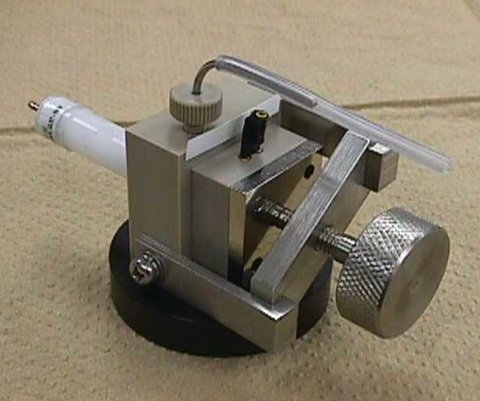
Non-Aqueous Ag/Ag+ Reference Electrode w/ porous Teflon Tip. For the CHI112, Ag+ solution (typically 10 mM) should be prepared with the supporting electrolyte and AgNO3 (not included). This solution is then filled into the reference electrode compartment using a syringe (not included). The instructions will come with the components.
CATEGORY
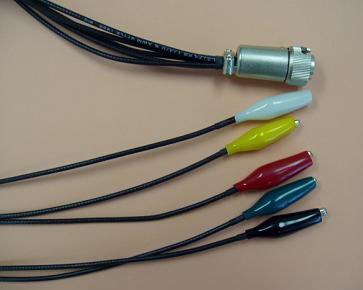
Electrode leads for model number xxx (where xxx = 600, 710B, etc.)
CATEGORY
Electrode Polishing Kit. The CHI120 electrode polishing kit contains 1 bottle of 1.0 micron Alpha alumina powder, 1 bottle of 0.3 micron Alpha alumina powder, 3 bottles of 0.05 micron Gamma alumina powder, 2 glass plates for polishing pads, 5 pieces of 73 mm diameter 1200 grit Carbimet disks (grey in color), 5 pieces of 73 mm diameter Mastertex polishing pads (white in color), and 10 pieces of 73 mm diameter Microcloth polishing pads (brown in color).
CATEGORY