Measure up to 100 times higher sample concentration with the NANOPHOX CS than with previous technologies The application of the cross-correlation technique allows the calculation of the particle size distribution without the influence of multiple scattering. Comparability between conventional PCS and PCCS can be established by measuring a concentration series with monomodal suspensions of 100 nm polystyrene standards. Five latex samples represent a spectrum ranging from the undiluted suspension with 1 % solids per volume to a dilution level of 1:10,000. For measurements in PCCS mode, the measured hydrodynamic diameter varies between 97 nm and 106 nm and is thus within specifications - regardless of dilution. The PCS results, on the other hand, deviate from the specifications for concentrated samples above a dilution of 1:1,000. The determination of reliable particle sizes with PCS starts at 5,000-fold dilution. PCCS achieves correct results already in the concentrated latex sample. With the PsB PCCS, the NANOPHOX CS revolutionises dynamic light scattering and takes the advantages of PCCS to the next level. With sample concentrations up to a hundred times higher and measurements up to ten times faster, reliably repeatable measurement results are achieved with accuracy at a maximum. - Concentration-independent characterisation of particle size and particle size distribution - For nanoparticles in turbid suspensions and emulsions - For analyses in research, development or quality laboratories - Robust method for measuring ranges from 0.5 nm to 10,000 nm - High signal quality due to 3D correlation with polarisation-separated Backscattering [patent pending] - Simple sample preparation without dilution series | Elimination of sample preparation errors and sample contamination - Measurability check of the sample before starting the measurement - Short measuring times of < 1 - 3 min. typical - Enables investigations of special effects such as particle-particle interactions and viscosity changes of highly concentrated samples - High sensitivity for size changes and measurement of bimodal distributions - Contactless measuring method for in-situ observations of stability or size changes, e.g., growth or crystallisation processes - Direct measurement method of the stability, agglomeration and sedimentation of slightly charged (electrostatically stabilised) to non-charged (sterically stabilised) particles of turbid samples With measurement times from less than one minute, users can quickly achieve reliable measurement results with the NANOPHOX CS. Time-consuming sample dilution series can be ruled out, as measurements can be carried out in even highly concentrated samples. Time and sample preparation errors are reduced and possible sample impurities are minimised, which can significantly influence the particle distribution in highly diluted samples. The automatic positioning of the cuvette and the precise adjustment of the laser intensity to optimise the measurement signal are particularly user-friendly. This supports fast and easy measurement. NANOPHOX CS can be operated with disposable cuvettes made of acrylic glass. For special liquids or applications, glass cuvettes or solvent-resistant cuvettes (up to 4 ml) are available. For small sample volumes, a micro cuvette is used, which makes the analysis of 50 µl to 2.7 ml sample material possible. NANOPHOX CS covers the vast particle size range of 0.5 nm to 10,000 nm. The size analysis is independent of concentration and masters high concentrations up to approximately 40 % by volume. With a precisely controlled temperature range from 0°C to 90°C the behaviour of nano dispersions can be observed or influenced, respectively. NANOPHOX CS proves its specific performance for stability analysis of steric or electrostatic stabilising in high-concentrated nano dispersions. No matter if the particles have been stabilised with electric charges, polymers or surfactants, NANOPHOX CS reliably provides information on aggregation or agglomeration behaviour. Thus, new opportunities for characterization in previously uncharted fields, such as particle-particle interactions and changes in dynamic viscosity, are easily accessible. Typical applications are polymer suspensions and emulsions in the chemical sector, pharmaceutical emulsions such as ophthalmic emulsions (eye drops), propofol, infusion emulsions or liposomes. In medicine and biochemistry, nanoparticles can serve as active ingredient carriers or be equipped as active ingredient carriers for specific functions. In the field of oxides (ZnO, AI 2 O 3, TiO 2, SiO 2) and metal colloids (gold, silver, palladium), but also paints, varnishes and inks, as well as general research into nanomaterials, the NANOPHOX CS is suitable.
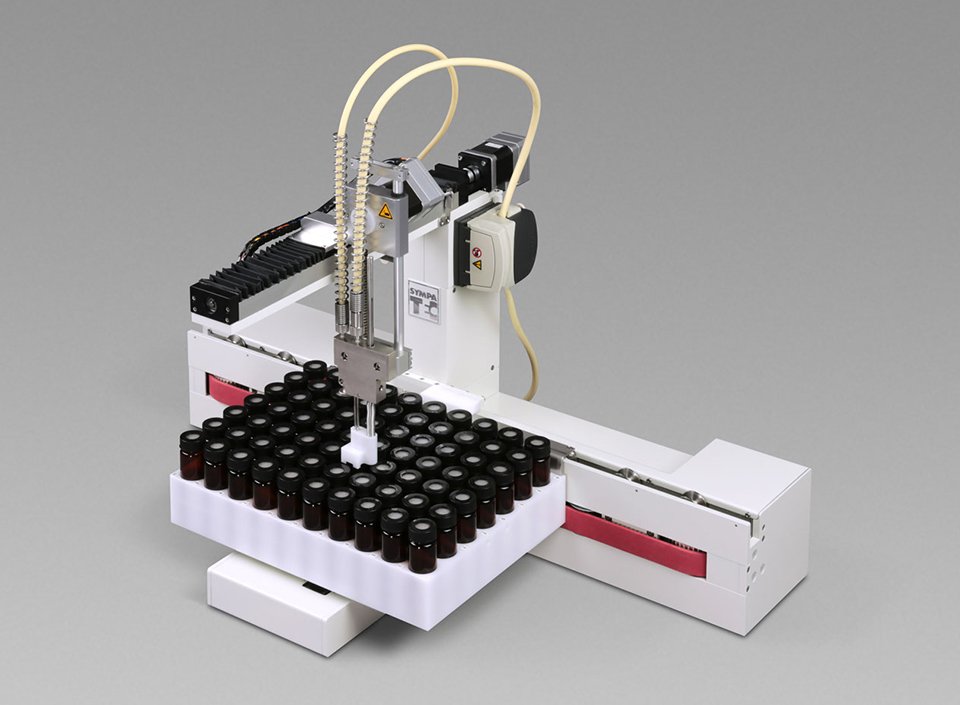
For a high throughput of dry or wet samples, MULTISAMPLER offers a fully-automate
CATEGORY
Suction … our industrial extraction system! The dispersion and measurement of soli
CATEGORY