By CEA Tech
Contactless high-speed data transmission CEA Tech developed a low-power chip that can transmit gigabits of data at very high speeds (1 Gbit/s currently) between two devices located near each other. The chip, which measures just a few square millimeters, was built by some of the world’s top wireless communications and antenna specialists. The circuits operate at high frequency (60 GHz), enabling very high transmission speeds. The tiny 600-micrometer antennas provide contactless transmission and directivity. Today, the transmission speeds G-Link is capable of delivering are opening the door to further exploration of industrial applications for which connectivity is a must in situations where space for wiring and connectors is at a premium.
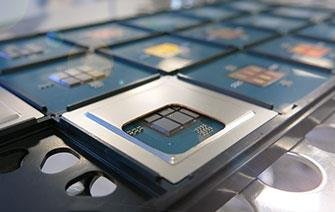
The institute's work also encompasses CAD tool development for integrated-component design, as well as emulators and characterization and testing equipment.
CATEGORY
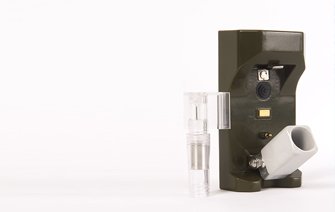
Coriolis Nano, commercialized by Bertin Technologies, was developed by Leti, a CEA Tech institute. The device, which can detect airborne viruses, could help prevent the spread of Covid-19. When it comes to detecting the presence of viruses in the air, Bertin Technologies' Coriolis Nano is a particularly effective weapon. The device was initially developed to head off bacteriological threats like anthrax attacks. The current pandemic has given it a new mission: detecting coronavirus particles in the air. The compact and very quiet portable system, which collects airborne particles, bacteria, and viruses and measures individuals' risk of exposure, is based on a technology developed and patented by Leti in research conducted through a joint lab with Bertin Technologies. It is especially useful in hospitals and other medical settings. The collector is made up of a tube through which the air flows at a rate of 10 liters per minute, representative of the average person's breathing. The device has already proven effective on respiratory viruses and was tested on SARS-Cov-2. Once the air is inside the device, an electrostatic field instantly charges any particles present, orienting them toward one of two electrodes. Particles of all sizes (even less than 1 micron) can be captured. And, because there is no filter, the device's yields do not diminish over time and it is easier to recover the samples for more advanced lab tests.
CATEGORY
Low-power asynchronous 3D circuits The 3D NoC (Network on Chip) is a demonstrator system that gives showroom visitors a unique opportunity to see the advantages of 3D architectures from an integrated circuit designer’s perspective. The costs of advanced technologies are rising. 3D architectures, which are easier and more cost-effective to produce, give medium-sized companies and fabless manufacturers access to a much broader and more heterogeneous portfolio of integrated circuits. 3D circuits are built on a silicon interposer and broken down into chiplets specific to given functions such as processing and memory. This makes the circuits modular and easier to design. Chiplets with different functions are simply stacked to meet the needs of the target application (HPC, servers, etc.). Through silicon vias (TSVs), a technology CEA Tech’s silicon researchers master completely, link the chiplets and interposer. Whether they are planar or stacked, 3D circuits are one way for manufacturers to produce cheaper products with smaller chips that have smaller surface areas while delivering enhanced performance and lower energy consumption.
CATEGORY
High-luminance microdisplay The DiamonDisplay demonstrator system is made up of a GaN LED microdisplay and compact power electronics housed in a single unit. The microdisplay offers truly remarkable luminance of 10 million cd/m², a thousand times higher than today’s microdisplays which come in at 1,000 cd/m². Just one or several groups of 29 pixels is all that is required to display an image. The demonstrator is more than just a display, however. It is a miniature augmented reality system that lets the wearer see information superimposed on the actual environment. The tiny 3 mm x 2 mm display is not designed to be viewed directly; it requires an optical system to enlarge the image. And, because it is very energy efficient, it is suitable for applications like augmented reality glasses and heads-up displays for aviation and car windshields. It could also be used for very compact micro-video projectors. The research is ongoing; the next step will be to design a more complete display (500,000 pixels instead of 70,000).
CATEGORY
