By Nuvu Cameras
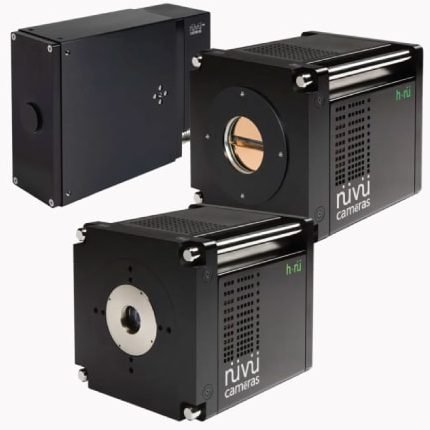
Nüvü Camēras uniquely offers 30 MHz pixel readout rates on all its models for unmatched imaging speeds and supports multi-output sensors, such as with the HNü 240, which enable faster frames rates even with larger sensors.

The CCCP controller line offers a flexible and customizable readout architecture for a variety of CCD & EMCCD sensors. Offered for both space-based and ground based use. The CCCP is the technology behind Nüvü Camēras’ high-performance sensitivity in low light imaging. Thanks to unmatched control over the charge transfer process, the CCCP generates significantly less CIC than any other CCD and EMCCD controller. - CCCP – controller Built for unmatched electron transfer - CCCPs – controller Built for unmatched electron transfer in space-based conditions
CATEGORY
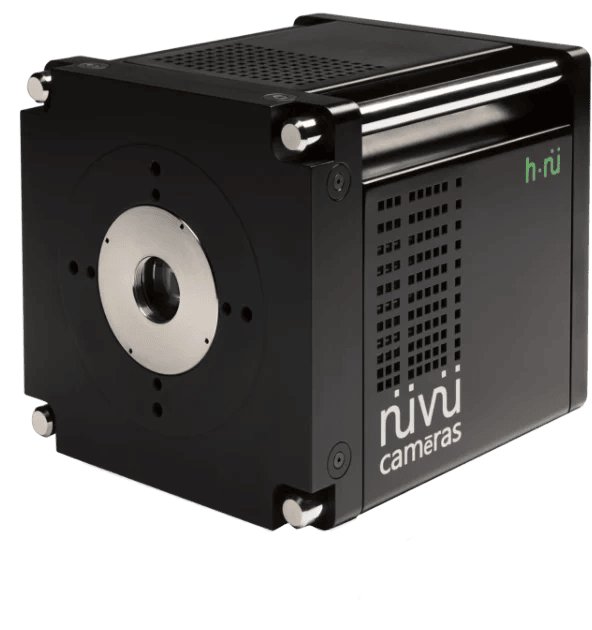
Built for high frame rates Achieve sub-millisecond exposures with continuous frame rates and single-photon sensitivity. Outstanding SNR performances Operation rate up to 1460 fps full frame < 0.004 ē/pixel/frame background noise EM gain up to 5000 Air-cooling down to -60°C The EMCCD camera optimized for speed Frame rates exceeding 1460 fps in full frame Made for high-speed applications such as Adaptive Optics (AO) and neural and cardiac imaging, the HNü 128 camera exceeds expectations, with unmatched sensitivity thanks to Nüvü’s patented electronics. With virtually no noise in each image, this EMCCD enables highly efficient low-flux imaging – allowing faster acquisitions while maintaining superior image quality. Highest quantum efficiency The HNü 128 integrates the high QE (up to 95%) typical to high-end EMCCD detectors. Coupled with Nüvü’s patented electronics for the lowest background noise and the highest EM gain, this HNü 128 camera is ideal for ultra-fast imaging in photon-counting conditions. The HNü 128 EMCCD camera is also available with UV-enhanced detectors or a UV Lumogen® coating for higher quantum efficiency in the UV spectral range. Different models for increased versatility Nüvü offers the HNü 128 in both Gamma and Omega variants to suit different requirements. With a 30 MHz readout speed, the Omega model reaches higher frame rates, while the Gamma model supports slower but more sensitive readout rates. With unmatched performances across the board, pick the best model for your project. Features for faster acquisition - Crop Mode - Fast Kinetics Mode - Time-Delay Integration (TDI) Mode - Multiple Region of Interest (mROI) & ROI Designed for easy integration The user-friendly HNü camera provides many advantages to efficiently bridge the gaps between purchase, setup and discoveries. The HNü camera is a compact and easy-to-use device with a Windows or Linux operating system. To allow quick and easy integration into any system, all standard HNü cameras come with a C-mount optical interface, imperial and metric mechanical holes on the faceplate, and standard holding posts on the sides of the camera. For fast and reliable image data transmission, the HNü camera communication interface are either Gigabit Ethernet or Camera Link. A built-in shutter enhances detector longevity, allows dark frame acquisitions, and is remotely controllable with our software tools for all application requirements. Options available Further customize the camera to your requirements for improved performances in your measurement contexts and increased versatility. A variety of options are available. Darker EMCCD — Less noise The darkest EMCCD cameras are manufactured by Nüvü Camēras. The secret? The CCD Controller for Counting Photons (CCCP), an innovative technology that virtually suppresses clock-induced charges (CIC), and a cooling Peltier unit integrated into an ingenious packaging. The thermoelectrically cooled HNü camera operates between -60 and -90°C with outstanding precision to optimize CIC and dark current to their ground level. The images below illustrate the accumulation of dark current when the shutter is closed. The darker the image, the less noise is present. No pixel leaking, superior image quality At high readout speeds, the electron transfer from one potential well to the next may be incomplete, leaving a few charges behind. Consequently, the leftover electrons artificially increase the brightness of certain pixels, thereby diminishing the overall image quality with the addition of arbitrary blurry spots. However, Nüvü Camēras’ CCCP preserves charge transfer efficiency (CTE), even at low operating temperature and increased EM gain, while decreasing CIC, yielding highly superior image quality. New standard for photon-counting imaging cameras As stated in its name, Nüvü Camēras’ proprietary CCD Controller for Counting Photons was purposely designed for photon-counting imaging. As such, no noise-filtering algorithms are used. The amount of noise generated is simply lower, eliminating the risk of removing genuine photoelectrons. Resorting to arbitrary clocks rather than regular square clocks to shift the electrons through the EMCCD, the CCCP clamps down the generation of clock-induced charges and significantly reduced the detector’s total background noise. Consequently, the EMCCD ability to discriminate single-photon events is considerably increased, and the camera can effectively operate in photon-counting mode as long as the background noise is low. In extreme cases where the expected intensity is about a single photon per pixel per second or even less, the photon counting (PC) mode is the ideal solution to obtain high-quality images. By eliminating the excess noise factor (ENF) and using a statistically significant threshold, pixels are individually analyzed to determine whether or not they truly detected a photon despite various noise sources.
CATEGORY
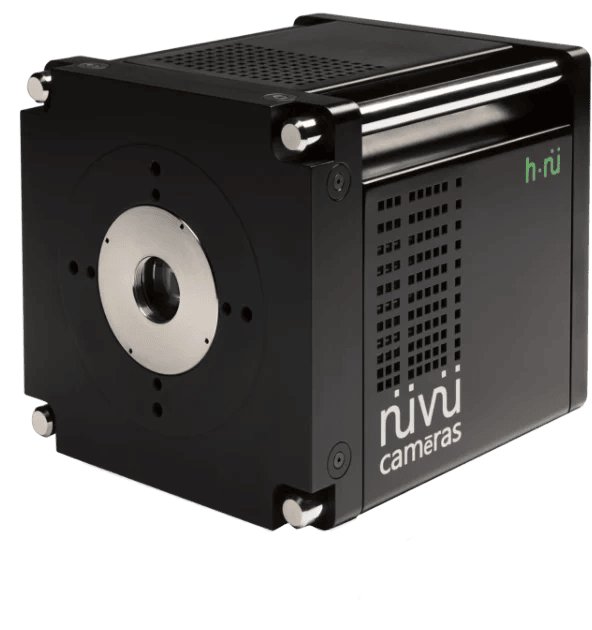
Built for maximum sensitivity The ultimate imaging sensitivity with the lowest noise on the EMCCD market, along with versatile options for all acquisition speeds. Outstanding SNR performaces - Operation rate up to 90 fps full frame - < 0.0009 ē/pixel/frame background noise - EM gain up to 5000 - Air-cooling down to -85°C The EMCCD camera optimized for performance With industry-leading low-light SNR Made for applications requiring the ultimate sensitivity in Space & Defense, Life Sciences, Physics, Industry and many other fields, the HNü 512 camera exceeds expectations, with unmatched sensitivity thanks to Nüvü’s patented electronics. With virtually no noise in each image, this EMCCD enables highly efficient low-flux imaging – allowing faster acquisitions while maintaining superior image quality. Typical spectral response as a function of wavelength, as specified by the EMCCD detector manufacturer Highest quantum efficiency The HNü 512 integrates the high QE (up to 95%) typical to high-end EMCCD detectors. Coupled with Nüvü’s patented electronics for the lowest background noise and the highest EM gain, this HNü 512 camera is ideal for applications requiring the utmost sensitivity in ultra-low light conditions. The HNü 512 EMCCD camera is also available with a Low fringing detector, UV Lumogen coating or a blue enhanced sensor for higher quantum efficiency in the blue and UV spectral region. HNü 512 benefits for photon counting imaging Photon counting performance comparison Thanks to Nüvü’s CCD Controller for Counting Photons, less clock-induced charges (CIC) are generated, the dominant source of noise in low light EMCCD imaging, providing up to 10x less noise than other cameras using the same detector whilst counting at least 15% more genuine photons. mROI on NüPixel Software Features for faster acquisition - Crop Mode - Fast Kinetics Mode - Time-Delay Integration (TDI) Mode - Multiple Region of Interest (mROI) & ROI Built for easy integration The user-friendly HNü camera provides many advantages to efficiently bridge the gaps between purchase, setup and discoveries. The HNü camera is a compact and easy-to-use device with a Windows or Linux operating system. To allow quick and easy integration into any system, all standard HNü cameras come with a C-mount optical interface, imperial and metric mechanical holes on the faceplate, and standard holding posts on the sides of the camera. For fast and reliable image data transmission, the HNü camera communication interface are either Gigabit Ethernet or Camera Link. A built-in shutter enhances detector longevity, allows dark frame acquisitions, and is remotely controllable with our software tools for all application requirements. Options available Further customize the camera to your requirements for improved performances in your measurement contexts and increased versatility. A variety of options available. Fully integrated services NüPixel software Darker EMCCD — Less noise The darkest EMCCD cameras are manufactured by Nüvü Camēras. The secret? The CCD Controller for Counting Photons (CCCP), an innovative technology that virtually suppresses clock-induced charges (CIC), and a cooling Peltier unit integrated into an ingenious packaging. The thermoelectrically cooled HNü camera operates between -60 and -90°C with outstanding precision to optimize CIC and dark current to their ground level. The images below illustrate the accumulation of dark current when the shutter is closed. The darker the image, the less noise is present. With Nüvü Camēras' EMCCD technology Other EMCCD technology Acquisition conditions: -85 °C cooling, 10MHz readout speed, EM gain of 5000 for Nüvü Camēras, and 1000 for other EMCCD manufacturers. No pixel leaking, superior image quality At high readout speeds, the electron transfer from one potential well to the next may be incomplete, leaving a few charges behind. Consequently, the leftover electrons artificially increase the brightness of certain pixels, thereby diminishing the overall image quality with the addition of arbitrary blurry spots. However, Nüvü Camēras’ CCCP preserves charge transfer efficiency (CTE), even at low operating temperature and increased EM gain, while decreasing CIC, yielding highly superior image quality. Nüvü Camēras EMCCD technology Other EMCCD technologies Acquisition conditions: -85 °C cooling, 10MHz readout speed, EM gain of 5000 for Nüvü Camēras, and 1000 for other EMCCDs. New standard for photon-counting imaging cameras As stated in its name, Nüvü Camēras’ proprietary CCD Controller for Counting Photons was purposely designed for photon-counting imaging. As such, no noise-filtering algorithms are used. The amount of noise generated is simply lower, eliminating the risk of removing genuine photoelectrons. Resorting to arbitrary clocks rather than regular square clocks to shift the electrons through the EMCCD, the CCCP clamps down the generation of clock-induced charges and significantly reduced the detector’s total background noise. Consequently, the EMCCD ability to discriminate single-photon events is considerably increased, and the camera can effectively operate in photon-counting mode as long as the background noise is low. In extreme cases where the expected intensity is about a single photon per pixel per second or even less, the photon counting (PC) mode is the ideal solution to obtain high-quality images. By eliminating the excess noise factor (ENF) and using a statistically significant threshold, pixels are individually analyzed to determine whether or not they truly detected a photon despite various noise sources. Displayed below are images of extremely dim light sources — low concentration bioluminescent samples — and illustrate the power of photon-counting imaging in such conditions. All figures are courtesy of the Université de Sherbrooke Hospital Centre. Single 30 seconds acquisition in conventional (CCD) mode. No details are visible where we should have seen several bioluminescent ATP samples. Applying electron multiplication to suppress the readout noise reveals the bioluminescent ATP samples in 5 seconds. As such, all six ATP concentrations are detectable with SNR values varying from 1.9 to 14.1 (or, equivalently, 2.8 dB to 11.5 dB). Photon counting mode with an EMCCD increases the contrast of all ATP samples by suppressing the excess noise factor (ENF), thus allowing considerable improvements in image quality. The SNR increases from 6.6 to 51.3 (equivalent to a range of 8.2 dB to 17.1 dB).
CATEGORY