By NAWAH
Vertically Aligned Carbon Nanotubes (VACNT), by contrast, grow as dense “forests” with their axes perpendicular to a substrate. They form a pure carbon thin film characterized by high porosity and high external surface area. This structure preserves the nanotubes properties, including electrical, thermal, and mechanical behavior. VACNT can be integrated exactly where they will have the maximal effect. They enable more controlled interfaces for applications such as electrodes, sensors, and thermal interfaces, or localized mechanical reinforcement at weak interfaces. VACNTs are also near-perfect scaffolds for other materials to be architectured at nanoscale. By coating individual nanotubes with nanoparticles or continuous, conformal layers, a wide range of new materials can be offered to next-generation electrodes and multi-material assemblies.
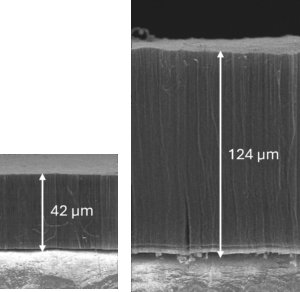
NAWAH’s Architectured Nanomaterials are manufactured from a unique base of Vertically Aligned Carbon Nanotubes (VACNT) This unique base is engineered at nanoscale to adjust the width, height and density of the microstructure. Additionally, specific patterning can be achieved to meet the design requirements, be it at nanoscale or macroscale. Thanks to VACNT unique properties, applications can be electrically or thermally functionalized for specific needs. The unique properties of our Architectured Nanomaterials open new horizons across industries to address critical material challenges and enable the development of next-generation products. NAWAH’s multi-walled vertically aligned carbon nanotubes are architectured during synthesis to meet specific structural requirements. (SEM Images) Our carbon nanotubes are perfectly vertically aligned (TEM Images) Our carbon nanotubes are multi-walled offering superior surface area. (SEM Images) Our manufacturing process enables patterned micro-structuration
CATEGORY
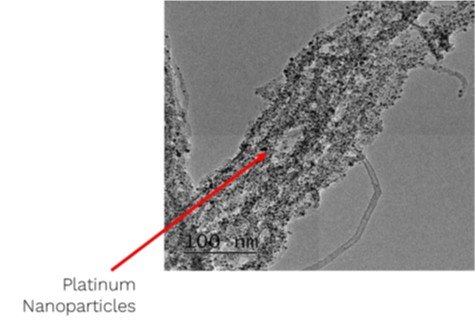
NAWAH’s unique architectured nanomaterials set a new standard for catalyst support, paving the way for highly efficient and durable next-generation fuel cells. Optimized scaffold Structures: Our advanced nanomaterials feature vertically aligned, pillar-like architectures—creating high-surface-area active layers that maximize catalyst accessibility and reaction efficiency. Exceptional Support for Platinum Catalysts: Vertically Aligned Carbon Nanotubes (VACNTs) from NAWAH have been scientifically demonstrated to serve as outstanding supports for platinum-based catalysts, significantly enhancing stability, and catalytic efficiency. Enhanced Durability & Longevity: The robust nano-architecture resists degradation, providing longer catalyst lifespans even under demanding conditions. Unlock the next generation of catalytic performance with NAWAH’s architectured nanomaterials—engineered for efficiency and longevity.
CATEGORY

NAWAH-Stitch film implements Vertically Aligned Carbon Nanotubes right where they are the most efficient to bring additional mechanical, thermal or electrical performances to composite pieces. By bridging the inter-ply region,carbon nanotubes prevent cracks from propagating, reducing the risk of delamination. Connecting plies together, they furthermore enhance electrical and thermal conductivities.
CATEGORY
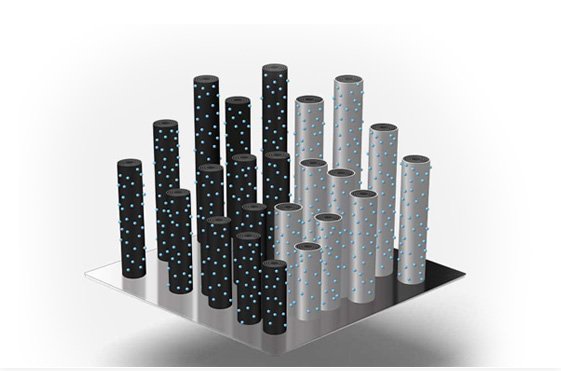
Developing Products for Next-Generation Catalysts Features enabling superior performance, increased lifetime and stability of catalytic systems For all catalytic applications (purely chemical and electrochemical): - Precision-engineered nanostructured scaffolds: Enable uniform dispersion and stable anchoring of catalyst nanoparticles (e.g., platinum). - High surface area: Maximizes the number of active sites, enhancing catalytic efficiency and durability. - Highly porous structure: - Facilitates efficient electron transport. - Allows reactants easy access to the catalyst. - Enables rapid diffusion of by-products away from the active area. Only for electro-catalytic / electrochemical applications: High electrical conductivity: Multi-walled carbon nanotube-based nanomaterials ensure efficient electrical contact with the catalyst. Additional Product Platforms are currently under development
CATEGORY
