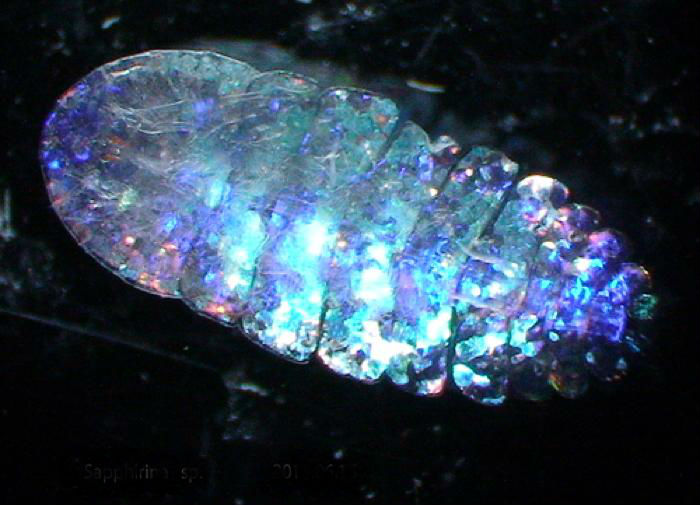
Crystal structures on the sea sapphire's back appear differently depending on the angle of reflection
Tiny ocean creatures known as sea sapphires perform a sort of magic trick as they swim: One second they appear in splendid iridescent shades of blue, purple or green, and the next they may turn invisible (at least the blue ones turn completely transparent). How do they get their bright colors and what enables them to “disappear?” New research at the Weizmann Institute has solved the mystery of these colorful, vanishing creatures, which are known scientifically as Sapphirinidae. The findings, which recently appeared in the Journal of the American Chemical Society, could inspire the development of new optical technologies.
Sapphirinidae belong to a subclass of crustaceans called copepods; and they live in fresh or salt water. These animals are barely visible to the human eye, ranging from around one to several millimeters in length. It is the male Sapphirinidae that display striking, iridescent colors, whereas the female is transparent. Scientists think that their unique magic trick could help Sapphirinidae escape predators when necessary, but still display their flashy colors when a female of the species – or possibly another male – is nearby.
The scientists, Profs. Lia Addadi and Steve Weiner, and Dvir Gur and Maria Pierantoni of the Weizmann Institute’s Structural Biology Department; Prof. Dan Oron and Ben Leshem of the Institute’s Physics of Complex Systems Department; and Dr. Viviana Farstey of the Interuniversity Institute for Marine Sciences, Eilat, Israel, investigated the makeup of a crystal layer on the backs of male Sapphirinidae of several species. They first measured the reflectance, which determines the color, and then, using a microscope technique called cryo-SEM, observed the organization of the crystals along with the cellular material holding them in place.
These colors are due to iridescence – the result of light reflecting off periodic (repeating) structures. These multilayer reflectors – a type of structure known to scientists as a photonic crystal – are composed of thin, transparent crystals of guanine. Guanine is more generally known as one of the nucleic acid bases found in DNA.
The research group found that the guanine plates in Sapphirinidae are stacked in incredibly precise periodic arrays. What gives each species its unique color? Their analysis revealed that the main factor determining whether an animal will be yellow, blue or purple is the spacing between plates, which is controlled by the thin layer of cellular material separating them.
The researchers also showed how this complex arrangement of plates enables some Sapphirinidae to disappear from sight: When certain species of male Sapphirinidae rotate their backs to the light at a 45-degree angle as they perform a spiral swimming maneuver, the wavelength of the reflected light is shifted out of the visible light range and into the invisible ultraviolet. In contrast, light hitting straight-on returns the beautiful blue color. In the ocean’s light, which comes from above, the tiny creature can control its visibility, from neon to none, just by adjusting its rudder.
The spacing between the plates acts as a sort of “tuning” for the wavelength of the light and thus the organism’s color: The closer the plates are to one another, the shorter the wavelength, that is, the bluer the light, reflected from them. This sophisticated strategy for manipulating light, say the scientists, could be used in the design of artificial photonic crystal structures – nanoscale structures that can manipulate the flow of photons. These could have many potential uses including adaptive or changeable reflective coatings, optical mirrors and optical displays.
Weizmann Institute of Science
#Chemistry #Nanooptics
